
 To enhance service speed and avoid tariff delays, we've opened a US warehouse. All US orders ship directly from our US facility.
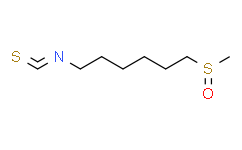




| Cas No.: | 4430-35-7 |
| Chemical Name: | 6-Methylsulfinylhexyl Isothiocyanate |
| Synonyms: | 6-Methylsulfinylhexyl Isothiocyanate;1-ISOTHIOCYANATO-6-(METHYLSULFINYL)-HEXANE;1-isothiocyanato-6-methylsulfinylhexane;6-Methylsulfinylhexy;(6-Isothiocyanato-hexyl)-methyl-sulfoxid;6-(methylsulfinyl)hexyl isothiocyanate;CHEMBL573428;CTK1D2491;Hexane, 1-isothiocyanato-6-(methylsulfinyl)-;Hesperin |
| SMILES: | O=S(CCCCCCN=C=S)C |
| Formula: | C8H15NOs2 |
| M.Wt: | 205.3408 |
| Purity: | >98% |
| Sotrage: | 2 years -20°C Powder, 2 weeks 4°C in DMSO, 6 months -80°C in DMSO |
| Description: | Hesperin is a bioactive ingredient present in Japanese horseradish (wasabi) and has been shown to be an Nrf2 activator. |
| In Vivo: | Hesperin (6-Methylsulfinylhexyl isothiocyanate, 6-MSITC) is an active compound in wasabi (Wasabia japonica Matsum.). Whether Hesperin induces cytotoxicity of HUVECs is determined. More than 1 μg/mL of Hesperin markedly induces cytotoxicity and morphological alterations. In subsequent experiments we used Hesperin is used at concentrations of 0-1 μg/mL, to study the anti-coagulant and anti-inflammatory properties of Hesperin in HUVECs[2]. |
| In Vitro: | Hesperin (6-Methylsulfinylhexyl isothiocyanate, 6-MSITC) is an active compound in wasabi (Wasabia japonica Matsum.). Whether Hesperin induces cytotoxicity of HUVECs is determined. More than 1 μg/mL of Hesperin markedly induces cytotoxicity and morphological alterations. In subsequent experiments we used Hesperin is used at concentrations of 0-1 μg/mL, to study the anti-coagulant and anti-inflammatory properties of Hesperin in HUVECs[2]. |
| Cell Assay: | Hesperin (6-Methylsulfinylhexyl isothiocyanate, 6-MSITC) is an active compound in wasabi (Wasabia japonica Matsum.). Whether Hesperin induces cytotoxicity of HUVECs is determined. More than 1 μg/mL of Hesperin markedly induces cytotoxicity and morphological alterations. In subsequent experiments we used Hesperin is used at concentrations of 0-1 μg/mL, to study the anti-coagulant and anti-inflammatory properties of Hesperin in HUVECs[2]. |
| Animal Administration: | Hesperin (6-Methylsulfinylhexyl isothiocyanate, 6-MSITC) is an active compound in wasabi (Wasabia japonica Matsum.). Whether Hesperin induces cytotoxicity of HUVECs is determined. More than 1 μg/mL of Hesperin markedly induces cytotoxicity and morphological alterations. In subsequent experiments we used Hesperin is used at concentrations of 0-1 μg/mL, to study the anti-coagulant and anti-inflammatory properties of Hesperin in HUVECs[2]. |
| References: | [1]. Tanaka Y, et al. 6-Methylsulfinylhexyl isothiocyanate prevents high-fat diet-induced fatty liver but fails to attenuate hepatic iron accumulation in mice. Clin Exp Pharmacol Physiol. 2016 Nov;43(11):1153-1156. [2]. Okamoto T, et al. 6-Methylsulfinylhexyl isothiocyanate modulates endothelial cell function and suppresses leukocyte adhesion. J Nat Med. 2014 Jan;68(1):144-53. |