 To enhance service speed and avoid tariff delays, we've opened a US warehouse. All US orders ship directly from our US facility.
| Cat. No. | Product Name | Field of Application | Chemical Structure |
|---|---|---|---|
| DC81559 | Sodium Channel-IN-8 |
Sodium Channel-IN-8 (Example 96) is a voltage-gated sodium channel (NaV1.7) inhibitor.Sodium Channel-IN-8 can be used for the research of pain.
More description
|

|
| DC81189 | Oberadilol |
Oberadilol (CID-3047798) is an ACE2 receptor binding agent. Oberadilol binds to the human ACE2 receptor and SARS-CoV proteins (Spike S glycoprotein, protease) with a Kd of 23.18 mM for the SARS-CoV-2 main protease.
More description
|
|
| DC81032 | Methoctramine |
Methoctramine is a potent and cardioselectivity antagonist of M2 muscarinic receptor. Methoctramine can inhibit Muscarine-induced bradycardia in vivo. Methoctramine can be used in the study of cardiovascular diseases.
More description
|
|
| DC81008 | Masoprocol tetrapivalate |
Masoprocol tetrapivalate (Nordihydroguaiaretic acid tetrapivalate) is a catecholic butane metabolite and also a tyrosine kinase activity inhibitor of IGF-1R and EGFR. Masoprocol tetrapivalate regulates tyrosine kinase signaling pathways associated with cell proliferation. Masoprocol tetrapivalate can be used in the research of proliferative diseases, including malignant, precancerous or benign cancers, and solid tumors.
More description
|
|
| DC80170 | AK177 |
AK177 is an allosteric activator of IRE1α ribonuclease, with values of 480 nM and 180 nM against non-phosphorylated and phosphorylated IRE1α, respectively.\n
More description
|
|
| DC79963 | 1,3-Linolenin-2-linolein |
1,3-Linolenin-2-linolein is an acylglycerol.
More description
|
|
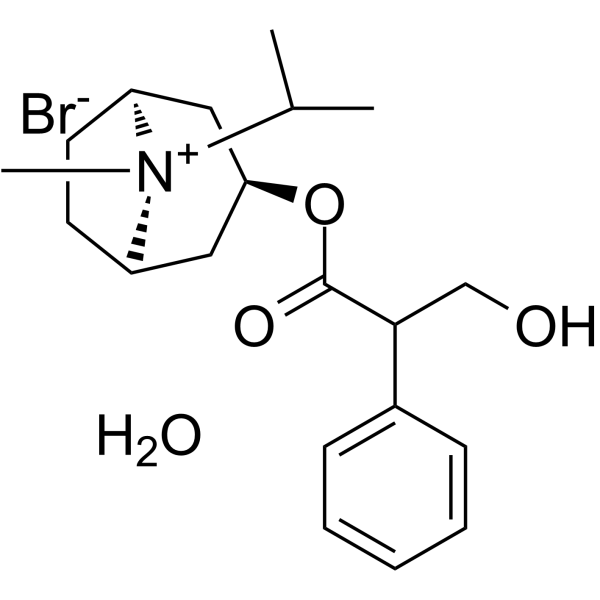
| DC44703 | Ipratropium bromide monohydrate Featured |
Ipratropium bromide (Atrovent, Sch 1000) monohydrate is an antagonist of muscarinic acetylcholine receptors (mAChR) with IC50 of 2.9 nM, 2.0 nM, and 1.7 nM for M1, M2, and M3 receptors, respectively.
More description
|
|
| DC79632 | A-72055 |
A-72055 is a partial agonist of muscarinic receptors. A-72055 has binding activity to both M1 and M2 receptors, with Ki values of 32 nM and 30 nM, respectively. A-72055 can enhance cognitive function and improve learning and memory deficits. A-72055 has better security. A-72055 can be used for research on neurological disorders such as cognitive impairment.
More description
|
|
| DC79581 | PSD-506 |
PSD-506 (RO 3202904) is a muscarinic M2/M3 antagonist. PSD-506 has the potential to be used in studies of bladder overactivity and urinary incontinence.
More description
|
|
| DC79345 | Lu AE51090 |
Lu AE51090 is selective muscarinic M1 receptor agonist with blood-brain barrier penetration. Lu AE51090 activates human M1 receptor with EC50 of 61 nM, while showing no significant agonism at M2-M5 receptors. Lu AE51090 exerts procognitive effects in mice. Lu AE51090 can be used for the study of Alzheimer’s disease (AD) and cognitive impairment associated with schizophrenia (CIAS).
More description
|
|
| DC79138 | RS-86 |
RS-86 is a potent, central acting, and selective muscarinic acetylcholine receptor agonist. RS-86 exhibits typical cholinergic excitatory effects, such as inducing smooth muscle contraction, ganglion depolarization, central hypothermia, etc. RS-86 can be used for research on Alzheimer's disease.
More description
|
|
| DC78746 | TD-6301 |
TD-6301 is a bladder-selective M2/4 muscarinic receptor antagonist. TD-6301 binds to and blocks M2/4 muscarinic receptors with high selectivity, especially human M2 receptors with strong affinity (Ki = 0.36 nM). TD-6301 inhibits volume-induced bladder contractions (ID50 = 0.075 mg/kg). TD-6301 can be used in the research of overactive bladder.
More description
|
|
| DC78489 | Anisodine |
Anisodine (Daturamine) is a neuroprotective compound that reduces exacerbated M1, M2, M4, and M5 receptor expression in brain tissues under hypoxia/reoxygenation conditions. Anisodine inhibits calcium ion influx and reactive oxygen species (ROS)levels. Anisodine leads to decreased aspartate levels during hypoxia.
More description
|
|
| DC78461 | L 689660 maleate |
L 689660 maleate, a cholinomimetic agent, is a selective M1 and M3 muscarinic receptors agonist. L 689660 maleate is a potent M1 muscarinic receptor full agonist in the rat superior cervical ganglion (pEC50 of 7.3). L 689660 maleate is a potent M3 receptors agonist in the guinea-pig ileum myenteric plexus-longitudinal muscle or in trachea (pEC50 of 7.5 and 7.7, respectively).
More description
|
|
| DC78391 | AD109 |
AD109 is a combination of the selective norepinephrine reuptake inhibitor atomoxetine and the antimuscarinic agent aroxybutynin. AD109 shows orally active significantly and reduce the apnea–hypopnea index.
More description
|
|
| DC78328 | VU6008055 |
VU6008055 is a potent, selective, cross the blood-brain barrier and orally actively M4 positive allosteric modulator with EC50 values of 73.4, 19.5 nM for hM4, rM4, respectively. VU6008055 shows antipsychotic-like activity.
More description
|
|
| DC78275 | VU6002703 |
VU6002703 (Compound 17) is a BBB-penetrable M4 mAChR positive allosteric modulator (PAM) with an EC50 of 0.6 μM for hM4. VU6002703 can be used for neuropsychiatric and rare genetic CNS disorders research.
More description
|
|
| DC76554 | VU0467319 |
VU0467319 (Compound VU319) is a highly selective and blood-brain-permeable, orally active M1 positive allosteric modulator (PAM) (EC50: 492 nM). VU0467319 is selective (EC50 > 30 μM) versus M2-5 for both human and rat. VU0467319 improves cognitive impairment in Alzheimer's disease (AD) through central M1 muscarinic receptors. VU0467319 does not induce cholinergic adverse reactions and has potential in AD research.
More description
|
|
| DC76553 | Solifenacin N-oxide |
Solifenacin N-oxide (Solifenacin N1-oxide) is an inactive metabolite of the muscarinic receptor antagonist Solifenacin.
More description
|
|
| DC76552 | SCH 211803 |
SCH 211803 is a selective antagonist of the M2 muscarinic receptor. SCH 211803 is promising for research of cardiovascular and nervous system diseases.
More description
|
|
| DC76551 | p-F-HHSiD hydrochloride |
p-F-HHSiD (p-Fluorohexahydrosiladifenidol) hydrochloride is a selective M3 mAChR antagonist. p-F-HHSiD hydrochloride blocks Acetylcholine-mediated vasodilatation in human umbilical vein endothelial cells (HUVECs).
More description
|
|
| DC76550 | Oxotremorine |
Oxotremorine is an agonist for mAChR, that activates M1 and M3 acetylcholine receptors. Oxotremorine exhibits nicotine-like effects in drug discrimination experiments in macaques.
More description
|
|
| DC76549 | LU-25-077 |
Lu 25-077 is a brain-penetrant and pharmacologically active N-demethyl metabolite of Lu 25-109, a DNA topoisomerase I (topoisomerase I) inhibitor.
More description
|
|
| DC76548 | KTX-005 |
KTX-005 is the agonist for mAChR that regulates the signaling pathway of the neurotransmitter acetylcholine, and can be used for research of schizophrenia.
More description
|
|
| DC76547 | Imidafenacin Metabolite M4 |
Imidafenacin Metabolite M4 is a metabolite of the muscarinic acetylcholine receptor antagonist Imidafenacin.
More description
|
|
| DC76546 | Desiodomethyl 4-DAMP |
Desiodomethyl 4-DAMP is a muscarinic receptor antagonist.
More description
|
|
| DC76545 | Caramiphen hydrochloride |
Caramiphen hydrochloride is a muscarinic antagonist. Caramiphen hydrochloride shows anticonvulsive properties. Caramiphen hydrochloride offers partial protection against Soman-induced seizures and neuropathology.
More description
|
|
| DC76544 | Betovumeline |
Betovumeline is the agonist for muscarinic receptor and can be used for researchs of neurological disorders.
More description
|
|
| DC76543 | AE9C90CB |
AE9C90CB, muscarinic receptor antagonist, has greater affinity for M3 muscarinic receptors with pKi of 9.90 and was 20-fold more selective for M3 than for M2 muscarinic receptors.
More description
|
|
| DC76542 | 5-Hydroxymethyl tolterodine formate |
5-Hydroxymethyl tolterodine (formate) (PNU-200577 (formic)) is an active metabolite of the muscarinic acetylcholine receptor antagonists Tolterodine and Fesoterodine. 5-Hydroxymethyl tolterodine (formate) is formed from tolterodine by the cytochrome P450 (CYP) isoform CYP2D6 and from fesoterodine by plasma esterases.
More description
|
|
