 To enhance service speed and avoid tariff delays, we've opened a US warehouse. All US orders ship directly from our US facility.
| Cat. No. | Product Name | Field of Application | Chemical Structure |
|---|---|---|---|
| DC81727 | VKT-17-P4-23 |
VKT-17-P4-23 is a blood-brain barrier-permeable DksA inhibitor. DksA is a highly conserved transcriptional regulator in Gram-negative bacteria, with a Kd of 124 μM. Through the DksA-regulated, SPI-2-dependent survival pathway, VKT-17-P4-23 exhibits antibacterial activity against both planktonic and intracellular pathogens such as Salmonella, and also effectively combats persistent bacteria that are difficult to eliminate. VKT-17-P4-23 can be used in studies of Salmonella infection.
More description
|

|
| DC81725 | VHR-IN-6 |
VHR-IN-6 is a selective vaccinia H1-related (VHR) phosphatase inhibitor with an IC50 of 74 nM. VHR-IN-6 shows very weaker inhibitory activity against MKP-1 (IC50 = 0.52 μM), CD45 (IC50 = 0.50 μM), Cdc25A (IC50 = 2.8 μM), PTP1B (IC50 = 0.42 μM), and HePTP (IC50 = 0.87 μM). VHR-IN-6 inhibits the proliferation of HeLa cells. VHR-IN-6 can be used for the research of cervical cancer.
More description
|
|
| DC81282 | PI3K/AKT/ERK/CREB activator 1 |
PI3K/AKT/ERK/CREB activator 1 is an orally active PI3K/AKT/ERK/CREB pathway activator. PI3K/AKT/ERK/CREB activator 1 maintains neuronal survival and function, promotes neuronal proliferation, restores the viability of damaged neurons, and facilitates synapse formation. PI3K/AKT/ERK/CREB activator 1 alleviates neuroinflammation by reducing the levels of pro-inflammatory cytokines, preserves synaptic ultrastructure and restores spatial memory in Alzheimer's disease models. PI3K/AKT/ERK/CREB activator 1 can be used in research related to Alzheimer's disease.
More description
|
|
| DC81112 | nAChR antagonist 3 |
nAChR antagonist 3 is a selective α7 nAChR antagonist with an IC50 of 0.86 μM. nAChR antagonist 3 exerts a protective effect against paraoxon-induced toxicity. nAChR antagonist 3 can be used for the research of organophosphate poisoning.
More description
|
|
| DC81000 | MAO-B-IN-49 |
MAO-B-IN-49 is a selective and reversible MAO-B inhibitor (IC50 of 1 nM for human MAO-B). MAO-B-IN-49 shows much higher selectivity for MAO-B than for MAO-A (IC50 = 633.9 μM). MAO-B-IN-49 can reduce ROS production induced by Lipopolysaccharides (LPS) in HT22 cells. MAO-B-IN-49 demonstrates substantial neuroprotective properties and significantly improves motor dysfunction in MPTP-induced mouse models of Parkinson’s disease (PD). MAO-B-IN-49 can be used for the study of PD.
More description
|
|
| DC80656 | FGFR-IN-26 |
FGFR-IN-26 is an orally active FGFR inhibitor. FGFR-IN-26 inhibits FGFR2 wild-type and clinically relevant resistance mutations. FGFR-IN-26 inhibits tumor growth in FGFR2-amplified xenograft mouse models. FGFR-IN-26 can be used for the research of cancer, suah as gastric carcinoma.
More description
|
|
| DC80239 | Antitumor agent-214 |
Antitumor agent-214 is a chalcone analogue with anti-tumor activity. Antitumor agent-214 induces cell cycle arrest and apoptosis in tumor cells, disrupts mitochondrial metabolism, and upregulates the expression of caspase 3, caspase 7 and caspase 9, downregulates PARP1. Antitumor agent-214 can be used for anti-tumor research related to colorectal cancer, breast cancer, lung cancer, and cervical cancer.
More description
|
|
| DC79805 | TRK-851 |
RK-851 is a highly selective and orally active δ-opioid receptor antagonist, with a negative logarithm of the antagonist concentration (pA2) of 8.84. TRK-851 exhibits the selectivity for the δ receptor of more than 100 times higher than that for the μ or κ receptors. TRK-851 exhibits a potent antitussive effect in a rat model of capsaicin-induced cough. TRK-851 can be used for research on antitussive effects.
More description
|
|
| DC79367 | CJ-15161 |
CJ-15161 is a κ-opioid receptor agonist. CJ-15161 can be used to study physiological functions such as pain relief and emotional regulation.
More description
|
|
| DC79060 | MP1202 |
MP1202 is a dual-functional agonist of MOR and KOR with EC50s of 0.32 and 0.13 μM for mMOR-1 and mKOR-1, respectively. MP1202 has functional selectivity with reduction of β-arrestin1/2 recruitment but significant activation of G-protein and Gα-subtype at hMOR and hKOR. MP1202 has potent antinociceptive effects without typical opioid side effects, but it shows conditioned place preference and aversion behaviors in subtype-selective opioid KO mice model, promising for analgesia research.
More description
|
|
| DC78876 | MDAN-21 |
MDAN-21 is a bivalent opioid ligand that contains both μ-opioid receptor agonists and δ-opioid receptor antagonists. MDAN-21 has a strong analgesic effect and does not produce tolerance in mouse studies. MDAN-21 can effectively inhibit the withdrawal of morphine dependent monkeys and alleviate abnormal pain in the study of rhesus monkeys. MDAN-21 can be used for the study of allodynia.
More description
|
|
| DC78640 | BRL-52656 |
BRL-52656 is a blood-brain barrier (BBB)-penetrable KOR receptor agonist that exhibits a biphasic effect. At low doses, BRL-52656 decreases blood pressure, whereas high doses have the opposite effect in spontaneously hypertensive rats. Additionally, BRL-52656 induces water diuresis by inhibiting the secretion of vasopressin (AVP).
More description
|
|
| DC78520 | BU08028 |
BU08028 is a dual-functional agonist that targets both the μ-opioid peptide receptor (MOP) and the neuropeptide FQ receptor (NOP). BU08028 activates the inhibitory G protein (Giα), thereby inhibiting the activity of adenylate cyclase (AC), resulting in a decrease in intracellular second messenger cyclic adenosine monophosphate (cAMP) levels, and suppressing the generation and transmission of pain signals. BU08028 can take effect within 30 minutes in mouse models of neuropathic pain and inflammatory pain, and its analgesic effect can last for up to 24 hours. BU08028 has excellent safety, no addiction, respiratory depression, or side effects. BU08028 can be used for pain research.
More description
|
|
| DC78465 | 1-Naphthyl U-47700 |
1-Naphthyl U-47700 is an α-isomer. 1-Naphthyl U-47700 is a racemic mixtures of the trans-isomers [R,R and S,S]. 1-Naphthyl U-47700 activates MOR in a concentration-dependent manner (EC50 > 23 μM).
More description
|
|
| DC78423 | SRI-22136 |
SRI-22136 is a Delta Opioid Receptor (DOR) antagonist that can cross blood-brain barrier with a IC50 of 0.42 nM. SRI-22136 does not have agonistic activity but antagonistic activity against DOR, MOR (IC50 = 370 nM), KOR (IC50 = 54 nM) and can avoid addiction/aversion effects. SRI-22136 can effectively inhibit the BACE1 activity induced by DADLE (a DOR agonist)) (IC50 = 120 nM). SRI-22136 prevents completely Alzheimer’s-like pathology in mouse model. SRI-22136 can used for the study of Alzheimer’s disease.
More description
|
|
| DC78390 | AZD-2327 |
AZD-2327 is a potent and selective δ-opioid receptor agonist. AZD-2327 binds to the human opioid receptor (Ki = 0.49 and 0.75 nM and EC50 = 24 and 9.2 nM at the C27 and F27 isoforms, respectively). AZD-2327 shows selectivity of >1000-fold over the human μ- and κ-opioid receptor subtypes as well as >130 other receptors and channels. AZD-2327 exhibits antidepressant and anxiolytic activities and can be used for the research of neurological disease.
More description
|
|
| DC78129 | Phenethyl 4-ANPP |
Phenethyl 4-ANPP is a MOR (μ-opioid receptor) agonist. Phenethyl 4-ANPP is an analytical reference standard that is structurally similar to known opioids.
More description
|
|
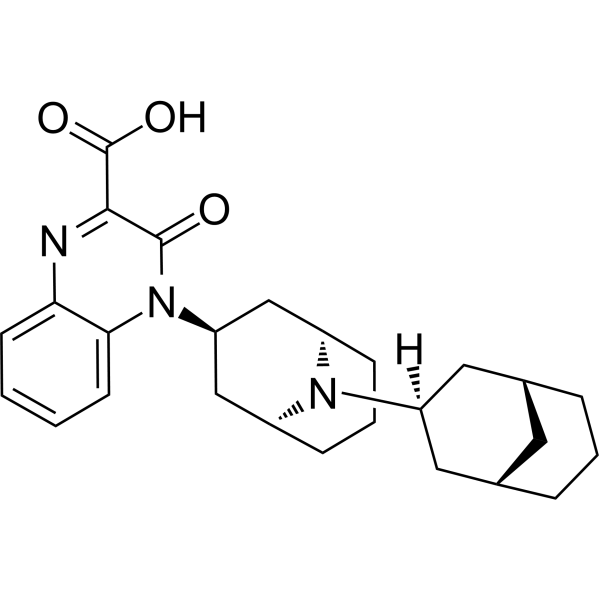
| DC47074 | Sunobinop Featured |
Sunobinop (S 117957) is a modulator of the opioid receptor-like orphan receptor (ORL1).
More description
|
|
| DC76632 | β-Funaltrexamine hydrochloride |
β-Funaltrexamine (β-FNA) hydrochloride is a selective μ opioid receptor antagonist. β-Funaltrexamine hydrochloride also inhibits cytokine-induced iNOS activation. β-Funaltrexamine hydrochloride inhibits neuroinflammation and ameliorated neuronal degeneration. β-Funaltrexamine hydrochloride has anti-inflammatory and neuroprotective effects and can be used for research of neurodegenerative diseases (eg: stroke)[1][2]
More description
|
|
| DC76631 | U-49900 |
U-49900 is a utopioid.
More description
|
|
| DC76630 | U-48520 |
U-48520 is an agonist for μ-opioid receptor with EC50 of 1561 nM.
More description
|
|
| DC76629 | Samidorphan isoquinoline dioxolane |
Samidorphan isoquinoline dioxolane (Compound 16) is a cyclazocine analogue with opioid receptor binding properties.
More description
|
|
| DC76628 | Salvinorin A propionate |
Salvinorin A (Divinorin A) propionate is a potent, unique and short-acting high efficacy kappa-opioid receptor (KOPr) agonist with Ki value of 4.3 nm. Salvinorin A propionate is a non-nitrogenous neoclerodane isolated from Salvia divinorum.
More description
|
|
| DC76627 | Salvinorin A carbamate |
Salvinorin A carbamate is an agonist for κ-opioid receptor with an EC50 of 6.2 nM and a Ki of 3.2 nM.
More description
|
|
| DC76626 | R-6890 |
R-6890 is an opiate compound with analgesic potencies.
More description
|
|
| DC76625 | Orphine |
Orphine is an opioid compound. Orphine can enhance the antinociceptive effects in mice that are mitigated by Naloxone and a linker
More description
|
|
| DC76624 | N-Phenethylnoroxymorphone |
N-Phenethylnoroxymorphone is an opioid compound. N-Phenethylnoroxymorphone enhances morphine-induced analgesia in rats. N-Phenethylnoroxymorphone can be used for research on neurological diseases.
More description
|
|
| DC76623 | Norcarfentanil hydrochloride |
Norcarfentanil hydrochloride is an opioid and is a metabolite of Carfentanil.
More description
|
|
| DC76622 | Nor-6α-Oxycodol |
Nor-6α-Oxycodol is structurally similar to known opioids and is a metabolite of Oxycodone.
More description
|
|
| DC76621 | Naltrindole 5′-isothiocyanate |
Naltrindole 5′-isothiocyanate (5'-NTII) is a non-selective delta opioid receptor antagonist that can antagonize the analgesic effects induced by DSLET without affecting the analgesic effects induced by DPDPE.
More description
|
|
