
 To enhance service speed and avoid tariff delays, we've opened a US warehouse. All US orders ship directly from our US facility.
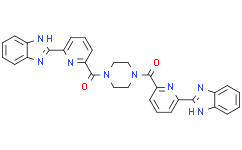




| Cas No.: | 1912399-75-7 |
| Chemical Name: | Methanone, 1,1'-(1,4-piperazinediyl)bis(1-(6-(1H-benzimidazol-2-yl)-2-pyridinyl)- |
| Synonyms: | BT-11;A4Y49H6YY8;BT11;GTPL10363;BCP32788;BT 11; BT11;Example 1 [US9556146B2];s6419;analogue 7 [PMID: 27933891];SB18706;J3.612.231E;Methanone, 1,1'-(1,4-piperazinediyl)bis(1-(6-(1H-benzimidazol-2-yl)-2-pyridinyl)-;Piperazine-1,4-diylbis((6-(1H-benzo[d]imidazol-2-yl)pyridin-2-yl)methanone);[4-[6-(1H-benzimidazol-2-yl)pyridine-2-carbonyl]piperazin-1-yl]-[6-(1H-benzimidazol-2-yl)pyridin-2-yl]methanone |
| SMILES: | O=C(C1=C([H])C([H])=C([H])C(C2=NC3=C([H])C([H])=C([H])C([H])=C3N2[H])=N1)N1C([H])([H])C([H])([H])N(C(C2=C([H])C([H])=C([H])C(C3=NC4=C([H])C([H])=C([H])C([H])=C4N3[H])=N2)=O)C([H])([H])C1([H])[H] |
| Formula: | C30N8O2H24 |
| M.Wt: | 528.564 |
| Purity: | >98% |
| Sotrage: | 2 years -20°C Powder, 2 weeks 4°C in DMSO, 6 months -80°C in DMSO |
| Description: | BT-11 is an orally available LANCL2 binding compound for treating inflammatory bowel disease. |
| In Vivo: | The oral treatment with BT-11 (8 mg/kg/d) in a mouse model of inflammatory bowel disease results in lowering the disease activity index, decreasing colonic inflammatory lesions by 4-fold, and suppressing inflammatory markers (e.g., TNF-α, and interferon-γ) in the gut. Furthermore, studies in LANCL2−/− mice demonstrates that loss of LANCL2 abrogates beneficial actions of BT-11, suggesting high selectivity for the target. Oral treatment with BT-11 (8 mg/kg/day) ameliorates colitis in mice. Initial safety assessment in rats indicates that oral treatment with BT-11 at high doses has an excellent safety profile up to 1000 mg/kg/day[1]. BT-11 is well tolerated in rats, and may hold promise as an orally active therapeutic for Crohn’s disease. One hour after oral administration of a single dose of 80 mg/kg, BT-11 has a maximal concentration of 21 ng/mL; the half-life is 3 hours[2]. |
| In Vitro: | LANCL2 engagement produces an increase of PKA, followed by an accumulation of cAMP in the cytoplasm. BT-11 treatment splenocytes shows a dose−response increase of cAMP production. BT-11 stimulates cAMP production by activating the LANCL2 pathway[1]. |
| Animal Administration: | Rats: Male Harlan Sprague Dawley rats are treated with a single oral dose of 500 mg/kg and 80 mg/kg/d for 14 days. Treated and control rats are observed for behavioral detriments, and blood and tissues are collected for clinical pathology and histopathological examination[2]. Mice: Wild type and LANCL2−/− male mice are treated with 8 mg/kg/d BT-11 over 8 weeks. Mice are sacrificed and spleens are collected for splenocytes isolation. Cell lysates are collected and cAMP intracellular concentration is measured[1]. |
| References: | [1]. Carbo A, et al. An N,N-Bis(benzimidazolylpicolinoyl)piperazine (BT-11): A Novel Lanthionine Synthetase C-Like 2-Based Therapeutic for Inflammatory Bowel Disease. J Med Chem. 2016 Nov 23;59(22):10113-10126. [2]. Bissel P, et al. Exploratory Studies With BT-11: A Proposed Orally Active Therapeutic for Crohn's Disease. Int J Toxicol. 2016 Sep;35(5):521-9. |