
 To enhance service speed and avoid tariff delays, we've opened a US warehouse. All US orders ship directly from our US facility.
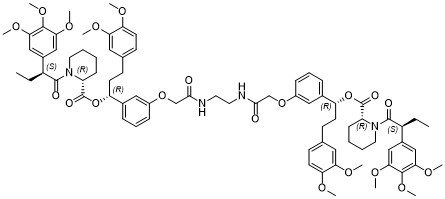




| Cas No.: | 195514-63-7 |
| Chemical Name: | AP1903 |
| Synonyms: | AP-1903;Rimiducid;AP1903;Rimiducid(AP1903);Bis[1-[2(S)-(3,4,5-Trimethoxypheny)butyryl]piperidine-2(S)-carboxylic acid] ester with 1,2-ethanediylbis[imino(2-oxo-2,1-etha;AP 1903;Bis[1-[2(S)-(3,4,5-Trimethoxypheny)butyryl]piperidine-2(S)-carboxylic acid] ester with 1,2-ethanediylbis[imino(2-oxo-2,1-ethanediyl)oxy-3,1-phenylene[(1R)-3-(3,4-dimethoxyphenyl)propylidene]] ester |
| SMILES: | O=C(NCCNC(COC1=CC([C@H](OC([C@H]2CCCCN2C([C@H](C3=CC(OC)=C(OC)C(OC)=C3)CC)=O)=O)CCC4=CC=C(OC)C(OC)=C4)=CC=C1)=O)COC5=CC([C@H](OC([C@H]6CCCCN6C([C@@H](CC)C7=CC(OC)=C(OC)C(OC)=C7)=O)=O)CCC8=CC=C(OC)C(OC)=C8)=CC=C5. |
| Formula: | C78H98N4O20 |
| M.Wt: | 1411.66556 |
| Purity: | >98% |
| Sotrage: | 2 years -20°C Powder, 2 weeks 4°C in DMSO, 6 months -80°C in DMSO |
| Description: | Rimiducid (AP1903) is a dimerizer agent that acts by cross-linking the FKBP domains, initiating Fas signaling and hence apoptosis. |
| Target: | EC50: 0.1 nM (FKBP, in HT1080 cells)[1] Fas receptor[1] |
| In Vivo: | Rimiducid (AP1903; i.v.,0.01, 0.1, 1, 10, and 100 mg/kg) elicits a dose-dependent decrease in serum hGH levels, with a half-maximal effective dose of 0.4±0.1 mg/kg[1]. |
| In Vitro: | The human fibrosarcoma line HT1080 is engineered to express stably a fusion protein comprising a myristoylation sequence, two copies of F36V-FKBP, and the human first apoptosis signal (Fas) intracellular domain. Rimiducid (AP1903) elicits potent and dose-dependent apoptotic death of these engineered cells in culture, with an EC50 of ≈0.1 nM[1]. Maximal killing occurred in the presence of 3 to 10 nM Rimiducid (AP1903), and the IC50 is approximately 0.2 nM. LV′VFas-transduced T lymphocytes expressing high levels of CD25 (top panel) are eliminated by with 66%±7.5% (n=10) efficiency. When cells are examined after CD25 expression returned to basal levels, 63%±4.7% (n=9) killing is observed after Rimiducid treatment[2]. |
| Cell Assay: | Cloned HT1080 cell lines (ATCC CCL-121) retrovirally transduced with Fas constructs are prepared. Cell viability after overnight incubation with Rimiducid (0.01 nM, 0.1 nM, 1 nM, 10 nM, 100 nM, 1000 nM) is measured by Alamar Blue assay[1]. For annexin V assays, sorted LV′VFas-transduced T cells (2×10⁶ cells/mL) are incubated with 10 nM Rimiducid. At the indicated time, an aliquot of 2×10⁵ cells is taken, stained with annexin V-fluorescein isothiocyanate, and analyzed by flow cytometry[2]. |
| Animal Administration: | Mice[1] Male nu/nu mice are used. For injection, HTFasGH-3 cells are harvested from tissue culture dishes in PBS/0.1% glucose/10 mM EDTA, washed, and resuspended in PBS/0.1% BSA/0.1% glucose at a concentration of 2×10⁷ cells/mL. Between 2 and 4×10⁶ cells are implanted into two i.m. sites. After 24 h, mice are administered i.v. Rimiducid at 2 mL/kg. After a further 24 h mice are killed and serum hGH concentrations are determined by ELISA. |
| References: | [1]. Clackson T, et al. Redesigning an FKBP-ligand interface to generate chemical dimerizers with novel specificity. Proc Natl Acad Sci U S A. 1998 Sep 1;95(18):10437-42. [2]. Thomis DC, et al. A Fas-based suicide switch in human T cells for the treatment of graft-versus-host disease. Blood. 2001 Mar 1;97(5):1249-57. [3]. Valamehr, Bahram, et al. GENOMIC ENGINEERING OF PLURIPOTENT CELLS. Patent. US20180155717A1. |