
 To enhance service speed and avoid tariff delays, we've opened a US warehouse. All US orders ship directly from our US facility.
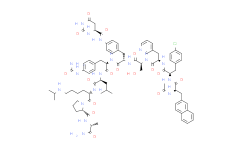




| Cas No.: | 214766-78-6 |
| Chemical Name: | Degarelix acetate |
| Synonyms: | Degarelix acetate;N-Acetyl-3-(2-naphthyl)-D-alanyl-4-chloro-D-phenylalanyl-3-(3-pyridyl)-D-alanyl-L-seryl-4-[2,6-dioxohexahydropyrimidin-4(S)-ylcarboxamido]-L-phenylalanyl-4-ureido-D-phenylalanyl-L-leucyl-N6-isopropyl-L-lysyl-L-prolyl-D-alaninamide acetate;Degarelix;Ac-D-2Nal-D-4Cpa-D-3Pal-Ser-4Aph(L-hydroorotyl)-D-4Aph(carbamoyl)-Leu-ILys-Pro-D-Ala-NH2;acetyl-3-(naphthalen-2-yl)-D-alanyl-4-chloro-D-phenylalanyl-3-(pyridin-3-yl)-D-alanyl-Ser-4-((((4S)-2,6-dioxohexahydropyrimidin-4-yl)carbonyl)amino)-L-phenylalanyl-4-(carbamoylamino)-D-phenylalanyl-Leu-N6-(1-methylethyl)-L-lysyl-Pro-D-Ala-NH2;SX0XJI3A11;UNII-SX0XJI3A11;地加瑞克 |
| SMILES: | CC(C)NCCCC[C@H](NC(=O)[C@H](CC(C)C)NC(=O)[C@@H](CC1=CC=C(NC(N)=O)C=C1)NC(=O)[C@H](CC2=CC=C(C=C2)NC(=O)[C@@H]3NC(=O)NC(=O)C3)NC(=O)[C@H](CO)NC(=O)[C@@H](CC4C=NC=CC=4)NC(=O)[C@@H](CC5=CC=C(Cl)C=C5)NC(=O)[C@H](NC(C)=O)CC6C=C7C(C=CC=C7)=CC=6)C(=O)N8[C@H](CCC8 |
| Formula: | C82H103ClN18O16.C2H4O2 |
| M.Wt: | 1692.33 |
| Sotrage: | 2 years -20°C Powder, 2 weeks 4°C in DMSO, 6 months -80°C in DMSO |
| Description: | Degarelix is a competitive and reversible gonadotropin-releasing hormone receptor (GnRHR) antagonist. |
| In Vivo: | At single subcutaneous injections of 0.3 to 10 μg/kg in rats, degarelix produces a dose-dependent suppression of the pituitary-gonadal axis as revealed by the decrease in plasma luteinizing hormone (LH) and testosterone levels. Duration of LH suppression increases with the dose: in the rat, significant suppression of LH lasted 1, 2, and 7 days after a single subcutaneous injection of degarelix at 12.5, 50, or 200 μg/kg, respectively[3]. Degarelix is stable when incubated in microsomes and cryopreserved hepatocytes from animal liver tissue. In rat and dog, most of the degarelix dose is eliminated within 48 h via urine and feces in equal amounts (40–50% in each matrix), whereas in monkey the major route of excretion is fecal (50%) and renal (22%)[4]. |
| In Vitro: | Degarelix acts directly on the pituitary receptors for luteinizing hormone-releasing hormone (LHRH), blocking the action of endogenous LHRH. The use of degarelix eliminates the initial undesirable surge in gonadotropin and testosterone levels, which is produced by agonists of LHRH[1]. Degarelix treatment reduces cell viability in all prostate cell lines (WPE1-NA22, WPMY-1, BPH-1 cells, VCaP cells), with the exception of the PC-3 cells. The GnRH antagonist degarelix exerts a direct effect on prostate cell growth through apoptosis[2]. |