
 To enhance service speed and avoid tariff delays, we've opened a US warehouse. All US orders ship directly from our US facility.
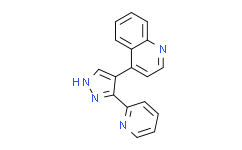




| Cas No.: | 396129-53-6 |
| Chemical Name: | 4-(3-Pyridin-2-YL-1H-pyrazol-4-YL)quinoline |
| Synonyms: | 4-(3-(Pyridin-2-yl)-1H-pyrazol-4-yl)quinoline;LY-364947;4-[3-(2-Pyridinyl)-1H-pyrazol-4-yl]-quinoline;[3-(Pyridin-2-yl)-4-(4-quinonyl)]-1H-pyrazole;LY364947;4-(3-Pyridin-2-yl-1H-pyrazol-4-yl)quinoline;LY364947 (LY-364947, HTS 466284);4-(5-pyridin-2-yl-1H-pyrazol-4-yl)quinoline;HTS466284;Transforming Growth Factor-β Type I Receptor Kinase Inhibitor;E 616451;TGF-beta RI Kinase Inhibitor;HTS 466284;TbetaR-I Inhibitor;LY 364947;4-[3-(pyridin-2-yl)-1H-pyrazol-4-yl]quinoline;4-[5-(pyridin-2-yl)-1H-pyrazol-4-yl]quinoline;Quinoline, 4-[3-(2-pyridinyl)-1H-pyrazol-4-yl]-;Transforming Growth Factor-beta Type I Receptor Kinase Inhibitor;4-[3-(2-Pyridinyl)-1H-pyrazol-4-yl]quinoline;4-(3-pyridin-2-yl)(1h)-pyra |
| SMILES: | N1([H])C(C2=C([H])C([H])=C([H])C([H])=N2)=C(C([H])=N1)C1=C([H])C([H])=NC2=C([H])C([H])=C([H])C([H])=C12 |
| Formula: | C17N4H12 |
| M.Wt: | 272.304 |
| Sotrage: | 2 years -20°C powder, 2 weeks 4°C in DMSO, 6 months -80°C in DMSO |
| Description: | LY-364947 is a potent ATP-competitive inhibitor of TGFβR-I with IC50 of 59 nM, and exhibits 7-fold selectivity over TGFβR-II. |
| In Vivo: | LY-364947 (1 mg/kg, i.p.) accelerates lymphangiogenesis, as evidence by significantly increasing the LYVE-1-positive areas in a mouse model of chronic peritonitis. LY-364947 (1 mg/kg, i.p.) significantly increases the LYVE-1-positive areas in tumor tissues in tumor xenograft models using BxPC3 pancreatic adenocarcinoma cells[2]. LY-364947 (25 mg/kg) increases p-Akt and decreases nuclear Foxo3a in leukaemia-initiating cells in CML-affected mice[3]. |
| In Vitro: | LY-364947 is an ATP competitive and tight-binding inhibitor, inhibiting phosphorylation of P-Smad3 by TGFβR-I Kinase with Ki of 28 nM. LY-364947 inhibits in vivo Smad2 phosphorylation within the NMuMg cells with IC50 of 135 nM. LY-364947 reverses TGF-β-mediated growth inhibition in NMuMg cells with IC50 of 0.218 μM. LY-364947 potentiates the xVent2-lux BMP4 response in NMuMg cells by 30% at concentrations as low as 0.25 μM. LY-364947 (2 μM) prevents TGF-β-induced epithelial−mesenchymal transition in NMuMg cells[1]. LY-364947 (3 μM) induces expression of Prox1 and LYVE-1 in almost all HDLECs after 24 hours[2]. LY-364947 promotes nuclear export of Foxo3a, with low Smad2/3 and high Akt phosphorylation levels in leukaemia-initiating cells. LY-364947 (< 20 μM) suppresses leukaemia-initiating cells colony-forming ability after co-culture with OP-9 stromal cells[3]. |