
 To enhance service speed and avoid tariff delays, we've opened a US warehouse. All US orders ship directly from our US facility.
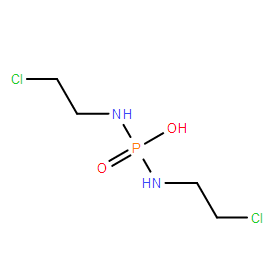




| Cas No.: | 31645-39-3 |
| Chemical Name: | N,N'-Bis(2-chloroethyl)phosphorodiamidic acid |
| SMILES: | C(CCl)NP(=O)(NCCCl)O |
| Formula: | C4H11Cl2N2O2P |
| M.Wt: | 221.02 |
| Purity: | >98% |
| Sotrage: | 2 years -20°C Powder, 2 weeks 4°C in DMSO, 6 months -80°C in DMSO |
| Description: | Palifosfamide is a novel DNA alkylator and the active metabolite of ifosfamide, with antitumor activity. |
| In Vivo: | Tumor growth inhibition is seen in both OS31 and OS33 xenografts and the RMS xenograft resulting in a significant difference in event-free survival between the control and the treated groups. Differential gene expression of ALDH3A1 but not ALDH1A1 is noted in the OS31 xenograft[1]. Stabilized palifosfamide administered to mice suppresses MX-1 tumor growth by greater than 80% with 17% complete antitumor responses. Oral bioavailability in rats is 48-73% of parenteral administration, and antitumor activity in mice is equivalent by both routes. Treatment with palifosfamide-tris combined with docetaxelor doxorubicin at optimal regimens results in complete tumor regression in 62-75% of mice[2]. |
| In Vitro: | Palifosfamide lysine (ZIO-201) is a stable form of palifosfamide. Palifosfamide lysine has broad activity in sarcoma lines in vitro. The IC50 ranges from 2.25 ro 6.75 μM for most cell lines except OS222 (IC50=31.5 μM)[1]. |
| Cell Assay: | Palifosfamide is dissolved in phosphate buffered saline (PBS). Cells are plated in 96-well microtiter plates with approximately 500 cells per well in 100 μL of media. After 24 h of incubation at 37°C, cells are treated with increasing concentrations of palifosfamide lysine in separate plates either as a single-day treatment or three consecutive days of treatment, with fresh drug being added each day. The plates are incubated for 72 h at 37°C with 5% CO2. After 72 h, 250 μg of MTT is added to each well and incubated at 37°C for 6 h. MTT is converted to formazine crystals by mitochondria of viable cells, which are then dissolved in 100 μL of dimethyl sulfoxide. Optical density is measured at 595 nm[2]. |
| Animal Administration: | Mice: CB17 female SCID mice are used in the study. Once the tumors reached 50–150 mm3, mice are randomized into control and treatment groups (5-8 mice/group) for each tumor line. Cyclophosphamide is administered at the dose of 150 mg/kg intraperitoneally once a week for 6 weeks. Palifosfamide lysine is administered intravenously at the maximum tolerated dose of 100 mg/kg for three consecutive days as a one-time treatment and serial tumor volumes are determined over the next 6 weeks. Mice are sacrificed at the end of the experiment[2]. |
| References: | [1]. Hingorani P, et al. Preclinical activity of palifosfamide lysine (ZIO-201) in pediatric sarcomas including oxazaphosphorine-resistant osteosarcoma. Cancer Chemother Pharmacol. 2009 Sep;64(4):733-40. [2]. Jones B, et al. Anticancer activity of stabilized palifosfamide in vivo: schedule effects, oral bioavailability, and enhanced activity with docetaxel and doxorubicin. Anticancer Drugs. 2012 Feb;23(2):173-84. |