
 To enhance service speed and avoid tariff delays, we've opened a US warehouse. All US orders ship directly from our US facility.
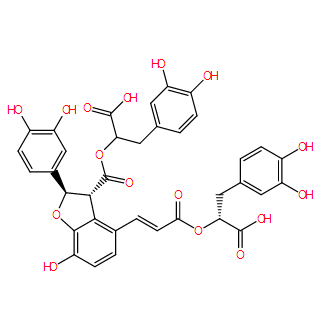




| Cas No.: | 121521-90-2 |
| SMILES: | C1=CC(=C(C=C1C[C@H](C(=O)O)OC(=O)/C=C\C2=C3[C@H]([C@@H](OC3=C(C=C2)O)C4=CC(=C(C=C4)O)O)C(=O)O[C@H](CC5=CC(=C(C=C5)O)O)C(=O)O)O)O |
| Formula: | C36H30O16 |
| M.Wt: | 718.63 |
| Purity: | >98% |
| Sotrage: | 2 years -20°C Powder, 2 weeks 4°C in DMSO, 6 months -80°C in DMSO |
| Description: | Salvianolic acid B is an active ingredient of Salvia miltiorrhiza, which has been widely applied in China for the management of various microcirculation-related disorders, such as cardiovascular disease, cerebrovascular disease, and diabetic vascular complication. |
| In Vivo: | Salvianolic acid B (SalB) (5 mg · kg-1 · h-1) significantly attenuates LPS-induced pulmonary microcirculatory disturbance, including the increase in leukocyte adhesion and albumin leakage. In addition, LPS increases pulmonary tissue wet-to-dry weight ratio and tumor necrosis factor [alpha] and interleukin 8 levels in plasma and bronchoalveolar lavage fluid enhances the expression of E-selectin, intercellular adhesion molecule 1, myeloperoxidase, MMP-2, and MMP-9, whereas it decreases the expression of AQP-1 and AQP-5 in pulmonary tissue, all of which are attenuated by SalB pretreatment[1]. SalB administration (10 mg/kg) significantly ameliorate the Aβ25-35 peptide-induced memory impairment in the passive avoidance task (P<0.05). SalB treatment also reduced the number of activated microglia and astrocytes that are observed during the inflammatory reaction after the administration of the Aβ25-35 peptide. Moreover, SalB markedly reduce inducible nitric oxide synthase and cyclooxygenase-2 expression levels and thiobarbituric acid reactive substances, which are increased by the administration of the Aβ25-35 peptide. Furthermore, SalB administration significantly rescue the Aβ25-35 peptide-induced decrease of choline acetyltransferase and brain-derived neurotrophic factor protein levels[2]. |
| In Vitro: | Salvianolic acid B (SA-B) 1 and 10 micromol/L decrease the cell active TGF-beta1 secretion by 63.3 % and 15.6 % of the control, down-regulat pro-collgen alpha1(I) mRNA expression to 77.0% and 51.8% respectively (P<0.05). SA-B 1 and 10 micromol/L also inhibit MAPK activity by 1 to 2 fold respectively [3]. |
| References: | [1]. Lee YW, et al.Neuroprotective effects of salvianolic acid B on an Aβ25-35 peptide-induced mouse model of Alzheimer's disease. Eur J Pharmacol. 2013 Mar 15;704(1-3):70-7. [2]. Liu P, et al. Effect of salvianolic acid B on collagen production and mitogen-activated protein kinase activity in rat hepatic stellate cells. Acta Pharmacol Sin. 2002 Aug;23(8):733-8. [3]. Lin, Fang, et al. Salvianolic acid B protects from pulmonary microcirculation disturbance induced by lipopolysaccharide in rat. Shock. 2013 Mar;39(3):317-25. |