
 To enhance service speed and avoid tariff delays, we've opened a US warehouse. All US orders ship directly from our US facility.
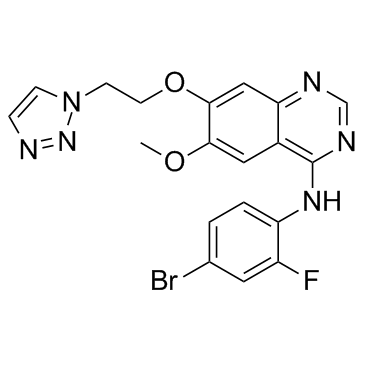




| Cas No.: | 413599-62-9 |
| Synonyms: | ZD-4190,ZD 4190,ZD4190 |
| SMILES: | COC1=CC2=C(NC3=CC=C(Br)C=C3F)N=CN=C2C=C1OCCN4N=NC=C4 |
| Formula: | C19H16BrFN6O2 |
| M.Wt: | 459.27 |
| Purity: | >98% |
| Sotrage: | 2 years -20°C Powder, 2 weeks 4°C in DMSO, 6 months -80°C in DMSO |
| Description: | ZD-4190 is a potent, orally available inhibitor of the vascular endothelial cell growth factor receptor 2 (VEGFR2) and of epidermal growth factor receptor (EGFR) signalling, used for the treatment of cancer. |
| Target: | EGFR VEGFR2 |
| In Vivo: | ZD4190 (100 mg/kg, p.o.) effectively delays MDA-MB-435 tumor growth in mice. In ZD4190-treated tumors, 18F-FPPRGD2 uptake has decreased significantly relative to baseline by 26.74±8.12% (p<0.05) on day 1 and by 41.19±6.63% (p<0.01) on day 3, then has returned to baseline on day 7. Tumor uptake of 18F-FLT has also decreased on both day 1 and day 3 after initiation of ZD4190 treatment. However, ZD4190 does not significantly change 18F-FDG uptake in tumors, compared with the control group[1]. ZD4190 (50 mg/kg, p.o.) prevents outgrowth of residual tumour in a muscle model of minimal residual carcinoma[2]. ZD4190 (12.5-100 mg/kg, p.o.) produces a dose-dependent reduction in K(trans) in PC-3 prostate tumors. At 100 mg/kg, ZD4190 reduces K(trans) in PC-3 tumors by 31% following 2 doses and by 53% following 8 doses[3]. |
| In Vitro: | ZD4190 exhibits cytotoxic activity against the tumor cells[2]. |
| Cell Assay: | The cytotoxicity of ZD4190 for PDVC57B cells is established when 104 cells are exposed to 1-10 μM ZD4190 for 96 h before MTS solution is added and the optical density measured at 490 nm. Cells are also grown to 40% confluence and treated with 1-100 μM ZD4190 for 7 days and the cytopathic effect examined by staining with crystal violet. |
| Animal Administration: | ZD4190 is suspended in a 1% (v/v) solution of polyoxyethylene sorbitan mono-oleate in deionized water and administered by oral gavage (0.1 mL/10 g body weight). In each experiment, mice are randomized to receive either vehicle or ZD4190, administered once daily using a 1 day (at 0 and 22 h) or 7 day (at 0, 24, 48, 72, 96, 120, 144, and 166 h) treatment regimen (i.e., daily administration of compound for 1 or 7 days with an additional dose given 2 h prior to the end of the treatment period) followed by DCEMRI under terminal anesthesia. |
| References: | [1]. Yang M, et al. PET imaging of early response to the tyrosine kinase inhibitor ZD4190. Eur J Nucl Med Mol Imaging. 2011 Jul;38(7):1237-47. doi: 10.1007/s00259-011-1742-z. Epub 2011 Mar 1. [2]. Gaballah K, et al. The antiangiogenic agent ZD4190 prevents tumour outgrowth in a model of minimal residual carcinoma in deep tissues. Br J Cancer. 2009 Aug 4;101(3):418-23. doi: 10.1038/sj.bjc.6605092. Epub 2009 Jul 21. [3]. Checkley D, et al. Dynamic contrast-enhanced MRI of vascular changes induced by the VEGF-signalling inhibitor ZD4190 in human tumour xenografts. Magn Reson Imaging. 2003 Jun;21(5):475-82. |