
 To enhance service speed and avoid tariff delays, we've opened a US warehouse. All US orders ship directly from our US facility.
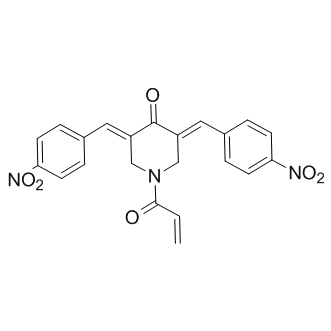




| Cas No.: | 1009817-63-3 |
| Chemical Name: | (3E,5E)-3,5-Bis[(4-nitrophenyl)methylene]-1-(1-oxo-2-propen-1-yl)-4-piperidinone |
| Synonyms: | NSC687852,NSC-687852,NSC 687852 |
| SMILES: | O=C1/C(CN(C(C=C)=O)C/C1=CC2=CC=C([N+]([O-])=O)C=C2)=C/C3=CC=C([N+]([O-])=O)C=C3 |
| Formula: | C22H17N3O6 |
| M.Wt: | 419.39 |
| Description: | b-AP15 is a specific inhibitor of the deubiquitinating enzymes UCHL5 and Usp14. |
| Target: | UCHL5/Usp14[1] |
| In Vivo: | b-AP15 (2.5 mg/kg) inhibits tumor growth in syngenic mice models with less frequent administration schedules. We administered b-AP15 to C57BL/6J mice with Lewis lung carcinomas (LLCs) using a 2-d-on, 2-d-off schedule and to BALB/c mice with orthotopic breast carcinoma (4T1) using a 1-d-on, 3-d-off schedule. b-AP15 significantly inhibited tumor growth in both models, with T/C=0.16 (P≤0.01) for the C57BL/6J mice and T/C=0.25 (P≤0.001) for the BALB/c mice. A reduction in the number of pulmonary metastases also is observed in the group of mice with 4T1 breast carcinomas treated with b-AP15[1]. |
| In Vitro: | Purified 19S proteasomes (5 nM) are treated with indicated concentrations of b-AP15 and DUB activity is determined by detectionof Ub-AMC cleavage. The IC50 value (2.1±0.411 μM) is determined from log concentration curves in Graph Pad Prism using non linear regression analysis. b-AP15 as a previously unidentified class of proteasome inhibitor that abrogates the deubiquitinating activity of the 19S regulatory particle. b-AP15 inhibited the activity of two 19S regulatory-particle-associated deubiquitinases, ubiquitin C-terminal hydrolase 5 (UCHL5) and ubiquitin-specific peptidase 14 (USP14), resulting in accumulation of polyubiquitin. b-AP15 induced tumor cell apoptosis that is insensitive to TP53 status and overexpression of the apoptosis inhibitor BCL2[1]. The ability of b-AP15 is determined to inhibit proteasome deubiquitinase activity using Ub-AMC as the substrate. An IC50 of 16.8±2.8 μM is observed[2]. b-AP15 is a specific USP14 and UCHL5 inhibitor, which blocks growth and induces apoptosis in MM cells[3]. |
| Kinase Assay: | For deubiquitinase inhibition assays, 19S regulatory particle (5 nM), 26S (5 nM) UCH-L1 (5 nM), UCH-L3 (0.3 nM), USP2CD (5 nM) USP7CD (5 nM) USP8CD (5 nM) or BAP1 (5 nM) is incubated with DMSO or b-AP15 and monitored the cleavage of ubiquitin-AMC (1,000 nM) using a Wallac VICTOR Multilabel counter or a Tecan Infinite M1000 equipped with 380 nm excitation and 460 nm emission filters[1]. |
| Cell Assay: | Cell viability is monitored by either the fluorometric microculture cytotoxicity assay or the MTT assay. For the MTT assay, cells are seeded into 96-well flat-bottomed plates overnight and exposed to drugs, using DMSO as the control. At the end of incubations, 10 µl of a stock solution of 5 mg/mL MTT is added into each well, and the plates are incubated 4 hours at 37°C. Formazan crystals are dissolved with 100 µL 10% SDS/10 mM HCl solution overnight at 37°C. Absorbance is measured using an enzyme-linked immunosorbent assay (ELISA) plate reader at 590 nm[2]. |
| Animal Administration: | Mice[1] For the squamous carcinoma model, 1×10⁶ FaDu cells are subcutaneously injected into the right rear flank of female SCID mice. Tumor growth is measured by the formula length×width2×0.44. When tumors have grown to a size of approximately 200 mm3 (defined as day 0), mice are randomized to receive either vehicle (n=10) or b-AP15 (n=15) at 5 mg per kg of body weight by daily subcutaneous injection. For the colon carcinoma model, we subcutaneously injected 2.5×10⁶ HCT-116 colon carcinoma cells overexpressing Bcl2 into the right flank of female nude mice. We treated mice with 5 mg of b-AP15 per kg of body weight by intraperitoneal injection. For the lung carcinoma model, we subcutaneously injected 2×10⁵ LLC cells into the right rear flank of female C57/B6 mice. When tumors had grown to a size of approximately 50 mm3 (defined as day 0), we randomized mice to receive either vehicle (n=4) or b-AP15 (n=4) at 5 mg per kg of body weight intraperitoneally, with a treatment cycle consisting of 2 d of treatment followed by 2 d of rest (2 d on, 2 d off) for 2 weeks. |
| References: | [1]. D'Arcy P, et al. Inhibition of proteasome deubiquitinating activity as a new cancer therapy. Nat Med. 2011 Nov 6;17(12):1636-40. [2]. Wang X, et al. The 19S Deubiquitinase Inhibitor b-AP15 is Enriched in Cells and Elicits Rapid Commitment to Cell Death. Mol Pharmacol. 2014 Jun;85(6):932-45. [3]. Tian Z, et al. A novel small molecule inhibitor of deubiquitylating enzyme USP14 and UCHL5 induces apoptosis in multiple myeloma and overcomes bortezomib resistance. Blood. 2014 Jan 30;123(5):706-16. |