
 To enhance service speed and avoid tariff delays, we've opened a US warehouse. All US orders ship directly from our US facility.
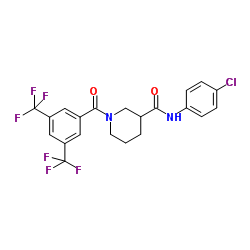




| Cas No.: | 1207113-88-9 |
| Chemical Name: | [3,5-Bis(trifluoromethyl)benzoyl]-N-(4-chlorophenyl)piperidine-3-carboxamide |
| Synonyms: | Ccg-100602;[3,5-bis(trifluoromethyl)benzoyl]-N-(4-chlorophenyl)piperidine-3-carboxamide |
| SMILES: | ClC1C=CC(=CC=1)N(C(C1C=C(C(F)(F)F)C=C(C(F)(F)F)C=1)=O)C(C1CNCCC1)=O |
| Formula: | C21H17ClF6N2O2 |
| M.Wt: | 478.81530547142 |
| Purity: | >98% |
| Sotrage: | 2 years -20°C Powder, 2 weeks 4°C in DMSO, 6 months -80°C in DMSO |
| Description: | CCG-100602 is a specific inhibitor of myocardin-related transcription factor A/serum response factor (MRTF-A/SRF) signaling. CCG-100602 specifically block MRTF-A nuclear localization and thus inhibit the fibrogenic transcription factor SRF. |
| In Vivo: | Treatment with CCG-100602 (7.5 mg/kg/day, continuously administered for 2 weeks by osmotic minipumps) abrogates the increase of aortic stiffness represented by reduced arterial compliance and strain, indicating a significant anti-stiffening effect resulting from the inhibition of SRF/myocardin[3]. Animal Model: Adult (4 month-old) male spontaneously hypertensive rats (SHR) and normotensive control Wistar-Kyoto (WKY) rats[3] Dosage: 7.5 mg/kg/day Administration: Continuously administered for 2 weeks by osmotic minipumps. Result: Abrogated the increase of aortic stiffness represented by reduced arterial compliance and strain. |
| In Vitro: | CCG-100602 (3-30 μM) decreases the number of adherent hASC cells[2]. CCG-100602 blocks the expression of MRTF-A/SRF-activated genes[2]. CCG-100602 (5-40 μM) diminishes the TGF-β1 (5 ng/mL)-induced increase in COL1A1, FN1, and ACTA2 transcription in a dose-dependent manner[1]. CCG-100602 (5-40 μM) reduces the TGF-β1-induced increase in MRTFA and SRF mRNA expression in the HIMFs in a dose-dependent manner [1]. CCG-100602 (5-40 μM) significantly reduces the protein expression levels of the ECM and α-SMA in TGF-β1 (5 ng/mL)-stimulated cells in a dose-dependent manner[1]. CCG-100602 (5-40 μM) also significantly represses the MRTF-A and SRF protein expression, which were induced by TGF-β1, in the nuclear fraction of the HIMFs in a dose-responsive manner[1]. Cell Viability Assay[2] Cell Line: Human adipose stem cell (hASC) Concentration: 3, 8, 15, or 30 μM Incubation Time: 7 days Result: The number of adherent cells decreased as a response to increasing inhibitor amount. The effect was also dependent on the culture media because the osteogenic medium condition supported the viability over basic culture medium and adipogenic medium conditions. RT-PCR[1] Cell Line: Human intestinal myofibroblasts (HIMFs) Concentration: 5, 10, 20, and 40 μM Incubation Time: 30 min prior to the addition of TGF-β1 (5 ng/mL) for 24 hours Result: Diminished the TGF-β1-induced increase in COL1A1, FN1, and ACTA2 transcription in a dose-dependent manner. Reduced the TGF-β1-induced increase in MRTFA and SRF mRNA expression in the HIMFs in a dose-dependent manner. Western Blot Analysis[1] Cell Line: Human intestinal myofibroblasts (HIMFs) Concentration: 5, 10, 20, and 40 μM Incubation Time: 30 min prior to the addition of TGF-β1 (5 ng/mL) for 48 hours Result: The protein expression levels of the ECM and α-SMA in TGF-β1-stimulated cells are significantly reduced. Repressed the MRTF-A and serum response factor (SRF) protein expression, which were induced by TGF-β1, in the nuclear fraction of the HIMFs. |
| References: | [1]. Yoon Jeong Choi, et al. Umbilical cord/placenta-derived mesenchymal stem cells inhibit fibrogenic activation in human intestinal myofibroblasts via inhibition of myocardin-related transcription factor A. Stem Cell Res Ther. 2019 Sep 23;10(1):291. [2]. Laura Hyväri, et al. Myocardin-Related Transcription Factor A (MRTF-A) Regulates the Balance between Adipogenesis and Osteogenesis of Human Adipose Stem Cells. Stem Cells Int. 2020 Sep 22;2020:8853541. [3]. Ning Zhou, et al. Rho Kinase Regulates Aortic Vascular Smooth Muscle Cell Stiffness Via Actin/SRF/Myocardin in Hypertension. Cell Physiol Biochem. 2017;44(2):701-715. |