
 To enhance service speed and avoid tariff delays, we've opened a US warehouse. All US orders ship directly from our US facility.
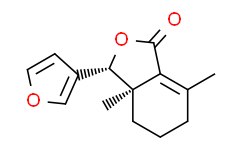




| Cas No.: | 28808-62-0 |
| Chemical Name: | Fraxinellone |
| Synonyms: | FRAXINELLONE;1(3H)-Isobenzofuranone,3-(3-furanyl)-3a,4,5,6-;tetrahydro-3a,7-dimethyl-,(3R,3aR)- (9CI);(3R)-3β-(3-Furanyl)-3aβ,7-dimethyl-1,3,3a,4,5,6-hexahydroisobenzofuran-1-one;(3R)-3β-(3-Furyl)-3a,4,5,6-tetrahydro-3aβ,7-dimethylisobenzofuran-1(3H)-one;3-(3-Furyl)-3a,4,5,6-tetrahydro-3a,7-dimethylphthalide;FRAXINELLONE(RG);1(3H)-Isobenzofuranone,3-(3-furanyl)-3a,4,5,6-tetrahydro-3a,7-dimethyl-, (3R,3aR)-;(3R,3aR)-3-(Furan-3-yl)-3a,7-dimethyl-3a,4,5,6-tetrahydroisobenzofuran-1(3H)-one;[ "" ];NSC638730;Phthalide, 3-(3-furyl)-3a,4,5,6-tetrahydro-3a,7-dimethyl-;3-Furan-3-yl-3a,7-dimethyl-3a,4,5,6-tetrahydro-3H-isobenzofuran-1-one;Fraxinellone, >=98% (HPLC);1(3H)-Isobenzofuranone, 3-(3-furanyl)-3a,4,5,6-tetrahydro-3a,7-dimethyl-, (3R,3aR)-;s9100;1(3H)-Isobenzofuranone, 3-(3-furanyl)-3a,4,5,6-tetrahydro-3a,7-dimethyl-, (3R-cis)-;NCGC0038549 |
| SMILES: | O1C(C2=C(C([H])([H])[H])C([H])([H])C([H])([H])C([H])([H])[C@@]2(C([H])([H])[H])[C@]1([H])C1=C([H])OC([H])=C1[H])=O |
| Formula: | C14H16O3 |
| M.Wt: | 232.2750 |
| Purity: | >98%, Standard References Grade |
| Sotrage: | 4°C for 1 year, -20°C for more than 2 years |
| Description: | Fraxinellone is isolated from the root bark of the Rutaceae plant, Dictamnus dasycarpus. Fraxinellone is a PD-L1 inhibitor and inhibits HIF-1α protein synthesis without affecting HIF-1α protein degradation. Fraxinellone has the potential to be a valuable candidate for cancer treatment by targeting PD-L1[1]. |
| In Vivo: | Fraxinellone (oral gavage; 30 and 100 mg/kg; every three days; 30 days) significantly suppresses tumor growth, reduces HIF-1α, pTyr705 STAT3, PD-L1 and VEGF staining compared with the control group in female athymic BALB/c nude mice[1]. Animal Model: BALB/c nude mice[1] Dosage: 30 and 100 mg/kg Administration: Oral gavage; 30 and 100 mg/kg; every three days; 30 days Result: Significantly suppressed tumor growth. |
| In Vitro: | Fraxinellone (0-100 μM;12 hours) decreases the percent of PD-L1 positive cells from 20.4% to 11.4% in A549 cells[1]. Cell Viability Assay[1] Cell Line: A549 cells Concentration: 0 μM, 10 μM, 30 μM, 100 μM Incubation Time: 12 hours Result: Inhibited the percent of PD-L1 positive cells. |
| References: | [1]. Xing Y, et al. Fraxinellone has anticancer activity in vivo by inhibiting programmed cell death-ligand 1 expression by reducing hypoxia-inducible factor-1α and STAT3. Pharmacol Res. 2018 Sep;135:166-180. |