 To enhance service speed and avoid tariff delays, we've opened a US warehouse. All US orders ship directly from our US facility.
| Cat. No. | Product Name | Field of Application | Chemical Structure |
|---|---|---|---|
| DC67525 | Hopewell Lipid 649 Featured |
L649 is a next-generation, lung-targeting ionizable lipid specifically designed for systemic mRNA delivery developed by Hopewell. Belonging to the novel "N-series" lipid class, it features a unique structure with an amine-containing head group and hydrophobic tails incorporating amide bonds. This design enables L649 to form highly stable lipid nanoparticles (LNPs) that exhibit exceptional tropism for the lower respiratory tract (lungs, bronchi, trachea) following intravenous administration. It demonstrates superior efficiency in delivering therapeutic payloads (like mRNA) specifically to key lung cell types, including alveolar epithelial cells (AT1 and AT2) and bronchial cells, while minimizing off-target accumulation in organs like the liver. L649-based LNPs, particularly when formulated with helper lipids like POPE, combine high potency with significantly improved tolerability, allowing for effective dosing in vivo. This makes L649 a promising candidate for developing treatments for various lung diseases such as pulmonary fibrosis, COPD, lung cancer, and infectious diseases like COVID-19.
More description
|
|
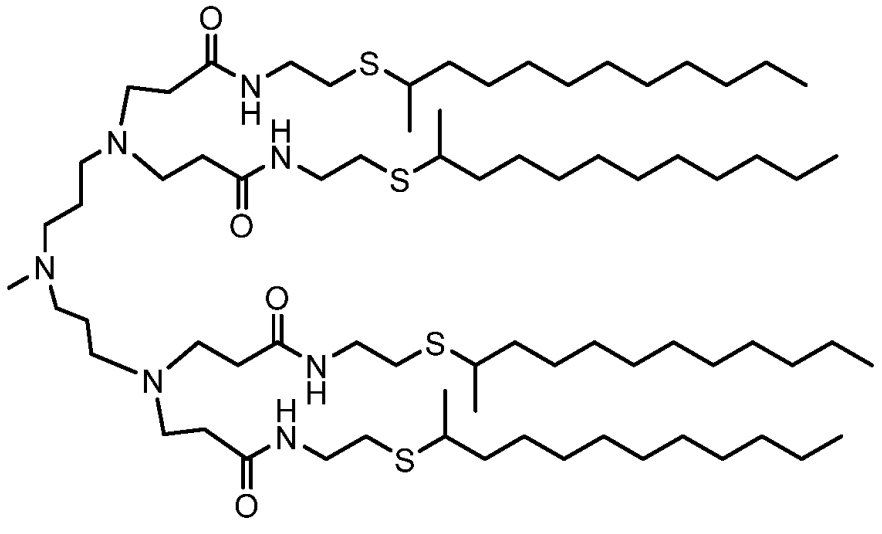
| DC60506 | IR-117-17 |
IR-117-17 (A10-LIN) is an ionizable and biodegradable lipid specifically designed for nebulized mRNA delivery. When formulated into lipid nanoparticles (LNPs), IR-117-17 demonstrates remarkable efficacy, achieving a 300-fold enhancement in lung mRNA delivery compared to the best-performing LNP previously reported. Additionally, it shows a two-fold improvement over the leading PBAE-based delivery system, with up to a 45-fold increase in mRNA delivery efficiency to the large airways.
More description
|
.png)
|
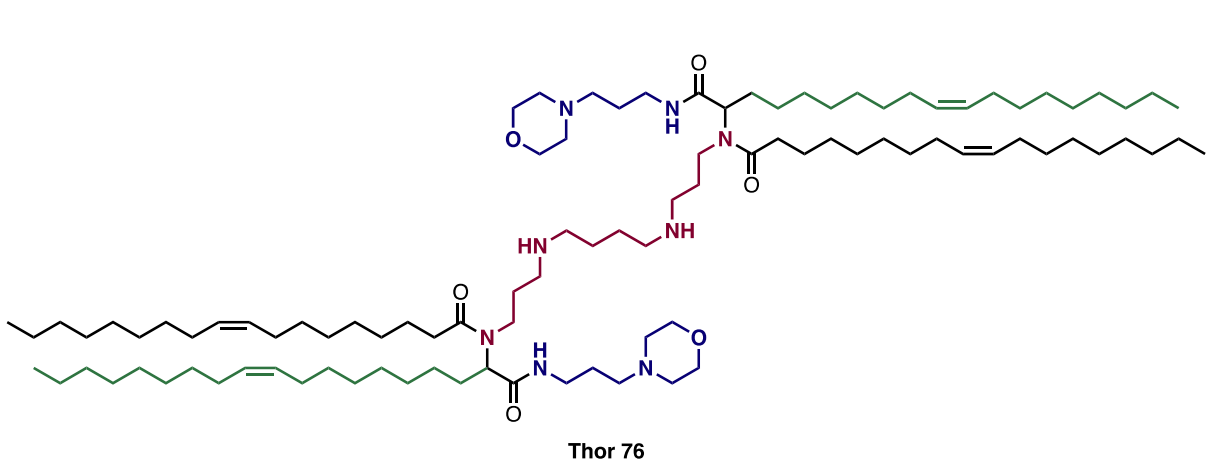
| DC60849 | THOR 76 Crude |
THOR 76 is an ionizable lipid developed for lung-targeted mRNA delivery, synthesized via a high-throughput Ugi four-component reaction (U4CR). It combines spermine (N3, amine core), oleyl aldehyde (A2), oleic acid (C2), and a morpholine-functionalized isonitrile (D3). Remarkably, its crude reaction mixture outperforms purified forms in efficacy, suggesting synergistic impurities or intermediates enhance function. Formulated into lipid nanoparticles (LNPs) with cholesterol, DOPE, and PEG-lipid, THOR 76 LNPs exhibit exceptional lung tropism with secondary spleen affinity after intravenous administration. They efficiently transfect pulmonary endothelial cells, enabling robust gene expression (e.g., Cre recombinase) and significant CRISPR-Cas9-mediated gene editing (1.22% at 0.1 mg/kg dose) in the lungs. With a particle size <150 nm, positive zeta potential, and >90% mRNA encapsulation, THOR 76 achieves targeted delivery while minimizing off-target effects in the liver. Its design overcomes limitations of cationic helper lipids, offering a potent, tolerable platform for treating pulmonary genetic disorders and cancers.
More description
|
|
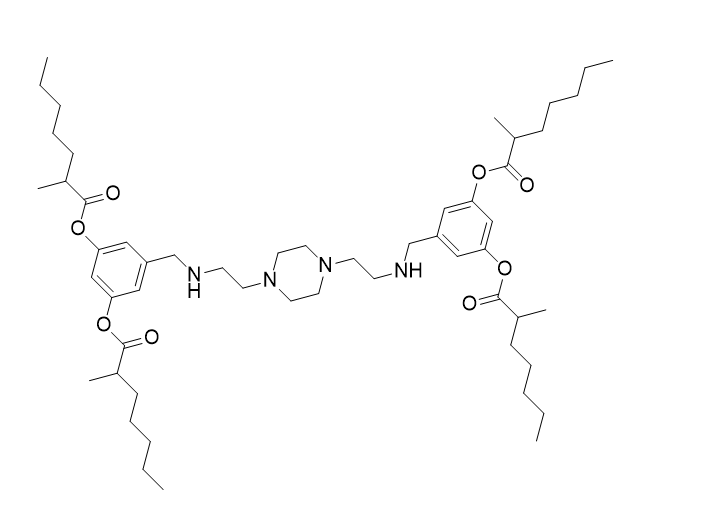
| DC60566 | Lipid CAD9 (3-A2-7b) |
Lipid CAD9 (3-A2-7b is a cationic degradable (CAD) lipid. 3-A2-7b formulated LNP, LNP-CAD9, can deliver FLuc mRNA to the lungs in vivo. LNP-CAD9 co-delivering Cas9 mRNA/VEGFR2 single guide RNA (sgRNA) effectively induces VEGFR2 knock out in lung endothelial cells of female mice.
More description
|
|
| DC60838 | A3T2C7 (CP-LC-1495) |
A3T2C7 (CP-LC-1495) is a biodegradable ionizable lipid featuring three β-propionate linkers and an azetidine polar head, formulated in four-component LNPs. It demonstrates exceptional lung-targeted mRNA delivery with 97.1% selectivity and high protein expression (1.21×10⁸ p/s) in mice. Its slightly positive zeta potential (~3.5 mV) correlates with lung tropism, likely mediated by protein corona enrichment of vitronectin and prothrombin. The β-propionate structure enables pH-sensitive biodegradability for enhanced endosomal escape while maintaining low cytotoxicity (>90% cell viability). This lipid enables organ-specific mRNA delivery without permanently charged additives, outperforming conventional SORT strategies in selectivity and expression efficiency.
More description
|
.png)
|
