Alternate TextTo enhance service speed and avoid tariff delays, we've opened a US warehouse. All US orders ship directly from our US facility.
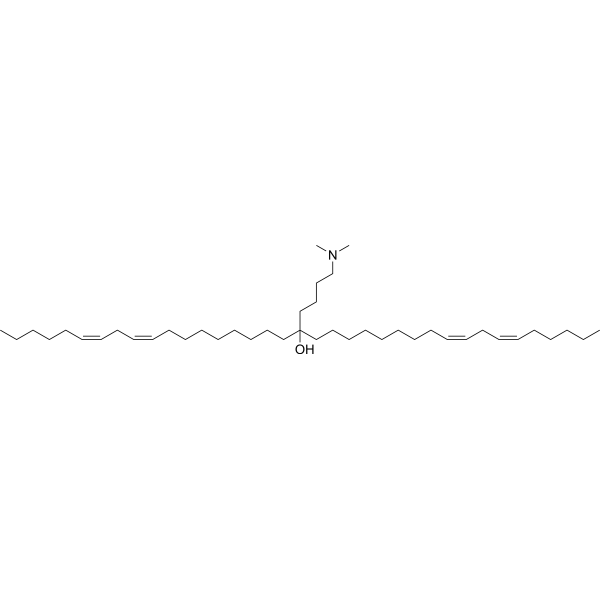
YSK12-C4 (YSK12-MEND)

  Cat. No.:  DC67120   Featured
Chemical Structure
1829511-70-7
For research use only. We do not sell to patients.
We match the best price and quality on market.
Email:order@dcchemicals.com  sales@dcchemicals.com
Tel:+86 21 58447131
We are official vendor of:
  • 20
  • 19
  • 18
  • 17
  • 16
  • 15
  • 14
  • 12
  • 11
  • 10
  • 9
  • 8
  • 13
  • 6
  • 5
  • 4
  • 3
  • 2
  • 1
More than 5000 active chemicals with high quality for research!
Field of application
YSK 12C4 is an ionizable cationic lipid primarily used to enhance siRNA cellular delivery via multifunctional envelope-type nanodevices (MEND). YSK 12C4 promotes siRNA uptake and endosomal escape, effectively silencing genes in human immune cell lines.
Cas No.: 1829511-70-7
Chemical Name: YSK12-C4 (YSK12-MEND)
Synonyms: 6,9,28,31-Heptatriacontatetraen-19-ol, 19-[4-(dimethylamino)butyl]-, (6Z,9Z,28Z,31Z)-;YSK12C4, YSK12 C4
SMILES: CCCCC/C=C\C/C=C\CCCCCCCCC(CCCCN(C)C)(O)CCCCCCCC/C=C\C/C=C\CCCCC
Formula: C43H81NO
M.Wt: 628.109353780746
Purity: ELSD-HPLC>95%
Sotrage: 1 year -20°C
Publication: Nakamura T, et al. Small-sized, stable lipid nanoparticle for the efficient delivery of siRNA to human immune cell lines. Sci Rep. 2016 Nov 28;6:37849.
Cat. No. Product name Field of application
DC59010 C14-4 C14-4 (C14-494,Lipid B-4,Lipid B4) is a novel ionizable lipid with the highest T-cell transfection efficiency and low cytotoxicity.The C14-4 ionizable lipid has been explored for CAR-T therapy.To screen the excellent formulations for mRNA delivery, a lipid library of 24 ionizable lipids was constructed to make iLNPs, which were used to deliver luciferase mRNA into Jurkat cells.[115] The optimal iLNPs formulation was C14-4 iLNPs (C14-4 ionizable lipid, DOPE, chol, and PEG at a molar ratio of 35%, 16%, 46.5%, and 2.5%) (Figure 6c). The optimal dose of luciferase mRNA for C14-4 iLNPs was 30 ng. Compared with electroporated CAR T cells, the CAR T cells engineered via C14-4 iLNPs showed potent cancer-killing activity when they were cocultured with Nalm-6 acute lymphoblastic leukemia cells. To obtain a safer and more effective CAR mRNA delivery vehicle, the orthogonal design provided 256 potential formulations, and 16 representative iLNPs formulations were evaluated.Through evaluating the safety, delivery efficiency, and transfection efficiency of 16 iLNPs, the formulation B10 (C14-4 ionizable lipid, DOPE, chol, PEG at a molar ratio of 40%, 30%, 25%, and 2.5%) was screened out as the optimal performing formulation. The luciferase expression based on B10 formulation was increased threefold than the initial formulation. Reducing the accumulation and clearance of iLNPs in the liver can increase the expression of CAR mRNA in T cells, further improving the therapeutic effect of CAR-T. Studies have shown that cholesterol analogs can alter the mechanisms of intracellular circulation and enhance the delivery of mRNA, which may be related to the reduced recognition of iLNPs by the Niemann Pick C1 (NPC1) enzyme.The addition of a hydroxyl group to various locations in the cholesterol molecule can alter the binding kinetics between the modified cholesterol and NPC1, and reduced NPC1 recognition of cholesterol. The results showed that replacement of 25% and 50% 7 α-hydroxycholesterol for cholesterol in iLNPs improved mRNA delivery to primary human T cells in vitro by 1.8-fold and twofold, respectively.C14-4 is one of the ionizable lipids to efficiently deliver mRNA to Jurkat cells or primary human T cells. It will effectively promote the development of mRNA delivery by iLNPs for CAR-T therapy.
DC60808 503O8,12 503O8,12​​ is an ionizable lipidoid synthesized via Michael addition, combining a hydrophilic amine headgroup ("503" series) with two hydrophobic branched acrylate tails (C8 and C12 chains, likely with unsaturated bonds). Its design emphasizes organ-specific delivery, exhibiting ​​spleen-tropic targeting​​ in vivo.
DC67120 YSK12-C4 (YSK12-MEND) YSK 12C4 is an ionizable cationic lipid primarily used to enhance siRNA cellular delivery via multifunctional envelope-type nanodevices (MEND). YSK 12C4 promotes siRNA uptake and endosomal escape, effectively silencing genes in human immune cell lines.
DC60639 Acid-degradable Anionic Lipid (ADA) ADA (Acid-Degradable Anionic Lipids) is revolutionizing mRNA delivery with its unique azido-acetal linker, enabling rapid hydrolysis in endosomes (pH ~6.0). This breakthrough technology ensures efficient endosomal escape, significantly enhancing mRNA delivery to target cells. ADA-LNPs excel in delivering mRNA to the spleen and liver, making them ideal for immune-related therapies.By degrading into biocompatible byproducts, ADA minimizes long-term tissue persistence and toxicity.ADA-LNPs outperform traditional LNPs, delivering mRNA more effectively to immune cells like macrophages and B cells.
DC60503 C12-A1 Lipid C12-A1 is an ionizable lipid. C12-A1-LPN is a potent and safe LNP platform to deliver Foxp3 mRNA to CD4+ T cells to engineer immunosuppressive FP3T cells. C12-A1 has a slightly lower average cell viability than C14-A1.
DC82102 PPZ-A10 PPZ-A10 is an ionizable cationic lipid.It has been used in the generation of lipid nanoparticles (LNPs) for the delivery of siRNA and mRNA in vitro and in vivo. Intraperitoneal administration of LNPs containing PPZ-A10 and encapsulating an mRNA reporter preferentially accumulates in hepatic Kupffer cells and splenic macrophages in mice.
DC80080 OF-C4-Deg-Lin OF-C4-Deg-Lin is a novel ionizable lipid for RNA delivery.
X