
 To enhance service speed and avoid tariff delays, we've opened a US warehouse. All US orders ship directly from our US facility.




| Cas No.: | |
| Purity: | >98% |
| Sotrage: | 2 years -20°C Powder, 2 weeks 4°C in DMSO, 6 months -80°C in DMSO |
| Cat. No. | Product name | Field of application |
| DC68215 | DSG-PEG3400-N3 | DSG-PEG3400-N3 is a conjugate composed of DSG, PEG chains, and terminal azido groups (-N3). DSG-PEG3400-Azide is a click chemistry reagent used for the targeted modification of liposomes/nanoparticles. |
| DC68214 | DSG-PEG3400-Mal | DSG-PEG3400-Mal is a conjugate composed of DSG, PEG chains, and maleimide (Mal). The maleimide group in DSG-PEG3400-Mal can undergo a specific Michael addition reaction with thiol-containing (-SH) biomolecules (such as peptides, antibodies, and aptamers), enabling targeted modification of liposomes/nanoparticles. |
| DC68163 | DSPE-PEG-DSS6 | DSS6-PEG-DSPE,DSPE-PEG-DSS6 is a composite molecule composed of phospholipids(DSPE),polyethylene glycol(PEG),and bone targeting peptide DSS6,mainly used for bone targeted drug delivery and bone tissue repair. Its core structure achieves precise targeting and efficient delivery through the synergistic effect of three parts.The DSS6 peptide consists of six Asp-Ser-Ser amino acid repeat sequences and can specifically recognize hydroxyapatite(HAp)in bone tissue. |
| DC68155 | DMG-PEG2000-Biotin | DMG-PEG2000-Biotin is a synthetic amphiphilic molecule composed of dimyristoyl glycerol (DMG), polyethylene glycol (PEG2000), and biotin functionalities. It is commonly employed in biomedical research for surface modification of lipid-based delivery platforms, such as lipid nanoparticles (LNPs) and liposomes. The PEG moiety enhances colloidal stability, prolongs circulation time, and reduces rapid clearance in vivo. The biotin termination facilitates conjugation to streptavidin-tagged biomolecules, exploiting the highly specific biotin-streptavidin interaction. Thus, DMG-PEG2000-Biotin is valuable for drug-delivery optimization, targeted therapeutic approaches, and in vitro diagnostic assay development. |
| DC68154 | Thiol-PEG2000-DMG | Thiol-PEG2000-DMG is a phospholipid polyPEG which can be used to prepare liposomes or nanoparticles. The terminal thiol group reacts with maleimide, OPSS, vinylsulfone and transition metal surfaces including gold, silver, etc. |
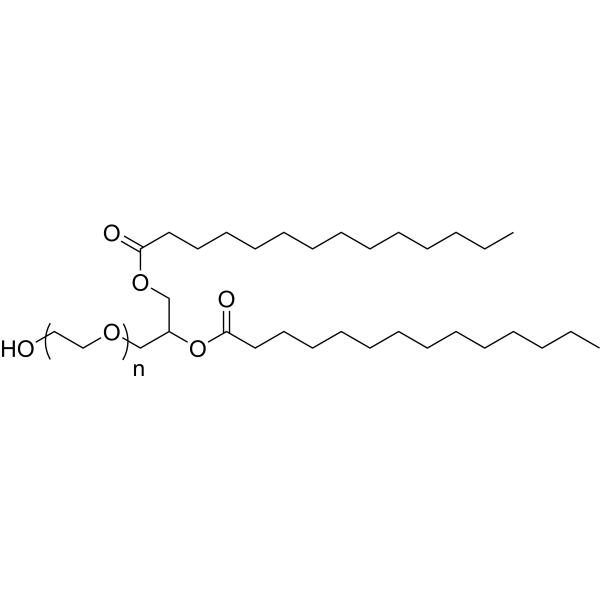
| DC68153 | DMG-PEG2000-OH | DMG-PEG2000-OH is a PEG derivative that can be used to construct drug delivery vehicles. |
| DC68152 | DMG-PEG2000-SH | DMG-PEG2000-SH is a PEG derivative that can be used to construct drug delivery vehicles. |
| DC67619 | DMG-PEG-TCO (MW2000) | DMG-PEG2000-TCO offer the ability to easily conjugate to specific biomolecules via metal free click chemistry to tetrazines. By changing the PEG length, one can change the micelle size, immunological safety, and change the drug release rate. |
| DC67603 | DMG-PEG-Mal, MW 2,000 | DMG-PEG-Mal, MW 2,000 is a lipid PEG consisting of DMG and maleimide for reacting with thiols between pH 6.5 to 7.5 |
| DC67571 | DMG-PEG-Mannose | DMG-PEG-Mannose is a specialized functionalized lipid used primarily for the targeted delivery of lipid nanoparticles (LNPs) and liposomes to cells expressing mannose receptors, such as macrophages and dendritic cells. It combines a 1,2-dimyristoyl-sn-glycerol (DMG) lipid anchor with a polyethylene glycol (PEG) spacer and a terminal mannose sugar moiety. |