| DC59010 |
C14-4
|
C14-4 (C14-494,Lipid B-4,Lipid B4) is a novel ionizable lipid with the highest T-cell transfection efficiency and low cytotoxicity.The C14-4 ionizable lipid has been explored for CAR-T therapy.To screen the excellent formulations for mRNA delivery, a
lipid library of 24 ionizable lipids was constructed to make
iLNPs, which were used to deliver luciferase mRNA into
Jurkat cells.[115] The optimal iLNPs formulation was C14-4
iLNPs (C14-4 ionizable lipid, DOPE, chol, and PEG at a molar
ratio of 35%, 16%, 46.5%, and 2.5%) (Figure 6c). The optimal
dose of luciferase mRNA for C14-4 iLNPs was 30 ng.
Compared with electroporated CAR T cells, the CAR T cells engineered
via C14-4 iLNPs showed potent cancer-killing activity
when they were cocultured with Nalm-6 acute lymphoblastic leukemia
cells. To obtain a safer and more effective CAR mRNA
delivery vehicle, the orthogonal design provided 256 potential
formulations, and 16 representative iLNPs formulations were
evaluated.Through evaluating the safety, delivery efficiency,
and transfection efficiency of 16 iLNPs, the formulation B10
(C14-4 ionizable lipid, DOPE, chol, PEG at a molar ratio of
40%, 30%, 25%, and 2.5%) was screened out as the optimal performing formulation. The luciferase expression based on B10
formulation was increased threefold than the initial formulation.
Reducing the accumulation and clearance of iLNPs in the liver
can increase the expression of CAR mRNA in T cells, further
improving the therapeutic effect of CAR-T. Studies have shown
that cholesterol analogs can alter the mechanisms of intracellular
circulation and enhance the delivery of mRNA, which may be
related to the reduced recognition of iLNPs by the Niemann
Pick C1 (NPC1) enzyme.The addition of a hydroxyl
group to various locations in the cholesterol molecule can alter
the binding kinetics between the modified cholesterol and NPC1,
and reduced NPC1 recognition of cholesterol. The results
showed that replacement of 25% and 50% 7 α-hydroxycholesterol
for cholesterol in iLNPs improved mRNA delivery to
primary human T cells in vitro by 1.8-fold and twofold,
respectively.C14-4 is one of the ionizable lipids to efficiently deliver mRNA
to Jurkat cells or primary human T cells. It will effectively promote
the development of mRNA delivery by iLNPs for CAR-T
therapy. |
| DC53130 |
93-O17S
|
93-O17S is an imidazole-based synthetic lipidoid for in vivo mRNA delivery. Lipid nanoparticles (LNPs) with 93-O17S promotes both the cross-presentation of tumor antigens and the intracellular delivery of cGAMP (STING agonist). |
| DC68179 |
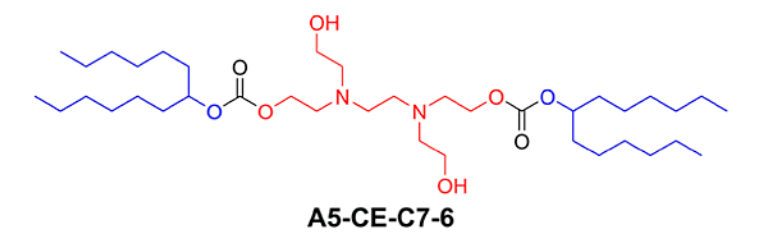
A5-CE-C7−6
|
A5-CE-C7-6 is an ionizable lipid engineered for spleen-targeted mRNA delivery, integrating a hydroxylated dual-amine core (A5) for enhanced mRNA binding and endosomal escape, a biodegradable carbonate ester linker (CE) enabling rapid hydrolysis (61% degradation in 24 h), and branched heptyl hydrophobic tails (C7-6) that optimize nanoparticle stability and spleen tropism. When formulated into cholesterol-free lipid nanoparticles (B-8 formulation), its unique architecture—combining hydroxyl groups for cellular uptake, carbonate-mediated biodegradability, and branched-chain fluidity—achieves unprecedented efficiency: low pKa (~6.0) minimizes liver accumulation while enabling 21% transfection of splenic NK cells, outperforming benchmark systems like MC3 SORT LNPs by >10-fold in spleen-specific delivery and establishing a new standard for in vivo immune cell engineering. |
| DC68177 |
L52715
|
L52715 is a novel ionizable lipid developed by Shanghai Vitalgen, used to deliver mRNA. |
| DC60942 |
113-AA-C8C14
|
113-AA-C8C14 is a spleen-tropic ionizable lipid with inherent splenic organ selectivity. Its formulated LNPs drastically reduce off-target liver uptake and drive 57-fold higher mRNA expression in spleen versus benchmark LNPs. It preferentially delivers nucleic acids to splenic immune cells like macrophages and T lymphocytes, supporting in vivo CAR-T engineering and mRNA vaccine research with minimal accumulation in other visceral organs. |
| DC68151 |
KC-34 (S,S)
|
KC‑34 (SPC‑A9) is a novel stereopure, diketopiperazine-based ionizable cationic lipid engineered to overcome traditional liver-restricted delivery, achieving balanced multi-organ mRNA transfection. Upon systemic intravenous administration, its precisely optimized chiral configuration allows the lipid nanoparticles (LNPs) to efficiently cross endothelial barriers and target the bone marrow, offering immense therapeutic potential for in vivo hematopoietic stem cell gene editing. Concurrently, KC-34 mediates robust and long-lasting protein expression in the spleen and lungs with minimal hepatic off-target toxicity. Its stable structure provides excellent biocompatibility and high in vivo tolerance, making it ideal for systemic, multi-dose mRNA therapies. |
| DC68141 |
AMG514
|
AMG514 is a novel ionizable lipid designed for formulating spleen-targeting lipid nanoparticles (LNPs) to deliver immune‑remodeling mRNAs (IR‑mRNAs). Its key advantage lies in the formation of a unique “protein corona” enriched with vitronectin, coagulation factors, and specific apolipoproteins (e.g., ApoA‑IV), together with its relatively high apparent pKa (~7.5), which actively redirects LNPs to the spleen instead of the liver. This precise spleen‑targeting property enables efficient transfection of splenic antigen‑presenting cells (APCs). As a vaccine adjuvant, AMG514‑LNPs therefore elicit a more robust activation of adaptive immunity compared to conventional LNPs (e.g., cKK‑E12), generating significantly enhanced antigen‑specific CD8⁺ T‑cell and antibody responses, and inducing durable anti‑tumor immune memory in preclinical models. |
| DC68057 |
Lipid Trp-L1-T4
|
Trp-L1-T4 is a novel tryptophan-derived ionizable lipid that serves as the core functional component of the optimized lipid nanoparticle (TLNP/RLNP) platform. Its primary function is to enable the efficient encapsulation and in vivo delivery of self-amplifying RNA (saRNA) cargo. Specifically, it facilitates high transfection efficiency and cytosolic release of the RNA payload in target follicular helper T (Tfh) cells, with minimal cytotoxicity. This capability is crucial for reprogramming pathogenic Tfh cells into regulatory CAR-Tfh cells, forming the foundation of the study's therapeutic strategy. |
| DC60929 |
Lipid 2310
|
Lipid 2310 is a novel ionizable lipid developed by Sail Biomedicine demonstrates excellent performance with a spleen-to-liver ratio of 5.58 and a very high total expression level of 1.3E+07. Lipid 2310 offers a strong balance of efficient systemic protein production and clear preferential delivery to the spleen. |
| DC60928 |
Lipid 2306
|
Lipid 2306 is a novel ionizable lipid developed by Sail Biomedicine demonstrates excellent performance with a spleen-to-liver ratio of 3.68 and a very high total expression level of 2.5E+07. Lipid 2306 offers a strong balance of efficient systemic protein production and clear preferential delivery to the spleen. |

 To enhance service speed and avoid tariff delays, we've opened a US warehouse. All US orders ship directly from our US facility.