 To enhance service speed and avoid tariff delays, we've opened a US warehouse. All US orders ship directly from our US facility.
| Cat. No. | Product Name | Field of Application | Chemical Structure |
|---|---|---|---|
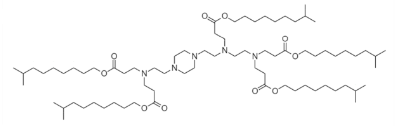
| DC60545 | 200Oi10 Featured |
200Oi10 is a highly potent, biodegradable ionizable lipidoid optimized for targeted mRNA delivery, with its organ tropism dynamic to the route of administration. Under intravenous injection, it demonstrates an extraordinary 97.7% liver specificity mediated by endogenous ApoE binding. Strikingly, shifting to intraperitoneal injection redirects its tropism, yielding up to 46.4% pancreatic targeting, which can be further boosted when co-formulated with DOTAP. Featuring ester-conjugated cleavable tails, 200Oi10 guarantees rapid metabolic clearance and negligible tissue accumulation toxicity, making it an exceptional candidate for localized pancreatic therapy and efficient hepatic gene delivery.
More description
|
|
| DC67658 | Lipid 4A2-B8-PH Featured |
4A2-B8-PH is an optimally designed thioketal-incorporated biodegradable ionizable lipid (TBIL) for mRNA delivery to pancreatic ductal epithelial cells. It features a 4A2 headgroup with three tertiary amines, a biodegradable thioketal-based B8 linker, and a branched PH tail. The thioketal linker enables ROS-responsive degradation in the tumor microenvironment, enhancing endosomal escape and mRNA release. In vivo, 4A2-B8-PH LNPs achieve 98.3% pancreas-specific targeting after intraperitoneal administration, with a 218-fold improvement in delivery efficiency compared to previous benchmarks. It successfully transfects 30.5% of pancreatic ductal epithelial cells and induces complete tumor regression in orthotopic PDAC models via IL-12 mRNA therapy, demonstrating high efficacy and safety.
More description
|

|
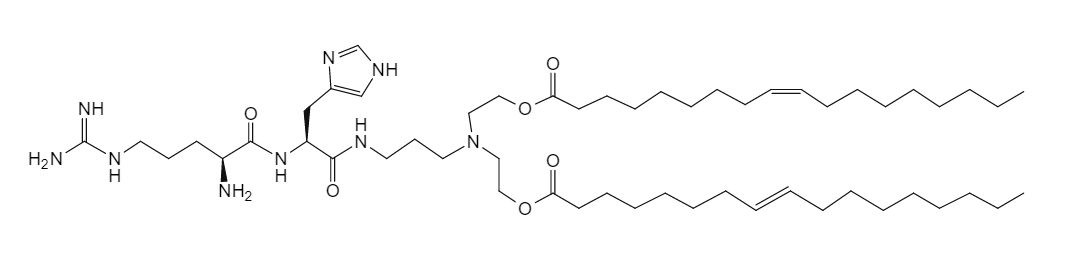
| DC60924 | AA76-lipid Featured |
AA76-lipid is a dipeptide-modified ionizable lipid, engineered with an arginine-histidine motif, that constitutes the core of the pancreatic-targeted AH-LNP delivery platform. Its chemical architecture, characterized by an externally positioned and C-terminally modified arginine residue, was identified through systematic screening as the optimal structure for function. Upon intraperitoneal administration, AH-LNPs formulated with this lipid interact with proteins in the peritoneal fluid, undergoing dynamic assembly into significantly larger complexes. This substantial increase in size (from ~100 nm to over 360 nm) exploits a physical targeting principle termed the Capsule-filter-mediated pancreatic targeting (CAMP) mechanism. Large particles are selectively filtered out by the dense capsules of other abdominal organs, leading to preferential enrichment in the capsule-deficient pancreas. Concurrently, the arginine-histidine motif directs the formation of a distinct protein corona enriched with apolipoproteins (e.g., APOE, APOB-100), which mimics very-low-density lipoprotein (VLDL). This corona enables efficient cellular internalization primarily into pancreatic stromal cells via VLDL receptor (VLDLR)-mediated endocytosis, known as the VMP pathway. The synergistic integration of the physical CAMP targeting and the biological VMP uptake mechanisms empowers AA76-lipid-based AH-LNPs to achieve highly specific, potent, and sustained mRNA delivery and gene editing within the pancreas across multiple species, demonstrating exceptional therapeutic efficacy in models of both autoimmune pancreatitis and pancreatic cancer.
More description
|
|
