Alternate TextTo enhance service speed and avoid tariff delays, we've opened a US warehouse. All US orders ship directly from our US facility.
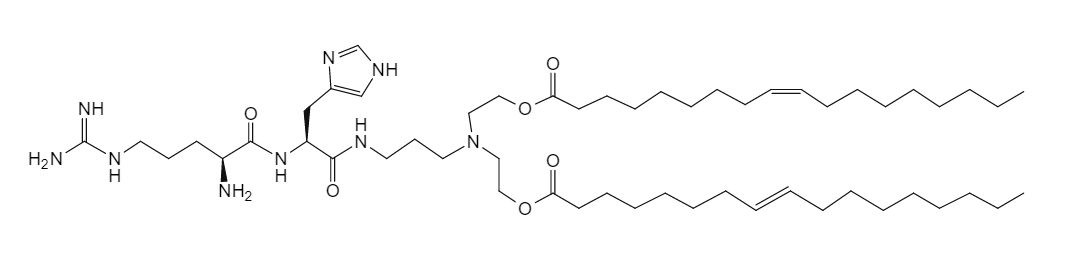
AA76-lipid

  Cat. No.:  DC60924   Featured
Chemical Structure
For research use only. We do not sell to patients.
We match the best price and quality on market.
Email:order@dcchemicals.com  sales@dcchemicals.com
Tel:+86 21 58447131
We are official vendor of:
  • 20
  • 19
  • 18
  • 17
  • 16
  • 15
  • 14
  • 12
  • 11
  • 10
  • 9
  • 8
  • 13
  • 6
  • 5
  • 4
  • 3
  • 2
  • 1
More than 5000 active chemicals with high quality for research!
Field of application
AA76-lipid is a dipeptide-modified ionizable lipid, engineered with an arginine-histidine motif, that constitutes the core of the pancreatic-targeted AH-LNP delivery platform. Its chemical architecture, characterized by an externally positioned and C-terminally modified arginine residue, was identified through systematic screening as the optimal structure for function. Upon intraperitoneal administration, AH-LNPs formulated with this lipid interact with proteins in the peritoneal fluid, undergoing dynamic assembly into significantly larger complexes. This substantial increase in size (from ~100 nm to over 360 nm) exploits a physical targeting principle termed the Capsule-filter-mediated pancreatic targeting (CAMP) mechanism. Large particles are selectively filtered out by the dense capsules of other abdominal organs, leading to preferential enrichment in the capsule-deficient pancreas. Concurrently, the arginine-histidine motif directs the formation of a distinct protein corona enriched with apolipoproteins (e.g., APOE, APOB-100), which mimics very-low-density lipoprotein (VLDL). This corona enables efficient cellular internalization primarily into pancreatic stromal cells via VLDL receptor (VLDLR)-mediated endocytosis, known as the VMP pathway. The synergistic integration of the physical CAMP targeting and the biological VMP uptake mechanisms empowers AA76-lipid-based AH-LNPs to achieve highly specific, potent, and sustained mRNA delivery and gene editing within the pancreas across multiple species, demonstrating exceptional therapeutic efficacy in models of both autoimmune pancreatitis and pancreatic cancer.
Cas No.:
Chemical Name: AA76-lipid
Synonyms: AA76-lipid
Formula: C54H99N9O6
M.Wt: 969.7718
Purity: 98%
Sotrage: 2 years -20°C Powder, 2 weeks 4°C in DMSO, 6 months -80°C in DMSO
Cat. No. Product name Field of application
DC60924 AA76-lipid AA76-lipid is a dipeptide-modified ionizable lipid, engineered with an arginine-histidine motif, that constitutes the core of the pancreatic-targeted AH-LNP delivery platform. Its chemical architecture, characterized by an externally positioned and C-terminally modified arginine residue, was identified through systematic screening as the optimal structure for function. Upon intraperitoneal administration, AH-LNPs formulated with this lipid interact with proteins in the peritoneal fluid, undergoing dynamic assembly into significantly larger complexes. This substantial increase in size (from ~100 nm to over 360 nm) exploits a physical targeting principle termed the Capsule-filter-mediated pancreatic targeting (CAMP) mechanism. Large particles are selectively filtered out by the dense capsules of other abdominal organs, leading to preferential enrichment in the capsule-deficient pancreas. Concurrently, the arginine-histidine motif directs the formation of a distinct protein corona enriched with apolipoproteins (e.g., APOE, APOB-100), which mimics very-low-density lipoprotein (VLDL). This corona enables efficient cellular internalization primarily into pancreatic stromal cells via VLDL receptor (VLDLR)-mediated endocytosis, known as the VMP pathway. The synergistic integration of the physical CAMP targeting and the biological VMP uptake mechanisms empowers AA76-lipid-based AH-LNPs to achieve highly specific, potent, and sustained mRNA delivery and gene editing within the pancreas across multiple species, demonstrating exceptional therapeutic efficacy in models of both autoimmune pancreatitis and pancreatic cancer.
X