 To enhance service speed and avoid tariff delays, we've opened a US warehouse. All US orders ship directly from our US facility.
| Cat. No. | Product Name | Field of Application | Chemical Structure |
|---|---|---|---|
| DC47334 | Ainsliadimer C |
Ainsliadimer C, a potential activator of SIRT1, ameliorates inflammatory responses in adipose tissue.
More description
|

|
| DC47332 | Antiallergic agent-1 |
Antiallergic agent-1, a Src-family kinase inhibitor, may serve as a new valuable lead compound for future antiallergic drug discovery.
More description
|
|
| DC47328 | 5,7-Dimethoxyflavanone |
5,7-Dimethoxyflavanone shows potent antimutagenic activity against MeIQ mutagenesis in Ames test using the S. typhimurium TA100 and TA98 strains. And 5,7-Dimethoxyflavanone significantly and dose-dependently inhibits the inflammatory mediato
More description
|
|
| DC47322 | 4-(Phenyldiazenyl)benzoic acid |
4-(Phenyldiazenyl)benzoic acid is a photosensitive and photoswitchable TRPA1 agonist that can be used as pharmacological tools for study of pain signaling.
More description
|
|
| DC46916 | 2-bromo-Hexadecanoic acid Featured |
2-Bromohexadecanoic acid (2-BP, 2-bromopalmitate) is a nonmetabolisable analogue of palmitate and acts as a palmitoylation inhibitor. 2-Bromohexadecanoic acid can directly and irreversibly inhibit the palmitoyltransferase activity of all DHHC (Asp-His-His-Cys) proteins.
More description
|

|
| DC46834 | Menin-MLL inhibitor 20,MRN73473 Featured |
Menin-MLL inhibitor 20 is an irreversible menin-MLL interaction inhibitor with antitumor activities (WO2020142557A1, compound 6).
More description
|
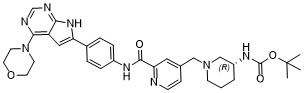
|
| DC47317 | Ammonium chloride |
Ammonium chloride is an inorganic compound and can be used for establishing the rat model of renal calcium oxalate calculus.
More description
|
|
| DC47314 | TPX-0046 |
TPX-0046 is a novel RET/SRC inhibitor with a mean IC50 of 17 nM for RETG810R in Ba/F3 cell proliferation assay.,RET [1]()
SRC [1]()
More description
|
|
| DC47313 | Cobomarsen |
Cobomarsen (MRG-106) is an oligonucleotide inhibitor of miR-155. Cobomarsen inhibits multiple gene pathways associated with cell survival (including JAK/STAT, MAPK/ERK and PI3K/AKT). Cobomarsen can be used for the research of B-cell lymphoma.
More description
|
|
| DC47312 | Inotersen sodium |
Inotersen (ISIS-420915) sodium is a 2′-O-methoxyethyl-modified antisense oligonucleotide. Inotersen sodium inhibits the production of transthyretin (TTR) protein by targeting the TTR RNA transcript and reduces the levels of the TTR transcript. Inotersen sodium can be used for the research of hereditary TTR amyloidosis polyneuropathy.
More description
|
|
| DC47311 | Revusiran |
Revusiran (ALN-TTRSC) is a 1st-generation short interfering RNA, which directed against transthyretin (TTR) mRNA. Revusiran can be used for transthyretin (TTR)-mediated amyloidosis research.
More description
|
|
| DC47309 | Vutrisiran |
Vutrisiran (ALN-TTRsc02) is a liver-directed, investigational, small interfering ribonucleic acid (siRNA) agent. Vutrisiran can be used for transthyretin (TTR)-mediated amyloidosis research.
More description
|
|
| DC47305 | IONIS-MAPTRx |
IONIS-MAPTRx (BIIB080) is the first Tau-lowering antisense oligonucleotide (ASO). IONIS-MAPTRx has the potential for the research of Alzheimer Disease.
More description
|
|
| DC47304 | AB-729 |
AB-729, a nucleoside analogue, is an RNA interference (RNAi). AB-729 conjugates to a trimer of N-acetylgalactosamine (GalNAc) ligand that promotes uptake into hepatocytes via the asialoglycoprotein receptor (ASGR). AB-729 inhibits viral replication and reduces HBV antigens.
More description
|
|
| DC47303 | Essential oils, Melaleuca alternifolia |
Essential oils, Melaleuca alternifolia is extracted from the leaves of Melaleuca alternifolia, has bactericidal and anti-inflammatory activies.
More description
|
|
| DC47302 | AZD8601 |
AZD8601 is an mRNA designed to produce vascular endothelial growth factor A (VEGF-A). AZD8601 accelerates diabetic wound healing.
More description
|
|
| DC47301 | Lexanersen |
Lexanersen (WVE-120102) is an antisense oligonucleotide used for the study of Huntington's disease.
More description
|
|
| DC47300 | Suvodirsen |
Suvodirsen (WVE-210201) is a oligonucleotide. Suvodirsen has the potential for study Duchenne muscular dystrophy (DMD).
More description
|
|
| DC47299 | Fitusiran |
Fitusiran (ALN-AT3SC), an small interfering RNA, specifically targets antithrombin (AT) messenger RNA to lower production of AT in the liver. Fitusiran increases thrombin generation and has the potential for the research of the hemophilia.
More description
|
|
| DC47298 | Lipoteichoic acid |
Lipoteichoic acid, a cell wall component of Staphylococcus aureus, activates the complement system via C3 induction and CD55 inhibition.
More description
|
|
| DC47297 | SLN124 |
SLN124 is a GalNac-siRNA targeting transmembrane serine protease 6 (Tmprss6). SLN124 is composed of a trimeric GalNAc ligand conjugated to TMPRSS6‐siRNA. SLN124 has the potential for an siRNA to restore hepcidin expression and normalise iron homeostasis in β‐thalassaemia.
More description
|
|
| DC47296 | MTL-CEBPA |
MTL-CEPBA is a small activating RNA targeting for upregulation of C/EBPα. MTL-CEPBA has anti-inflammatory and anti-cancer activity.
More description
|
|
| DC47295 | Lademirsen |
Lademirsen (SAR339375; RG-012) is a highly specific antisense oligonucleotide (ASO) targeting miR-21. Lademirsen has the potential for Alport nephropathy research.
More description
|
|
| DC47294 | Givosiran |
Givosiran (ALN-AS1) is a small interfering RNA that targets hepatic aminolevulinate synthase 1 (ALAS1) messenger RNA. Givosiran downregulates ALAS1 mRNA and prevents accumulation of neurotoxic δ-aminolevulinic acid and porphobilinogen levels. Givosiran can be used for the research of acute intermittent porphyria.
More description
|
|
| DC47293 | Golodirsen |
Golodirsen (SRP-4053) is a phosphorodiamidate morpholino oligomer (PMO) that specifically targets exon 53 of dystrophin pre-mRNA. Golodirsen can be used for the research of Duchenne muscular dystrophy (DMD).
More description
|
|
| DC47289 | RG-101 |
RG-101 is a hepatocyte targeted N-acetylgalactosamine conjugated oligonucleotide that antagonises miR-122. miR-122 is an important host factor for hepatitis C virus (HCV) replication.
More description
|
|
| DC47288 | Teprasiran |
Teprasiran (QPI-1002) is a small interfering RNA that temporarily inhibits p53-mediated cell death that underlies acute kidney injury (AKI).
More description
|
|
| DC47286 | Patisiran sodium |
Patisiran sodium is a double-stranded small interfering RNA that targets a sequence within the transthyretin (TTR) messenger RNA. Patisiran sodium specifically inhibits hepatic synthesis of mutant and wild-type TTR. Patisiran sodium can be used for the research of hereditary TTR amyloidosis.
More description
|
|
| DC47284 | Viltolarsen |
Viltolarsen (NS-065/NCNP-01), a phosphorodiamidate morpholino antisense oligonucleotide, targets the splicing of exon 53 in the dystrophin gene. Viltolarsen can be used for the research of the Duchenne muscular dystrophy (DMD).
More description
|
|
| DC47283 | Casimersen |
Casimersen (SRP-4045) is an antisense oligonucleotide of the phosphorodiamidate morpholino oligomer subclass. Casimersen binds to exon 45 of dystrophin pre-mRNA, restores the open-reading frame (by skipping exon 45) resulting in the production of an internally truncated but functional dystrophin protein. Casimersen can be used for the research of Duchenne muscular dystrophy (DMD).
More description
|
|
