 To enhance service speed and avoid tariff delays, we've opened a US warehouse. All US orders ship directly from our US facility.
| Cat. No. | Product Name | Field of Application | Chemical Structure |
|---|---|---|---|
| DC41327 | (±)-Anatoxin A fumarate |
(±)-Anatoxin A fumarate is a natural alkaloid isolated from freshwater cyanobacterium.(±)-Anatoxin A fumarate is a potent nicotinic receptor agonist and exhibits Ki values of 1.25 nM and 1.84 μM for binding to putative α4β2-type nAChR and α7-type nAChR in rat brain membranes, respectively. (±)-Anatoxin A fumarate stimulates [3H]-dopamine release from rat striatal synaptosomes (EC50=134 nM).
More description
|

|
| DC41230 | Benzoquinonium dibromide |
Benzoquinonium dibromide is a nicotinic acetylcholine receptors (nAChRs) antagonist, with an IC50 of 0.46 μM. Benzoquinonium dibromide can block neuromuscular and ganglionic transmission.
More description
|
|
| DC41121 | SSR180711 hydrochloride |
SSR180711 hydrochloride is an orally active, selective and reversible α7 acetylcholine nicotinic receptor (n-AChRs) partial agonist. SSR180711 hydrochloride can act on rat α7 n-AChR (Ki=22 nM; IC50=30 nM) and human α7 n-AChR (Ki=14 nM; IC50=18 nM). SSR180711 hydrochloride increases glutamatergic neurotransmission, ACh release and long-term potentiation (LTP) in the hippocampus.
More description
|
|
| DC41029 | (S)-UFR2709 hydrochloride |
(S)-UFR2709 (hydrochloride) is a competitive nAChR antagonist?and displays higher affinity for α4β2 nAChRs than for α7 nAChRs. (S)-UFR2709 (hydrochloride) decreases anxiety and reduces ethanol consumption and ethanol preference in alcohol-preferring rats. (S)-UFR2709 (hydrochloride) acts as an anxiolytic agent and can be used for the study of nicotine addiction.
More description
|
|
| DC41028 | (S)-UFR2709 |
(S)-UFR2709 is a competitive nAChR antagonist?and displays higher affinity for α4β2 nAChRs than for α7 nAChRs. (S)-UFR2709 decreases anxiety and reduces ethanol consumption and ethanol preference in alcohol-preferring rats. (S)-UFR2709 acts as an anxiolytic agent and can be used for the study of nicotine addiction.
More description
|
|
| DC40995 | 5-AMAM-2-CP |
5-AMAM-2-CP is a major metabolite of Acetamiprid. Acetamiprid is a neonicotinoid insecticide used worldwide and is a nAChR agonist.
More description
|
|
| DC40994 | 5-AAM-2-CP |
5-AAM-2-CP is a major metabolite of Acetamiprid. Acetamiprid is a neonicotinoid insecticide used worldwide and is a nAChR agonist.
More description
|
|
| DC40861 | nAChR agonist CMPI hydrochloride |
nAChR agonist CMPI hydrochloride is a potent and selective positive allosteric modulator (PAM) of nAChR containing a α4:α4 subunit interface. nAChR agonist CMPI hydrochloride enhances the response of (α4)3(β2)2 nAChR to ACh (10 μM) with an EC50 of 0.26 μM. nAChR agonist CMPI hydrochloride has potential for the research of nicotine dependence and many neuropsychiatric conditions associated with decreased brain cholinergic activity.
More description
|
|
| DC40851 | TC-2559 difumarate |
TC-2559 idifumarate is a CNS-selective, orally active α4β2 subtype of nicotinic acetylcholine receptor (nAChR) partial agonist (EC50=0.18 μM). TC-2559 difumarate shows selectivity for α4β2 over α2β4, α4β4 and α3β4 receptors, with EC50s in the range of 10-30 μM. Antinociceptive effect.
More description
|
|
| DC40156 | PSEM 89S TFA |
PSEM 89S TFA is a selective and brain penetrant agonists for the resulting ion channels. PSEM 89S TFA is orthogonally selective for Q79G and L141F, respectively.
More description
|
|
| DC40097 | Facinicline hydrochloride |
Facinicline hydrochloride (RG3487 hydrochloride) is an orally active nicotinic α7 receptor partial agonist, with a Ki of 6 nM for α7 human nAChR. Facinicline hydrochloride (RG3487 hydrochloride) improves cognition and sensorimotor gating in rodents. Facinicline hydrochloride (RG3487 hydrochloride) shows high affinity (antagonist) to 5-HT3Rs with a Ki value of 1.2 nM.
More description
|
|
| DC29052 | Pipecuronium bromide |
Pipecuronium bromide is a potent long-acting nondepolarizing steroidal neuromuscular blocking agent (NMBA), and a bisquaternary ammonium compound. Pipecuronium bromide is a powerful competitive nAChR antagonist with a Kd of 3.06 μM.
More description
|
|
| DC28471 | D-Tubocurarine chloride pentahydrate |
D-Tubocurarine chloride pentahydrate is the chloride salt form of Tubocurarine, a nicotinic acetylcholine receptors (AChR) antagonist, and can be used as a skeletal muscle relaxant during surgery or mechanical ventilation. D-Tubocurarine chloride pentahydrate is also a potent neuromuscular blocking agent.
More description
|
|
| DC28208 | 3-Bromocytisine |
3-Bromocytisine (3-Br-cytisine) is a potent nACh receptors agonist, with IC50s are 0.28, 0.30 and 31.6 nM for hα4β4, hα4β2, and hα7-nACh, respectively. 3-Bromocytisine (3-Br-cytisine) shows different effects on high (HS) and low (LS) ACh sensitivity α4β2 nAChRs with EC50s are 8 and 50 nM, respectively.
More description
|
|
| DC28207 | SIB-1553A |
SIB-1553A is an orally bioavailable nicotinic acetylcholine receptors (nAChRs) agonist, with selectivity for β4 subunit-containing nAChRs. SIB-1553A is also a selective neuronal nAChR ligand. SIB-1553A is a cognitive enhancer, and has therapeutic potential for the symptomatic treatment of Alzheimer’s disease and other cognitive disorders.
More description
|
|
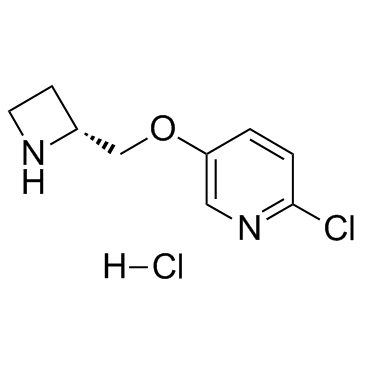
| DC10331 | Tebanicline hydrochloride |
Tebanicline hydrochloride (ABT594 hydrochloride) is a nAChR modulator with potent, orally effective analgesic activity. It inhibits the binding of cytisine to α4β2 neuronal nAChRs with a Ki of 37 pM.
More description
|
|
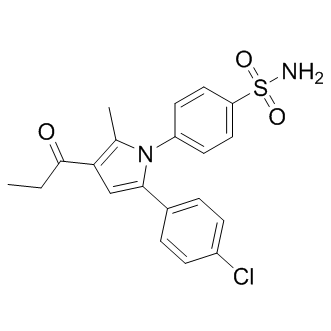
| DC9516 | A-867744 |
A-867744 is a positive allosteric modulator of α7 nAChRs (IC50 values are 0.98 and 1.12 μM for human and rat α7 receptor ACh-evoked currents respectively, in X.
More description
|
|
| DCJ-030 | Galanthamine |
>98%,Standard References
More description
|

|
