 To enhance service speed and avoid tariff delays, we've opened a US warehouse. All US orders ship directly from our US facility.
| Cat. No. | Product Name | Field of Application | Chemical Structure |
|---|---|---|---|
| DC72814 | 5'-Hydroxy-staurosporine |
5'-Hydroxy-staurosporine is an indolocarbazole alkaloid that can be isolated from marine Micromonospora sp. (strain L-31-CLCO-002). 5'-Hydroxy-staurosporine can be used in tumor related research.
More description
|

|
| DC72812 | Flurandrenolone Acetate |
Flurandrenolone Acetate is a derivative of Flurandrenolide. Flurandrenolone Acetate is a synthetic glucocorticoid steroid, can be used for the research of skin disorders such as eczema and psoriasis.
More description
|
|
| DC72811 | Mesembrenol |
Mesembrenol (Chemotype c) is an alkaloid widely found in plants. Mesembrenol has potential application in quality control of raw materials and products of S.tortuosum.
More description
|
|
| DC72810 | BJJF078 |
BJJF078 is an aminopiperidine derivative. BJJF078 is a potent inhibitor of recombinant human and mouse Transglutaminase enzyme (TG2) activity, IC50 values of 41 and 54 nM, respectively. BJJF078 also inhibits the close related enzyme TG1, with an IC50 of 0.16 μM. BJJF078 can be used for Multiple sclerosis (MS) research.
More description
|
|
| DC72805 | LY 295427 |
LY 295427 is a LDL receptor modulator and a hypocholesterolemic agent. LY 295427 derepresses the transcription of the LDLR (LDL Receptor). LY 295427 can be used for hypercholesterolemia research.
More description
|
|
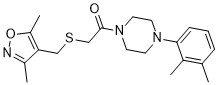
| DC12578 | IMTPPE Featured |
IMTPPE (SID3712502) is a novel small molecule capable of inhibiting androgen receptor (AR) transcriptional activity (IC50=1 uM) and protein level in C4-2 prostate cancer cells.
More description
|
|
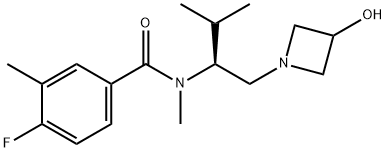
| DC46471 | RP101988 Featured |
RP101988, the major active metabolite of Ozanimod, is a selective, potent S1PR1 (sphingosine-1-phosphate receptor 1) agonist, with EC50s of 0.19 nM and 32.8 nM for S1PR1 and S1PR5, respectivlely.
More description
|
|
| DC12302 | CCR2 antagonist 3 Featured |
CCR2 antagonist 3 is a chemokine receptor 2 (CCR2) antagonist.
More description
|
|
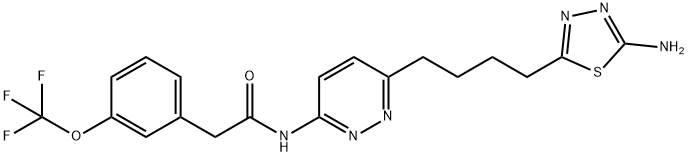
| DC42558 | Glutaminase-IN-3 Featured |
Glutaminase-IN-3 (compound 657) is a potent glutaminase inhibitor extracted from patent WO2014089048A1, compound 657, has an IC50 of 0.24 μM for Glutaminase 1 (GLS1).
More description
|
|
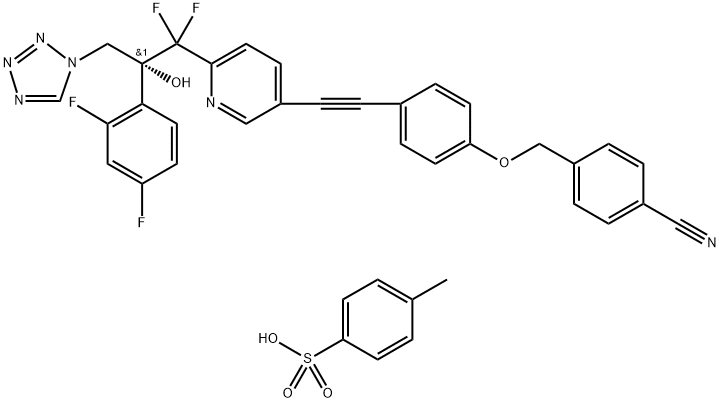
| DC72507 | VT-1598 tosylate Featured |
VT-1598 tosylate is an orally active and selective fungal inhibitor targeting CYP51. VT-1598 tosylate shows anti-fungal activity against C. auris.
More description
|
|
| DC20763 | BDP8900 |
BDP8900 (BDP-8900) is a highly potent and selective Myotonic dystrophy-related Cdc42-binding kinase MRCK inhibitor with IC50 of 43 nM (MRCKβ), >100-fold selectivity over related ROCK1 or ROCK2.
More description
|
|
| DC20764 | BDP9066 |
BDP9066 (BDP-9066) is a highly potent and selective Myotonic dystrophy-related Cdc42-binding kinase MRCK inhibitor with IC50 of 43 nM, >100-fold selectivity over related ROCK1 or ROCK2.
More description
|
|
| DC40014 | Gefitinib impurity 2 |
Gefitinib impurity 2 is the impurity of Gefitinib. Gefitinib is a potent, selective and orally active EGFR tyrosine kinase inhibitor with an IC50 of 33 nM. Gefitinib selectively inhibits EGF-stimulated tumor cell growth (IC50 of 54 nM) and that blocks EGF-stimulated EGFR autophosphorylation in tumor cells. Gefitinib also induces autophagy. Gefitinib has antitumour activity.
More description
|

|
| DC40119 | 10-OH-NBP D4 |
10-OH-NBP D4 is deuterium labeled 10-OH-NBP. 10-OH-NBP is a Butylphthalide hydroxylated metabolite and can penetrates the blood-brain barrier (BBB). Butylphthalide exerts neuroprotective effects and has potential for cerebral ischemia research.
More description
|
|
| DC40656 | 4,5-Dichloroveratrole |
4,5-Dichloroveratrole is a chlorinated product formed by reaction of Veratryl alcohol with chlorine dioxide solution.
More description
|

|
| DC47418 | 6,7-Dimethyl-8-ribityllumazine |
6,7-Dimethyl-8-ribityllumazine is a direct biosynthetic precursor of Riboflavin. 6,7-Dimethyl-8-ribityllumazine is a noncovalently bound fluorophore of Lumazine protein (LumP), which is a fluorescent accessory protein.
More description
|

|
| DC41055 | Sevelamer carbonate Featured |
Sevelamer carbonate is an orally active and non-calcium-based phosphate binding agent and used for the hyperphosphatemia of chronic kidney disease (CKD)research. Sevelamer carbonate effectively lowers serum phosphorus levels hile having minimal effect on serum calcium or serum chloride levels in vivo. Sevelamer carbonate is considered as an improved, buffered form of sevelamer.
More description
|

|
| DC21800 | VT-1161 Featured |
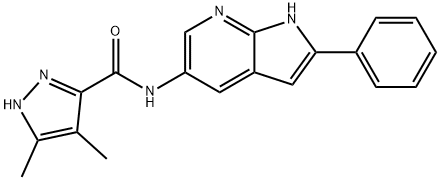
VT-1161 is a potent, highly-selective, and oral fungal CYP51 inhibitor with Kd of ≤ 39 nM.
More description
|
|
| DC72072 | 15-Keto Travoprost |
15-Keto Travoprost (15-Keto Fluprostenol isopropyl ester) is a metabolite of Travoprost. 15-Keto Travoprost shows stimulatory effect on the growth and thickening of the eyelashes.
More description
|

|
| DC72080 | Pegozafermin |
Pegozafermin is a fibroblast growth factor FGF21 analog, which is an endogenous metabolic hormone and regulates energy expenditure and glucose and lipid metabolism. Pegozafermin decreases the level of triglyceride (TG), can be used for non-alcoholic steatohepatitis (NASH) and severe hypertriglyceridemia (SHTG).
More description
|
|
| DC72093 | N-Trimethylchitosan |
N-Trimethylchitosan is a water-soluble multifunctional polymer which is a Chitosan derivative. N-Trimethylchitosan can be used for drug delivery and to synthesize nanoparticles.
More description
|
|
| DC72109 | W-7 isomer hydrochloride |
W-7 isomer hydrochloride is an isomer of W-7 hydrochloride. W-7 hydrochloride is a selective calmodulin antagonist.
More description
|

|
| DC44178 | 4-Chloro-7-fluoropyrrolo[1,2-a]quinoxaline-1-carbaldehyde |
4-Chloro-7-fluoropyrrolo[1,2-a]quinoxaline-1-carbaldehyde, a derivative of (E)-7-Fluoro-4-hydrazono-4,5-dihydropyrrolo[1,2-a]quinoxaline.
More description
|
|
| DC12590 | CCB 02 Featured |
CCB02 (CCB 02) is a specific small molecule inhibitor of CPAP-tubulin interaction with IC50 of 0.689 uM in AlphaScreen assay, selectively binds at the CPAP binding site of tubulin.
More description
|

|
| DC46686 | (R)-Pirtobrutinib Featured |
(R)-Pirtobrutinib ((R)-LOXO-305) is a less active enantiomer of Pirtobrutinib. Pirtobrutinib (LOXO-305), a highly selective and non-covalent next generation BTK inhibitor, inhibits diverse BTK C481 substitution mutations.
More description
|

|
| DC48302 | VL-6 Featured |
VL-6 can be used in the synthesis of biomimetic nanomaterials which for delivery of therapeutic, diagnostic, or prophylactic agents.
More description
|

|
| DC32518 | WEHI-539 Featured |
WEHI-539 is a highly potent and selective BCL-XL inhibitor. The prosurvival BCL-2 family protein BCL-X(L) is often overexpressed in solid tumors and renders malignant tumor cells resistant to anticancer therapeutics. WEHI-539 has high affinity (subnanomolar) and selectivity for BCL-X(L) and potently kills cells by selectively antagonizing its prosurvival activity. WEHI-539 will be an invaluable tool for distinguishing the roles of BCL-X(L) from those of its prosurvival relatives, both in normal cells and notably in malignant tumor cells, many of which may prove to rely upon BCL-X(L) for their sustained.
More description
|

|
| DC22497 | MMAF-OMe Featured |
MMAF-Ome belongs to ADC, and inhibits several tumor cell lines with IC50s of 0.056 nM, 0.166 nM, 0.183 nM, and 0.449 nM for MDAMB435/5T4, MDAMB361DYT2, MDAMB468, and Raji (5T4-) cell lines, respectively.
More description
|

|
| DC36059 | Antibiotic 1037 Featured |
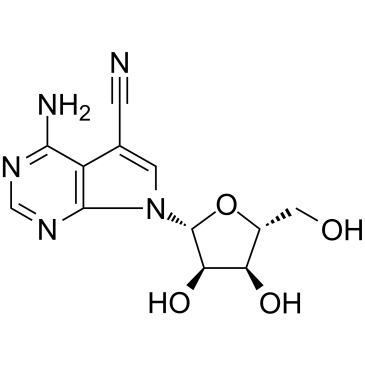
Toyocamycin (Vengicide) is an adenosine analog produced by Actinomycete, acts as an XBP1 inhibitor, inhibits IRE1α-induced ATP-dependent XBP1 mRNA cleavage, with an IC50 of 80 nM. Toyocamycin (Vengicide) induces apoptosis. Toyocamycin (Vengicide) shows no effect on IRE1α auto-phosphorylation[1].
More description
|
|
| DC8369 | Eltrombopag olamine Featured |
Eltrombopag olamine is a new, orally active thrombopoietin-receptor (c-mpl) agonist that stimulates thrombopoiesis.
More description
|

|
