 To enhance service speed and avoid tariff delays, we've opened a US warehouse. All US orders ship directly from our US facility.
| Cat. No. | Product Name | Field of Application | Chemical Structure |
|---|---|---|---|
| DC71263 | YXL-13 |
YXL-13 is a potent Pseudomonas aeruginosa (PAO1) inhibitor with an IC50 value of 3.686 μM. YXL-13 can inhibit virulence factors and biofilm formation of PAO1. YXL-13 reduces the pathogenicity and drug resistance of PAO1 by inhibition of the quorum sensing (QS) system. YXL-13 can be used for researching anti-bacteria.
More description
|

|
| DC71262 | GSK3036656 |
GSK3036656 (GSK070) is a potent, selective and orally active inhibitor of M. tuberculosis leucyl-tRNA synthetase, with an IC50 of 0.20 μM. GSK3036656 can be used for the research of tuberculosis.
More description
|
|
| DC71261 | WCK-4234 |
WCK-4234 is a potent β-lactamase inhibitor. WCK-4234 inhibits class A, C, and D β-lactamases activity. WCK-4234 lacks direct antibacterial activity. WCK-4234 potentiates imipenem and meropenem against Enterobacteriaceae with OXA-48/OXA-181 or KPC enzymes, or with combinations of impermeability and AmpC or ESBL activity. WCK-4234 distinctively overcomes resistance mediated by OXA-type carbapenemases.
More description
|
|
| DC71260 | Thaxtomin A |
Thaxtomin A is a major phytotoxin produced by S. scabies.
More description
|
|
| DC71259 | GSK2556286 |
GSK2556286 (GSK286) is an orally active inhibitor of M. tuberculosis. GSK2556286 inhibits growth within human macrophages (IC50 = 0.07 μM). GSK2556286 is effective against both multidrug-resistant (MDR) or extensively drug-resistant (XDR) and drug-sensitive (DS) M. tuberculosis.
More description
|
|
| DC71258 | 844-TFM |
844-TFM is a NBTI (novel bacterial topoisomerase inhibitor) DNA gyrase inhibitor, with an IC50 of 1.5 μM. 844-TFM exhibits bactericidal properties against M. abscessus.
More description
|
|
| DC71257 | HXR9 hydrochloride |
HXR9 hydrochloride is a cell-permeable peptide and a competitive antagonist of HOX/PBX interaction. HXR9 hydrochloride antagonizes the interaction between HOX and a second transcrip-tion factor (PBX), which binds to HOX proteins in paralogue groups1 to 8. HXR9 hydrochloride selectively decreases cell proliferation and promotes apoptosis in cells with a high level of expression of the HOXA/PBX3 genes, such as MLL-rearranged leukemic cells.
More description
|
|
| DC60207 | N-(1,2-Dimethylbenzimidazol-5-yl)-1-[(3-fluorophenyl)methyl]pyrrolo[3,2-c]pyridine-2-carboxamide Featured |

|
|
| DC60205 | N-[(6-methylpyridin-2-yl)methylideneamino]pyrrolidine-1-carbothioamide Featured |

|
|
| DC60204 | Hydrazinecarbothioamide, N,N-diethyl-2-[(6-methyl-2-pyridinyl)methylene]- Featured |

|
|
| DC42943 | VU0360172 Hydrochloride Featured |
Potent mGluR5 PAM modulator
More description
|

|
| DC33008 | CP-24879 hydrochloride Featured |
CP-24879 hydrochloride is a D5D/D6D dual-inhibitor, showing beneficial effects against increased intracellular lipid accumulation and inflammatory injury in hepatocytes.
More description
|

|
| DC70409 | FGIN-1-27 Featured |
FGIN-1-27 is an anxiolytic compound that acts as a selective agonist at the peripheral benzodiazepine receptor (TSPO).FGIN-1-27 inhibited Th17 cell differentiation, significantly downregulated the expression of RORγt target genes, notably Il17a, Il17f, Il23r, Ltb4r1,Ccr6.FGIN-1-27 protected mice against EAE, induced amino acid starvation response (AAR), FGIN-1-27 produced anti-anxiety and anti-panic effects in non-mammalian models.
More description
|

|
| DC71156 | SR2640 hydrochloride Featured |
SR2640 (hydrochloride) is a potent and selective competitive leukotriene D4/leukotriene E4 antagonist. SR2640 can be used for researching the role of leukotrienes in human asthma.
More description
|

|
| DC25013 | ARM-1 Featured |
A novel LTA4 hydrolase (LTA4H) inhibitor that inhibits LTB4 synthesis in human neutrophils with IC50 of 0.5 uM.
More description
|

|
| DC22768 | MP07-66 Featured |
A novel FTY720 analog that acts as PP2A activator, disrupts the SET/PP2A interaction devoid of immunosuppressive effects leads to the reactivation of PP2A.
More description
|

|
| DC49919 | FEN1-IN-SC13 Featured |
FEN1-IN-SC13 is a potent DNA fragmentation endonuclease 1 (FEN1) inhibitor (CN106692155A, SC13).
More description
|

|
| DC47376 | Rimtuzalcap Featured |
Rimtuzalcap (CAD-1883) is a first-in-class selective positive allosteric modulator of small-conductance calcium-activated potassium channels (SK channels). Rimtuzalcap can be used for the research of movement disorders including essential tremor (ET) and spinocerebellar ataxia (SCA).
More description
|

|
| DC43041 | CHR-6494 TFA salt Featured |
First-in-class Haspin inhibitor with a wide spectrum of anticancer effects
More description
|

|
| DC32826 | AM-2232 Featured |
AM-2232 is a drug that acts as a potent but unselective agonist for the cannabinoid receptors.
More description
|

|
| DC48532 | Tocainide Featured |
Tocainide hydrochloride is an orally activesodium channel blocker, it blocks the sodium channels in the pain-producing foci in the nerve membranes. Tocainide hydrochloride is a primary amine analog of lidocaine, can be used for the treatment of tinnitus.
More description
|

|
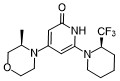
| DC22223 | SB02024 Featured |
SB02024 is a novel highly potent, selective, ATP competitive, orally active inhibitor of vacuolar protein sorting 34 (Vps34) with Kd of 1 nM, >1000 times selective towards other PI3K isoenzymes; SB02024 is also highly selective at 1 uM in the DiscoveRx ScanMax panel of 468 kinases; reduces the number of GFP-2xFYVE puncta with IC50 of 14 nM, induces a dose-dependent increase in levels of NCOA4 and p62; blocks autophagy in vitro and reduces xenograft growth of two breast cancer cell lines, MDA-MB-231 and MCF-7; also significantly potentiates cytotoxicity of Sunitinib and Erlotinib in MCF-7 and MDA-MB-231 in vitro.
More description
|
|
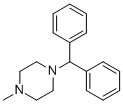
| DC47622 | Cyclizine Featured |
Cyclizine is a piperazine first-generation antagonist of histamine 1 receptor.
More description
|
|
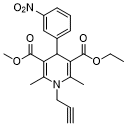
| DC20220 | MRS-1845 Featured |
MRS 1845 is a potent calcium channel protein inhibitor and inhibits capacitative Ca2+ influx in HL-60 cells (IC50 = 1.7 mM).
More description
|
|
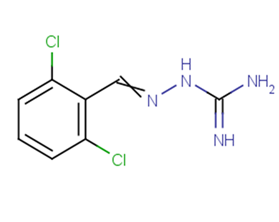
| DC21825 | Guanabenz Featured |
Guanabenz (WY 8678) is an α2 adrenergic receptor agonist that is used as an antihypertensive agent, also has been proposed to exert protective effects against misfolding by interfering with eIF2α-P dephosphorylation through selective disruption of a PP1-P
More description
|
|
| DC7232 | PI-103 Featured |
PI103 is a potent inhibitor with low IC50 values against recombinant PI3K isoforms p110alpha (IC50= 2 nM), p110beta (IC50= 3 nM), p110delta (IC50= 3 nM), and p110gamma (IC50= 15 nM), less potent to mTOR/DNA-PK with IC50 of 30 nM/23 nM.
More description
|

|
| DC28756 | J14 Featured |
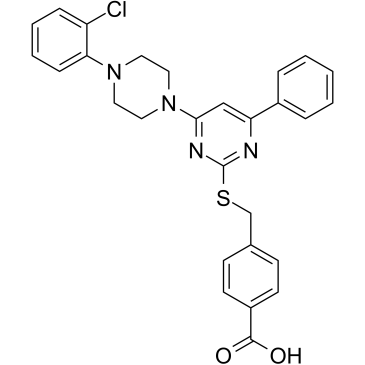
J14 is a reversible sulfiredoxin inhibitor with an IC50 of 8.1 μM. J14 induces oxidative stress (intracellular ROS accumulation) by inhibiting sulfiredoxin, leading to cytotoxicity and cancer cell death.
More description
|
|
| DC27007 | DDD107498 Featured |
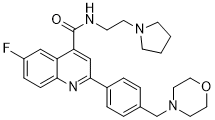
The product is discontinued. DDD107498, also known as DDD 498, is a multiple-stage antimalarial agent that inhibits protein synthesis. DDD107498 demonstrates potential to address a variety of clinical needs, including single-dose treatment, transmission blocking and chemoprotection. DDD107498 was developed from a screening programme against blood-stage malaria parasites; its molecular target has been identified as translation elongation factor 2 (eEF2), which is responsible for the GTP-dependent translocation of the ribosome along messenger RNA, and is essential for protein synthesis. This discovery of eEF2 as a viable antimalarial drug target opens up new possibilities for drug discovery.
More description
|
|
| DC10987 | LTX-315 |
This product is discontinued. LTX-315 (Oncopore) is a synthetic 9-mer anticancer peptide that preferentially permeabilizes mitochondrial membranes, thereby causing partially BAX/BAK1-regulated, caspase-independent necrosis.
More description
|

|
| DC7998 | ML 204 Featured |
ML 204 isa blocker of TRPC4 channels (IC50 values are 0.96 and 2.6 μM in fluorescent and electrophysiological assays, respectively).
More description
|

|
