 To enhance service speed and avoid tariff delays, we've opened a US warehouse. All US orders ship directly from our US facility.
| Cat. No. | Product Name | Field of Application | Chemical Structure |
|---|---|---|---|
| DC80076 | 447C88 |
447C88 is an acyl-coenzyme A cholesterol acyltransferase (ACAT) inhibitor with an IC50 of 23 nM. 447C88 can reduce plasma cholesterol levels and can be used in the research of endocrine and metabolic diseases such as hyperlipidemia.
More description
|

|
| DC80074 | 4-(2-Boc-aminoethyl)piperidine |
4-(2-Boc-aminoethyl)piperidine is a PROTAC linker that can be used in the synthesis of PROTACs.
More description
|
|
| DC80063 | 3'-Methoxy-4'-nitroflavone |
3'-Methoxy-4'-nitroflavone (MNF) is a specific aryl hydrocarbon receptor (AhR) antagonist. 3'-Methoxy-4'-nitroflavone activates AhR by inhibiting CYP1, the metabolic enzyme of the endogenous ligand FICZ, leading to the accumulation of FICZ. 3'-Methoxy-4'-nitroflavone reverses the anti-apoptotic effect of TCDD, attenuates the activation of Akt and Erk1/2 kinases and the expression of TGFα induced by TCDD. 3'-Methoxy-4'-nitroflavone can be used in research related to breast tumor promotion, rheumatoid arthritis, multiple sclerosis and inflammatory bowel disease.
More description
|
|
| DC80062 | 3'-Fluorothymidine-5'-triphosphate (tetrasodium) |
3'-Fluorothymidine-5'-triphosphate tetrasodium (3'-FdTTP tetrasodium) is a dTTP analog. 3'-Fluorothymidine-5'-triphosphate tetrasodium inhibits the T4 DNA polymerases competitively with dTTP. 3'-Fluorothymidine-5'-triphosphate tetrasodium inhibits DNA synthesis by T4 wild-type, L98 and CB121 DNA polymerase.
More description
|
|
| DC80059 | 3-Boc-aminomethylazetidine |
3-Boc-aminomethylazetidine is a PROTAC linker that can be used in the synthesis of PROTACs.
More description
|
|
| DC80051 | 3-(4-Carboxyphenyl)propanoic acid |
3-(4-Carboxyphenyl)propanoic acid is a PROTAC linker that can be used in the synthesis of PROTACs.
More description
|
|
| DC80049 | 3-(4-Bromobenzoyl)propionic acid |
3-(4-Bromobenzoyl)propionic acid is a PROTAC linker that can be used in the synthesis of PROTACs.
More description
|
|
| DC80048 | 2α-Ferrocenylmethyl-DHT |
2α-Ferrocenylmethyl-DHT is a dihydrotestosterone-derived ferrocene-steroid conjugate. 2α-Ferrocenylmethyl-DHT inhibits the growth of various cancer cells. 2α-Ferrocenylmethyl-DHT induces S-phase cell cycle arrest in ovarian cancer cells, elevates intracellular iron levels, triggers ROS-dependent cell death, and disrupts the integrity of multicellular tumor spheroids of ovarian cancer cells. 2α-Ferrocenylmethyl-DHT can be used in the research of prostate cancer and ovarian cancer.
More description
|
|
| DC80047 | 2-Tetralone |
2-Tetralone (Beta-Tetralone) is a pro-apoptosis agent. 2-Tetralone targets MDM2 E3 ubiquitin kinase and Bcl-w anti-apoptotic protein and exhibits anticancer activity.
More description
|
|
| DC80037 | 2-Chloro-1,3-propanediol-13C3 |
2-Chloro-1,3-propanediol-13C3 is the 13C-labeled 2-Chloro-1,3-propanediol. 2-Chloro-1,3-propanediol is an ester product.
More description
|
|
| DC80034 | 2-Boc-2,6-Diazaspiro[3.3]heptane hemioxalate |
2-Boc-2,6-Diazaspiro[3.3]heptane (hemioxalate) is a PROTAC linker that can be used in the synthesis of PROTACs.
More description
|
|
| DC80021 | 2-(Aminooxy)ethanamine dihydrochloride |
2-(Aminooxy)ethanamine (dihydrochloride) is a PROTAC linker that can be used in the synthesis of PROTACs.
More description
|
|
| DC79993 | 1-Boc-4-cyanopiperidine |
1-Boc-4-cyanopiperidine is a PROTAC linker that can be used in the synthesis of PROTACs.
More description
|
|
| DC79992 | 1-Boc-4-bromomethylpiperidine |
1-Boc-4-bromomethylpiperidine is a PROTAC linker that can be used in the synthesis of PROTACs.
More description
|
|
| DC79986 | 13-Hydroxy-alpha-tocopherol |
13-Hydroxy-alpha-tocopherol is a fat-soluble vitamin E derivative and anticancer agent with antioxidant and antiproliferative activities. 13-Hydroxy-alpha-tocopherol scavenges peroxyl free radicals and protects polyunsaturated fatty acids from oxidative damage. 13-Hydroxy-alpha-tocopherol not only inhibits the growth of glioma cancer cells, but its deficiency is also closely associated with recurrent miscarriage, embryonic growth retardation and death. Clinical observations show that the expression of 13-Hydroxy-alpha-tocopherol is downregulated in the follicular fluid of patients with recurrent miscarriage. 13-Hydroxy-alpha-tocopherol has important application potential in the research of recurrent miscarriage and glioma.
More description
|
|
| DC79985 | 13-cis Acitretin |
13-cis Acitretin (Isoacitretin; Ro 13-7652) is a retinoid and the major in vivo metabolite of etretinate. 13-cis Acitretin is formed via in vivo isomerization of etretinate. 13-cis Acitretin serves as the primary metabolite in blood.
More description
|
|
| DC79973 | 1,4-Bis(2-bromoethoxy)benzene |
1,4-Bis(2-bromoethoxy)benzene is a PROTAC linker that can be used in the synthesis of PROTACs.
More description
|
|
| DC79956 | 1,3-Bis-aminooxy propane dihydrochloride |
1,3-Bis-aminooxy propane dihydrochloride is an alkyl chain-based PROTAC linker that can be used in the synthesis of PROTACs.
More description
|
|
| DC79925 | (S)-IP-DK143 |
(S)-IP-DK143 is a polymeric micellar formulation. (S)-IP-DK143 inhibits the proliferation of cervical cancer cells, induces ROS-mediated apoptosis, and triggers mitochondrial dysfunction. (S)-IP-DK143 activates the p38 MAPK signaling pathway in cervical cancer cells, increases the phosphorylation level of p38, and slightly reduces the phosphorylation level of ERK. (S)-IP-DK143 can be used for the research of cervical cancer.
More description
|
|
| DC79922 | (S)-5-HT2CR agonist 1 |
(S)-5-HT2CR agonist 1 (Compound (S)-16k) is selective 5-HT2CR agonist, with an EC50 of 14 nM. FXa-IN-2 can be used in the research of hyperlocomotion.
More description
|
|
| DC79907 | (R)-LY-41 |
(R)-LY-41, R-enantiomer of LY-41, is 2-Sminotetralin derivative and 8-OH-DPAT analogue. (R)-LY-41 is a potent and selective 5-HT1A receptor agonist. (R)-LY-41 can reduce the accumulation of 5-hydroxytryptophan (the precursor for 5-HT synthesis) in the rat brain induced by decarboxylase inhibitors (NSD 1015). (R)-LY-41 can lower the body temperature of rats and inhibit the escape response from the cage. (R)-LY-41 can induce the 5-HT behavioral syndrome but is weaker than (S)-LY-41. (R)-LY-41 can be used for the research of neurological disease, such as depression and anxiety.
More description
|
|
| DC79905 | (R)-AM-1638 |
(R)-AM-1638 is a R-isomer of AM-1638. AM-1638 is an orally active full agonist of GPR40 (EC50: 0.16 μM).
More description
|
|
| DC79903 | (R)-5-OH-DPAT |
(R)-5-OH-DPAT ((R)-5-Hydroxy-DPAT) is the R-enantiomer of 5-OH-DPAT. 5-OH-DPAT is a weak antagonist of the dopamine D2 receptor (dopamine D2-receptor). 5-OH-DPAT moderately promotes sexual behavior in male rats.
More description
|
|
| DC79896 | (7α,24S)-7,24-Dihydroxycholest-4-en-3-one |
(7α,24S)-7,24-Dihydroxycholest-4-en-3-one is an oxysterol.
More description
|
|
| DC79892 | (4-Bromobutoxy)benzene |
(4-Bromobutoxy)benzene is a PROTAC linker that can be used in the synthesis of PROTACs.
More description
|
|
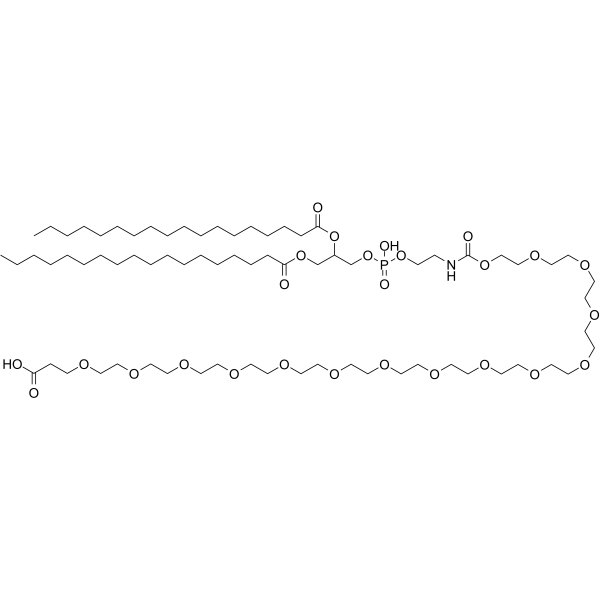
| DC44401 | DSPE-PEG14-COOH Featured |
DSPE-PEG14-COOH is a PEG-based PROTAC linker that can be used in the synthesis of PROTACs.
More description
|
|
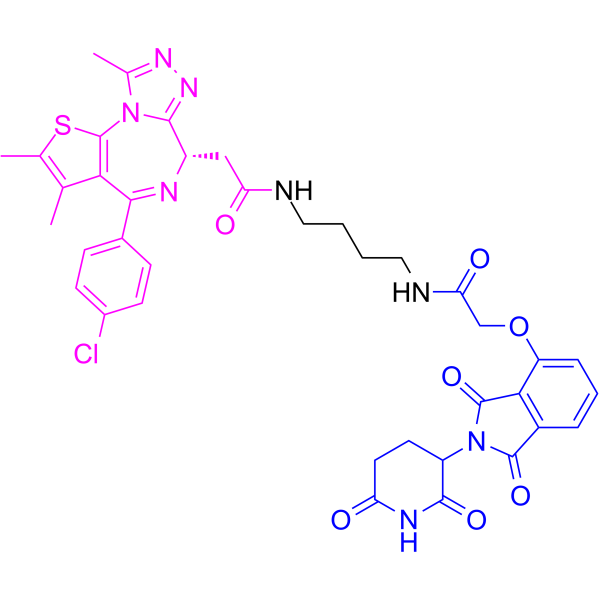
| DC12023 | dBET1 Featured |
dBET1 is a potent BRD4 protein degrader based on PROTAC technology with an EC50 of 430 nM.
More description
|
|
| DC65211 | KT-474 Featured |
KT-474 is a highly active and selective, orally bioavailable IRAK4 degrader being developed for the treatment of toll-like receptor (TLR)/interleukin-1 receptor (IL-1R)-driven immune-inflammatory diseases.
More description
|

|
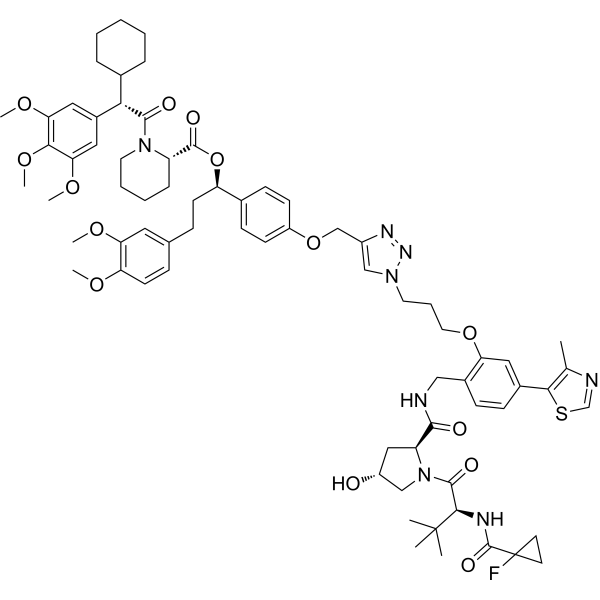
| DC74514 | SelDeg51 Featured |
SelDeg51 (Selective Degrader of FKBP51) is a potent, selective FKBP51 PROTAC with Kd of 18 nM, Emax=90%.
More description
|
|
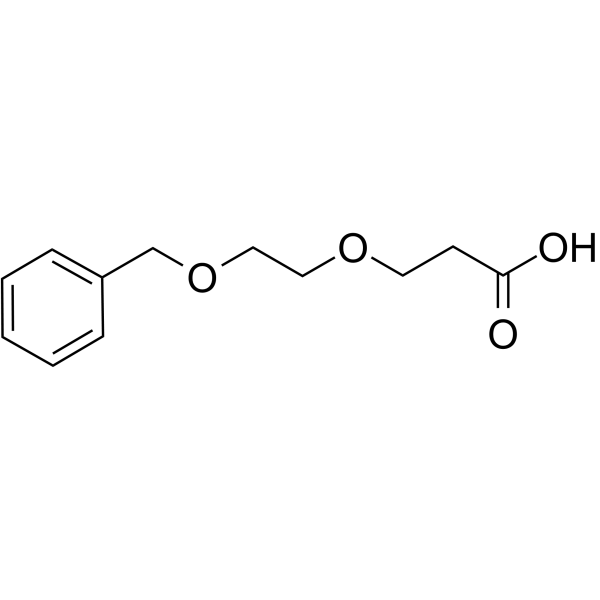
| DC44016 | Benzyl-PEG2-acid Featured |
Benzyl-PEG2-acid is a PEG-based PROTAC linker that can be used in the synthesis of PROTACs.
More description
|
|
