 To enhance service speed and avoid tariff delays, we've opened a US warehouse. All US orders ship directly from our US facility.
| Cat. No. | Product Name | Field of Application | Chemical Structure |
|---|---|---|---|
| DC71539 | Pinokalant |
Pinokalant is a broad-spectrum and non-selectivecation channel inhibitor. Pinokalant significantly reduces cortical infarct volume. Pinokalant o improves the metabolic and electrophysiologic status of the ischemic penumbra. Pinokalant reduces lesion size on magnetic resonance images in the acute phase following middle cerebral artery occlusion in rats. Pinokalant has the potential for the research of stroke. Pinokalant also shows anti-SARS-CoV-2 activity.
More description
|

|
| DC7998 | ML 204 Featured |
ML 204 isa blocker of TRPC4 channels (IC50 values are 0.96 and 2.6 μM in fluorescent and electrophysiological assays, respectively).
More description
|

|
| DC7262 | Optovin Featured |
Optovin is a reversible photoactive TRPA1 activator.
More description
|

|
| DC71170 | AMG9678 |
AMG9678 is a potent, selective, orally active antagonist of TRPM8 with an IC50 of 31.2 nM.
More description
|
|
| DC71169 | AMG8788 |
AMG8788 is a potent, selective, orally active antagonist of TRPM8 with an IC50 of 63.2 nM.
More description
|
|
| DC71040 | FEMA 4809 |
FEMA 4809 is a TRPM8 receptor agonist (EC50=0.2 nM) for use as a cooling agent. TRPM8 is the ion channel responsible for the cool perception.
More description
|
|
| DC70999 | A-784168 |
A-784168 is a potent and orally active inhibitor of vanilloid receptor type 1 (TRPV1). Vanilloid receptor type 1 (TRPV1) is a ligand-gated nonselective cation channel that is considered to be an important integrator of various pain stimuli such as endogenous lipids, capsaicin, heat, and low pH. A-784168 has good CNS penetration.
More description
|
|
| DC70982 | (E)-4-Oxo-2-nonenal |
(E)-4-Oxo-2-nonenal (4-ONE) is one of the major hemolytic decomposition products of lipid hydroperoxides. (E)-4-Oxo-2-nonenal is a major product of the FeII-mediated breakdown of lipid hydroperoxides. (E)-4-Oxo-2-nonenal is a potent transient receptor potential ankyrin 1 (TRPA1) agonist.
More description
|
|
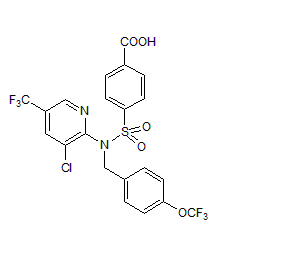
| DC8306 | RQ-00203078 Featured |
RQ-00203078 is a potent TRPM8 antagonist (IC50 values are 5.3 and 8.3 nM for rat and human channels respectively).
More description
|
|
| DC9722 | SKF96365 Featured |
SKF96365 is blocker of TRP cation channels. Inhibits capacitative Ca2+ entry.
More description
|

|
| DC11472 | TRPM8 antagonist 14 Featured |
TRPM8 Antagonist is a potent and selective TRPM8 antagonist, with an IC50 of 0.2 nM, used in the research of neuropathic pain syndromes.
More description
|

|
| DC70827 | tatM2NX |
tatM2NX is a novel potent, selective, cell permeable, peptide TRPM2 channel antagonist with IC50 of 396 nM, IC90 of 2 uM (TRPM2 channel currents), prevents ligand binding and TRPM2 activation.tatM2NX interacts with the ADPR binding site on the NUT9-H domain of TRPM2 channel. tatM2NX inhibits TRPM2-mediated dephosphorylation of GSK3β (activation), tatM2NX demonstrated selective neuroprotective effects in a mouse model of focal ischemia (stroke).
More description
|
|
| DC70774 | SH045 |
SH045 (SH-045, Larixyl-6-N-methylcarbamate) is a potent, selective TRPC6 antagonist (blocker) with IC50 of 63 nM.SH045 displays 13-fold subtype selectivity over TRPC3 in stably expressing HEK293 cells.Treatment of isolated perfused lung preparations with SH045 led to a decrease in lung ischemia-reperfusion edema (LIRE), a life-threatening condition associated with TRPC6 that may occur after organ transplantation.
More description
|
|
| DC70736 | RGM8-51 |
RGM8-51 is a β-lactam derivative, potent, selective TRPM8 antagonist with IC50 of 1.06 and 1.74 uM for rat and human TRPM8, respectively.RGM8-51 does not have any ability to activate TRPM8 channels, but produces a concentration-dependent inhibition of menthol activation.RGM8-51 is selective for cold-activated TRPM8 channels, displays no agonist or antagonist profile in cool-activated TRPA1 channels and has negligible activity as TRPV3 and ASIC3 channel antagonists.RGM8-51 (1 µM) inhibited menthol-activated currents in rTRPM8-expressing HEK293 cells.RGM8-51 exhibits in vivo antinociceptive activity in response to cold, in a mouse model of oxaliplatin-induced peripheral neuropathy.RGM8-51 reduces cold, mechanical and heat hypersensitivity in a rat model of neuropathic pain arising after chronic constriction of the sciatic nerve.RGM8-51 exhibits mechanical hypersensitivity-relieving activity, in a mouse model of NTG-induced hyperesthesia.
More description
|
|
| DC70604 | ML2-SA1 |
ML2-SA1 is a potent, selective and efficacious activator (agonist) of TRPML2 with EC50 of 1.24 uM and 2.38 uM for human and mouse TRPML2, respectively.ML2-SA1 displays high selectivity for TRPML2 and no significant activity at the related TRPML1 and TRPML3 channels.ML2-SA1 directly stimulates release of the chemokine CCL2 from macrophages, also stimulates macrophage migration, thus mimicking CCL2 function.
More description
|
|
| DC70603 | ML204 hydrochloride |
ML204 is a potent, selective antagonist of TRPC4 and TRPC5 channels, inhibits TRPC4β-mediated intracellular Ca(2+) rise with IC50 of 0.96 uM, exhibits 19-fold selectivity against TRPC6 channel; blocks TRPC4β currents activated through either μ-opioid receptor stimulation (50 nm DAMGO, IC50=3.55 uM) or intracellular dialysis of GTPγS (IC50=2.85 uM); shows no appreciable block by 10-20 uM for TRPV1, TRPV3, TRPA1, and TRPM8, as well as KCNQ2 and Nav Channels; also inhibits TRPC5 channel currents activated through co-stimulation of Gi/o and Gq/11 signaling by μ-opioid and M3-like muscarinic receptors.
More description
|
|
| DC70544 | KPR-5714 |
KPR-5714 (KPR5714) is a novel potent, selective TRPM8 antagonist with IC50 of 25.3 and 22.4 nM against hTRPM8 and rTRPM8, respectively.KPR-5714 dispalys 400-fold against human TRPA1, TRPV1, and TRPV4, and does not show inhibitory effects for ASIC1a, ASIC3, Nav1.3, Nav1.5, Nav1.6, Nav1.7, and Nav1.8 (IC50 values >10 uM).KPR-5714 (i.p.) inhibited the hyperactivity of mechanosensitive C-fibers of bladder afferents and dose-dependently increased the intercontraction interval shortened by intravesical instillation of acetic acid in anesthetized rats.KPR-5714 (orally administered) dose-dependently increased the mean voided volume and decreased voiding frequency without affecting total voided volume in vivo.
More description
|
|
| DC70531 | JW-65 |
JW-65 (JW65) is a selective, potent,CNS-permeable TRPC3 inhibitor improved stability compared to Pyr3.JW-65 shows similar potency and selectivity on TRPC3 channels, but is metabolically much more stable than its precursor, demonstrated by its much longer half-life (>4 h) in mouse, rat, and human liver microsomes when compared to Pyr3.JW-65-treated mice showed substantially decreased susceptibility to PTZ-induced seizures in a dose-dependent manner.
More description
|
|
| DC70451 | GSK205 derivative 16-8 |
GSK205 derivative 16-8 is a specific small molecule dual-inhibitor of TRPV4 and TRPA1 with IC50 of 0.45 and 0.41 uM, respectively; displays no inhibitory potency toward TRPV1, TRPV2 and TRPV3; effectively attenuates formalin-evoked trigeminal irritant pain in model of acute pancreatitis.
More description
|
|
| DC70297 | CDD-1102 |
CDD-1102 (CDD1102) is a potent, selective second bromodomain (BD2) of BRDT and BRD4 inhibitor with IC50 of 7 and 25 nM, >1,000-fold and 300-fold selectivity over BRDT-BD1 and BRD4-BD1.
More description
|
|
| DC70187 | AM237 |
AM237 is a selective TRPC5 channel activator that potently activated homomeric TRPC5:C5 channels (EC50=15–20 nM in Ca2+i assays).AM237 did not activate TRPC4:C4, TRPC4-C1, TRPC5-C1, TRPC1:C5, and TRPC1:C4 channels, or native TRPC1:C4 channels in A498 cells, but potently inhibited EA‐dependent activation of these channels with IC50 values ranging from 0.9 to 7 nM.AM237 (300 nM) did not activate or inhibit TRPC3, TRPC6, TRPV4, or TRPM2 channels.AM237 potentiated TRPC5:C5 channels activation by sphingosine‐1‐phosphate but suppressed activation evoked by (−)‐englerin A (EA).AM237 concentration‐dependently suppressed further activation of Ca2+ influx mediated by EA with IC50 of 13 nM, potentiated TRPC5:C5 activation by S1P.Pico145 is a competitive antagonist of AM237‐mediated TRPC5:C5 activation.
More description
|
|
| DC70078 | GSK 2833503A |
GSK 2833503A (GSK2833503A, GSK503A) is a potent, and selective inhibitor of TRPC3/6 channels with IC50 of 4 nM/5 nM, respectively.
More description
|
|
| DC10865 | GSK2193874 Featured |
GSK2193874 is an orally active, potent, and selective TRPV4 antagonist with IC50 of 2 nM and 40 nM for rTRPV4 and hTRPV4.
More description
|

|
| DC49717 | TRPC5-IN-3 |
TRPC5-IN-3 is a potent TRPC5 inhibitor with IC50 of 10.75 nM (WO2022001767A1, L001).
More description
|
|
| DC49716 | (1R,2R)-ML-SI3 |
(1R,2R)-ML-SI3 is a potent inhibitor of both TRPML1 and TRPML2 (IC50 values of 1.6 and 2.3 μM) and a weak inhibitor (IC50 12.5 μM) of TRPML3.
More description
|
|
| DC49715 | TRPC5-IN-2 |
TRPC5-IN-2 is a potent TRPC5 inhibitor (WO2019055966A2, Compound IO).
More description
|
|
| DC49714 | TRPC5 modulator-1 |
TRPC5 modulator-1 (Compound 9) is a TRPC5 modulator with an IC50 of <1 nM for the research of neuropsychiatry disorders.
More description
|
|
| DC49713 | N-Oleoyldopamine |
N-Oleoyldopamine (OLDA) is a product of condensation of oleic acid and dopamine (DA) and an endogenous TRPV1 selective agonist. N-Oleoyldopamine (OLDA) can crosses the blood-brain barrier. N-oleoyl-dopamine protects the heart against ischemia-reperfusion injury via activation of TRPV1.
More description
|
|
| DC11508 | AC1903 Featured |
AC1903 is a specific and selective inhibitor of TRPC5 and has podocyte-protective properties. AC1903 does no effects on TRPC4 or TRPC6 currents and shows no off-target effects in kinase profiling assays. AC1903 suppresses severe proteinuria and prevents podocyte loss in focal segmental glomerulosclerosis (FSGS) rat model.
More description
|

|
| DC48776 | TRPC5-IN-1 |
TRPC5-IN-1 (Compound 6j) is a selective TRPC5 inhibitor with 50.5 % Inhibition for TRPC5 at 3 μM. TRPC5-IN-1 can be used for the research of chronic kidney disease (CKD).
More description
|
|
