 To enhance service speed and avoid tariff delays, we've opened a US warehouse. All US orders ship directly from our US facility.
| Cat. No. | Product Name | Field of Application | Chemical Structure |
|---|---|---|---|
| DC74311 | HLQ2H Featured |
HLQ2H (Msi3 inhibitor 2H) is a first-in-class, specific inhibitor of fungal Hsp110 molecular chaperone Msi3, inhibits the holdase activity of Msi3 (IC50=5.02 uM) as well as the growth and viability of C. albicans.
More description
|

|
| DC74557 | PREX-in1 Featured |
PREX-in1 is a specific small-molecule inhibitor of P-Rex1 and P-Rex2 Rac-GEF activity with IC50 of 4.5 uM (P-Rex1 DHPH Rac-GEF activity) in liposome-based GEF assay, inhibits P-Rex1 and P-Rex2 through their catalytic DH domain.
More description
|

|
| DC22062 | SSR125543 Featured |
SSR125543 (Crinecerfont, SSR-125543) is a potent, nonpeptide, orally active corticotropin-releasing factor (CRF) receptor CRF1 antagonist, shows anxiolytic- and antidepressant-like activities in vivo. .
More description
|

|
| DC60152 | SHIN2 Featured |
SHIN-2 is a novel SHMT inhibitor, increasing survival in NOTCH1-driven mouse primary T-ALL in vivo
More description
|

|
| DC10319 | GLP-1(7-36), amide Featured |
GLP-1(7-36), amide is a physiological incretin hormone that stimulates insulin secretion.
More description
|

|
| DC10547 | X-376 Featured |
X-376 is a highly selective and potent inhibitor of ALK (anaplastic lymphoma kinase) tyrosine kinase, demonstrating strong activity with an IC50 of 0.61 nM. While it primarily targets ALK, it also exhibits inhibitory effects on MET kinase, though with slightly reduced potency (IC50 = 0.69 nM). Due to its robust kinase-blocking properties, X-376 shows significant anti-tumor efficacy, making it a promising candidate for cancer research and therapeutic development.
More description
|

|
| DC31351 | X396 Featured |
Ensartinib, also known as X-396, is an orally available small molecule inhibitor of the receptor tyrosine kinase anaplastic lymphoma kinase (ALK) with potential antineoplastic activity. Upon oral administration, X-396 binds to and inhibits ALK kinase, ALK fusion proteins and ALK point mutation variants. Inhibition of ALK leads to the disruption of ALK-mediated signaling and eventually inhibits tumor cell growth in ALK-expressing tumor cells. ALK belongs to the insulin receptor superfamily and plays an important role in nervous system development.
More description
|

|
| DC44000 | J-2156 TFA Featured |
J-2156 TFA is a high potent, selective somatostatin receptor type 4 (SST4 receptor) agonist with IC50s of 0.05 nM and 0.07 nM for human and rat SST4 receptors, respectively. J-2156 TFA is used for the relief of mechanical allodynia and mechanical hyperalg
More description
|

|
| DC32856 | Devazepide Featured |
Devazepide is a potent, and orally active CCK1 (CCK-A) receptor antagonist that displays appetite-stimulant effects. It blocks the anorectic response to CCK-8 and increases food intake in rats following systemic and i.c.v administration.
More description
|

|
| DC70585 | MBX3132 Featured |
MBX3132 is a small mocule inhibitor of AcrB multidrug efflux pump, fully potentiates the activity of a broad range of antibiotics at 0.1 uM; does not exhibit membrane-disrupting or antibacterial activity.
More description
|

|
| DCC0689 | Aqf026 Featured |
Novel agonist of the water channel aquaporin-1 (AQP1)
More description
|

|
| DC40289 | VU0238441 Featured |
VU0238441 is a pan muscarinic acetylcholine receptor (mAChR) positive allosteric modulator (PAM) with EC50s of 3.2 μM, 2.8 μM, 2.2 μM, 2.1 μM, >10 μM for M1, M2, M3, M5 and M4, respectively.
More description
|
.gif)
|
| DC67437 | PI-2620 precursor Featured |
PI-2620 precursor is the precursor of PI2620. 18F-PI-2620 is a PET tracer with high binding affinity for aggregated tau, a key pathologic feature of Alzheimer disease (AD) and other neurodegenerative disorders.
More description
|

|
| DC72886 | Dox-btn2 Featured |
Dox-btn2 is a biotinylated derivative of Doxorubicin, with a biotin label at the point of conjugation to doxorubicin at 3'-NH2. Dox-btn2 can be used for cell imaging. While Doxorubicin is mainly accumulated in the nucleus, while Dox-btn2 is mainly located in the cytoplasm.
More description
|

|
| DC7010 | Cyclosporin H Featured |
A potent inhibitor of tumor promoting phorbol ester TPA/PMA and inhibitor of Ca2+/calmodulin dependent EF-2 phosphorylation
More description
|

|
| DC47425 | ProSeAM Featured |
ProSeAM is a chemical tool for methylome analysis.
More description
|

|
| DC60844 | Oleyl Bromide Featured |
Oleyl bromide ((Z)-1-Bromooctadec-9-ene) is a hydrophobic compound that can carry out ring-opening reaction through a process called "encapsulation". Oleyl bromine can also be used as the starting material in the synthesis of oleylphosphonates.
More description
|

|
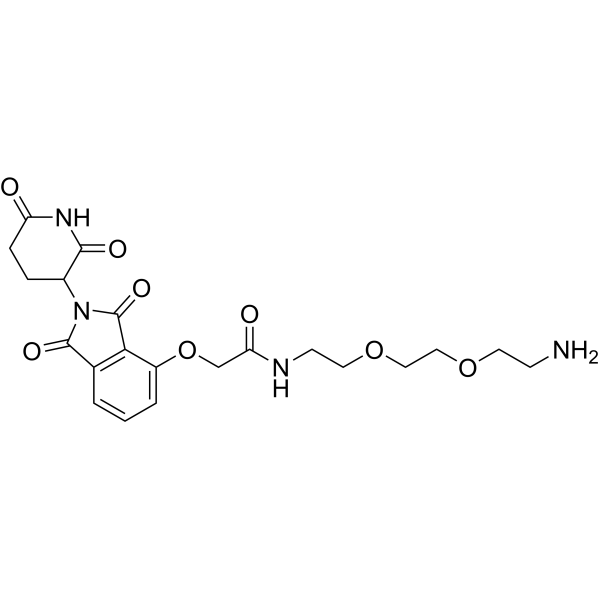
| DC11574 | E3 Ligand-Linker Conjugate 8 Featured |
E3 Ligand-Linker Conjugate 8 is a bifunctional compound combining an E3 ubiquitin ligase-binding moiety with a flexible linker, demonstrating potential as an immunomodulatory agent for cancer research applications.
More description
|
|
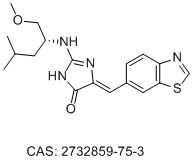
| DC74386 | Leucettinib-21 Featured |
Leucettinib-21 is a highly selective and potent dual inhibitor targeting both DYRK and CLK kinase families. It demonstrates nanomolar-level inhibitory activity, with IC50 values of 2.4 nM (DYRK1A), 6.7 nM (DYRK1B), 12 nM (CLK1), 33 nM (CLK2), and 5 nM (CLK4), respectively. This compound exhibits remarkable kinase selectivity, making it a valuable pharmacological tool for studying these kinase-mediated pathways.
More description
|
|
| A1060 | Muromonab Biosimilar(Anti-CD3 Reference Antibody) Featured |
Muromonab is a monoclonal antibody targeting the CD3 receptor. Muromonab can block all cytotoxic T cell function. Muromonab also as an immunosuppressant agent given to reduce acute solid organ transplant rejection.
More description
|

|
| A1059 | Atoltivimab Biosimilar(Anti-EBOV Reference Antibody) Featured |
Atoltivimab (REGN3470), or maftivimab/odesivimab (Inmazeb) is the first Food and agent Administration (FDA)-approved monoclonal antibody to target Zaire ebolavirus (EBOVs) infection.
More description
|

|
| A736 | Ivonescimab Biosimilar Featured |
Ivonescimab (AK112) is a PD-1/VEGF Bispecific Antibody. Ivonescimab can be used for cancer research.
More description
|

|
| A1058 | Navivumab Biosimilar(Anti-HA Reference Antibody) Featured |
Navivumab (CT-P23) is an influenza A virus hemagglutinin HA monoclonal antibody. neutralizes H1, H2, H5, and H9 influenza A viruses by binding to the stem fusion domain in HA2.
More description
|

|
| A1057 | Anti-IAV Reference Antibody Biosimilar Featured |

|
|
| A1056 | Odesivimab Biosimilar(Anti-Zaire Ebola virus Reference Antibody) Featured |
Odesivimab is a human monoclonal antibody, targeting Ebola virus glycoprotein with a KD value of 7.74 nM for recombinant histidine-tagged Makona strain Ebola virus glycoprotein ectodomain protein. Odesivimab can be used in research of Ebola virus infection.
More description
|

|
| A1055 | Cosfroviximab Biosimilar(Anti-Zaire Ebola virus Reference Antibody) Featured |
Cosfroviximab (c13C6-FR1) is a mouse/human chimeric monoclonal antibody against Ebola virus glycoprotein (EBOV-GP).
More description
|

|
| A1054 | Porgaviximab Biosimilar(Anti-Zaire Ebola virus Reference Antibody) Featured |
Porgaviximab is a monoclonal antibody that can be used Ebola infection research.
More description
|

|
| A1053 | Larcaviximab Biosimilar(Anti-Zaire Ebola virus Reference Antibody) Featured |
Larcaviximab (c4G7-N) is an IgG1 kappa anti-Ebola virus glycoprotein chimeric monoclonal antibody.
More description
|

|
| A1052 | Romlusevimab Biosimilar(Anti-Spike RBD Reference Antibody) Featured |
Romlusevimab (BRII-198) is a neutralizing recombinant human IgG1 monoclonal antibody against the spike protein of severe acute respiratory syndrome coronavirus 2 (SARS-CoV-2).
More description
|

|
| A1051 | Cilgavimab Biosimilar(Anti-Spike RBD Reference Antibody) Featured |
Cilgavimab (AZD-1061; COV2-2130) is a human SARS-CoV-2-neutralizing monoclonal antibody, can compose monoclonal-antibody combination AZD7442 with Tixagevimab (HY-P99556). Cilgavimab shows protective action on mouse models of SARS-CoV-2 infection.
More description
|

|
