 To enhance service speed and avoid tariff delays, we've opened a US warehouse. All US orders ship directly from our US facility.
| Cat. No. | Product Name | Field of Application | Chemical Structure |
|---|---|---|---|
| DC8767 | GSK256066 Featured |
GSK256066 is a selective PDE4B(equal affinity to isoforms A-D) inhibitor with IC50 of 3.2 pM, >380,000-fold selectivity versus PDE1/2/3/5/6 and >2500-fold selectivity against PDE4B versus PDE7.
More description
|

|
| DC9579 | Nortadalafil Featured |
Nortadalafil is demethyl Tadalafil, which is a PDE5 inhibitor, currently marketed in pill form for treating erectile dysfunction (ED) under the name Cialis; and under the name Adcirca for the treatment of pulmonary arterial hypertension.
IC50 value:
Ta
More description
|

|
| DC11518 | Cavosonstat Featured |
Cavosonstat is a potent, orally bioavailable inhibitor of S-nitrosoglutathione reductase (GSNOR) and CFTR modulator.
More description
|

|
| DC11338 | MMP-2/MMP-7 Fluorogenic Substrate Control Featured |
Mca-PL is a fluorogenic peptide that has been used as a building block in the synthesis of Mca-PLGL-Dpa-AR-NH2, a fluorogenic substrate for matrix metalloproteinase-2 (MMP-2) and MMP-7.
More description
|

|
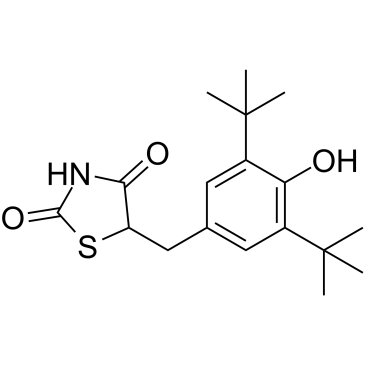
| DC28781 | NL-1 Featured |
NL-1 is a mitoNEET inhibitor with antileukemic effect. NL-1 inhibits REH and REH/Ara-C cells growth with IC50s of 47.35 µM and 56.26 µM, respectively. NL-1-mediated death in leukemic cells requires the activation of the autophagic pathway.
More description
|
|
| DC28198 | RHC 80267 Featured |
RHC 80267 (U-57908) is a potent and selective inhibitor of diacylglycerol lipase (DAGL) (with IC50 of 4 μM in canine platelets). RHC-80267 inhibits cholinesterase activity with an IC50 of 4 μM, thereby enhancing the relaxation evoked by acetylcholine. RHC 80267 also inhibits COX and the hydrolysis of phosphatidylcholine (PC).
More description
|

|
| DC28481 | (E/Z)-BCI(DUSP6 inhibitor) Featured |
(E/Z)-BCI (NSC 150117) is a dual-specificity phosphatase 6 (DUSP6) inhibitor with anti-inflammatory activities. (E/Z)-BCI attenuates LPS-induced inflammatory mediators and ROS production in macrophage cells via activating the Nrf2 signaling axis and inhibiting the NF-κB pathway.
More description
|

|
| DC11304 | A939572 Featured |
A939572 is a potent, and orally bioavailable SCD1 inhibitor with IC50 values of <4 nM and 37 nM for mSCD1 and hSCD1, respectively.
More description
|

|
| DC11857 | BAY-8040 (R) Featured |
Bay-8040 is a potent, selective human neutrophil elastase (HNE) inhibitor with IC50 of 28 nM; displays no significant inhibition toward 68 other pharmacologically relevant targets (>10 uM), and a panel of related serine proteases; shows in vivo efficacy with regard to decreasing cardiac remodeling and amelioration of cardiac function in monocrotaline-induced rat model for pulmonary arterial hypertension.
More description
|

|
| DC49409 | Glucose oxidase |
Glucose oxidase is used in the food and beverage industry as a preservative and stabilizer and is commonly derived from the fungus Aspergillus niger. Glucose oxidase can react with intracellular glucose and oxygen (O2) to produce hydrogen peroxide (H2O2) and gluconic acid, which can cut off the nutrition source of cancer cells and consequently inhibit their proliferation.
More description
|
|
| DC49398 | Hippuric acid-15N |
Hippuric acid-15N (2-Benzamidoacetic acid-15N) is the 15N-labeled Hippuric acid. Hippuric Acid (2-Benzamidoacetic acid), an acyl glycine produced by the conjugation of benzoic acid and glycine, is a normal component in urine as a metabolite of aromatic compounds from food.
More description
|
|
| DC49383 | Pheniprazine |
Pheniprazine is a potent and long acting inhibitor of monoamine oxidase. Pheniprazine has the potential for the research of depression.
More description
|
|
| DC49380 | L-Tyrosine-17O |
L-Tyrosine-17O is the 17O-labeled L-Tyrosine. L-Tyrosine is a non-essential amino acid which can inhibit citrate synthase activity in the posterior cortex.
More description
|
|
| DC49378 | rel-Tranylcypromine |
rel-Tranylcypromine (SKF 385) is a potent monoamine oxidase (MAO) inhibitor.
More description
|
|
| DC49369 | Endothall |
Endothall (Endothal) is a protein phosphatase 2A (PP2A) inhibitor with IC50s of 90 nM and 5 µM for PP2A and PP1, respectively. Endothall can be used as an herbicide. Endothall also is useful in cancer chemotherapy.
More description
|
|
| DC49363 | L-Tyrosine-4-13C |
L-Tyrosine-4-13C is the 13C-labeled L-Tyrosine. L-Tyrosine is a non-essential amino acid which can inhibit citrate synthase activity in the posterior cortex.
More description
|
|
| DC49362 | L-Tyrosine-1-13C |
L-Tyrosine-1-13C is the 13C-labeled L-Tyrosine. L-Tyrosine is a non-essential amino acid which can inhibit citrate synthase activity in the posterior cortex.
More description
|
|
| DC49361 | L-Tyrosine-13C |
L-Tyrosine-13C is the 13C-labeled L-Tyrosine. L-Tyrosine is a non-essential amino acid which can inhibit citrate synthase activity in the posterior cortex.
More description
|
|
| DC49352 | Valienamine |
Valienamine is the alpha-glucosidase inhibitor. Valienamine is the key functional component of many natural glycosidase inhibitors including the crop protectant validamycin A and the antidiabetic agent acarbose.
More description
|
|
| DC49345 | Octanoic acid-13C |
Octanoic acid-13C (Caprylic acid-13C) is the 13C labeled Octanoic acid. Octanoic acid (Caprylic acid) is an oily liquid with a slightly unpleasant rancid taste and used commercially in the production of esters used in perfumery and also in the manufacture of dyes.
More description
|
|
| DC49344 | L-Tyrosine-3,5-13C2 |
L-Tyrosine-3,5-13C2 is the 13C-labeled L-Tyrosine. L-Tyrosine is a non-essential amino acid which can inhibit citrate synthase activity in the posterior cortex.
More description
|
|
| DC49335 | L-Lysine-15N-1 dihydrochloride |
L-Lysine-15N-1 dihydrochloride is the 15N-labeled L-Lysine. L-lysine is an essential amino acid with important roles in connective tissues and carnitine synthesis, energy production, growth in children, and maintenance of immune functions.
More description
|
|
| DC49324 | L-Histidine-15N hydrochloride hydrate |
L-Histidine-15N (H-His-OH-15N) hydrochloride hydrate is the 15N-labeled L-Histidine hydrochloride hydrate. L-Histidine hydrochloride hydrate (H-His-OH.HCl.H2O) is an endogenous metabolite.
More description
|
|
| DC49323 | L-Histidine-15N3 hydrochloride hydrate |
L-Histidine-15N3 (H-His-OH-15N3) hydrochloride hydrate is the 15N-labeled L-Histidine hydrochloride hydrate. L-Histidine hydrochloride hydrate (H-His-OH.HCl.H2O) is an endogenous metabolite.
More description
|
|
| DC49322 | (S)-L-Cystine-15N2 |
(S)-L-Cystine-15N2 is the 15N-labeled L-Cystine. L-Cystine is an amino acid and intracellular thiol, which plays a critical role in the regulation of cellular processes.
More description
|
|
| DC49316 | L-Ornithine-15N2 hydrochloride |
L-Ornithine-15N2 hydrochloride is the 15N-labeled L-Ornithine hydrochloride. L-Ornithine hydrochloride is a free amino acid that plays a central role in the urea cycle and is also important for the disposal of excess nitrogen.
More description
|
|
| DC49300 | Stephacidin B |
Stephacidin B is a fungal metabolite. Stephacidin B shows in vitro cytotoxicity against a panel of human tumor cell lines. Stephacidin B shows the strongest cytotoxicity against testosterone-dependent prostate LNCaP cancer cells.
More description
|
|
| DC49294 | L-Isoleucine-1-13C |
L-Isoleucine-1-13C is the 13C-labeled L-Isoleucine. L-isoleucine is a nonpolar hydrophobic amino acid. L-Isoleucine is an essential amino acid.
More description
|
|
| DC49292 | L-Citrulline-13C |
L-Citrulline-13C is the 13C-labeled L-Citrulline. L-Citrulline is an amino acid derived from ornithine in the catabolism of proline or glutamine and glutamate, or from l-arginine via arginine-citrulline pathway.
More description
|
|
| DC49289 | D-Glucose-13C-1 |
D-Glucose-13C-1 (Glucose-13C-1) is the 13C labeled D-Glucose. D-Glucose (Glucose), a monosaccharide, is an important carbohydrate in biology. D-Glucose is a carbohydrate sweetener and critical components of the general metabolism, and serve as critical signaling molecules in relation to both cellular metabolic status and biotic and abiotic stress response.
More description
|
|
