 To enhance service speed and avoid tariff delays, we've opened a US warehouse. All US orders ship directly from our US facility.
| Cat. No. | Product Name | Field of Application | Chemical Structure |
|---|---|---|---|
| DCAPI1600 | Cisapride Featured |
Cisapride is a SR-4 agonist also known as Enteropride
More description
|

|
| DC9725 | Cl-amidine Featured |
Cl-amidine is a cell-permeable compound that acts as a pan PAD inhibitor (IC50 = 0.8 µM, 6.2 µM and 5.9 µM for PAD1, PAD3, and PAD4, respectively) in enzymatic assays.
More description
|

|
| DC8832 | Clemizole (free base) Featured |
Clemizole is a H1 histamine receptor antagonist.Recently, researchers have identified that clemizole hydrochloride can inhibit NS4B's RNA binding and hepatitis C virus (HCV) replication.
More description
|

|
| DC9380 | Cleviprex Featured |
Clevidipine(Clevidipine) is a short-acting dihydropyridine calcium channel antagonist (IC50= 7.1 nM, V(H) = -40 mV ) under development for treatment of perioperative hypertension.
More description
|

|
| DC10795 | CM-272 Featured |
CM-272 is a first-in-class reversible dual small molecule inhibitor against G9a and DNMTs in hematological malignancies.
More description
|

|
| DC7605 | CM346(Afobazole) Featured |
CM-346 increased the power of the low-frequency θ-rhythm (4.8–5.8 Hz) and the dominant activity peak (6.0–7.2 Hz) and decreased the spectral power in the 19–20 Hz band.
More description
|

|
| DC8651 | CO-1686 hydrobromide Featured |
CO-1686 hydrobromide is a novel, irreversible and orally delivered kinase inhibitor that specifically targets the mutant forms of EGFR including T790M (IC50=21 nM).
More description
|

|
| DC8477 | VER-49009 Featured |
Consistent with inhibition of Hsp90, VER-49009 induces the expression of Hsp27 and Hsp72 while reducing the client proteins C-RAF, B-RAF, survivin, and PRMT5, causing cell cycle arrest and apoptosis.
More description
|

|
| DC10686 | Cosan-528 Featured |
Cosan-528 is a bioactive chemical.
More description
|

|
| DC12046 | CP 105696 Featured |
CP-105696 is a potent and selective Leukotriene B4 Receptor antagonist, with an IC50 of 8.42 nM.
More description
|

|
| DC7028 | SB242235 Featured |
SB-242235 is a potent and selective p38 MAP kinase inhibitor with IC50 of 1.0 uM.
More description
|

|
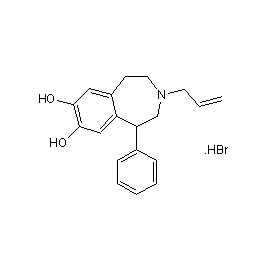
| DC26135 | SKF 77434 Featured |
Selective dopamine D1-like receptor partial agonist (IC50 values are 19.7 and 2425 nM for binding to D1-like and D2-like receptors respectively). Centrally active following systemic administration in vivo.
More description
|
|
| DC9726 | CP21 (CP21R7) Featured |
CP21R7 is a potent and selective GSK-3β inhibitor.
More description
|

|
| DC9265 | CP-640186 hydrochloride Featured |
CP-640186 Hcl is an isozyme-nonselective acetyl-CoA carboxylase (ACC) inhibitor with IC50s of 53 nM and 61 nM for rat liver ACC1 and rat skeletal muscle ACC2 respectively; with improved metabolic stability vs CP-610431.
More description
|

|
| DC7163 | ZLN005 Featured |
ZLN005 is a novel transcriptional regulator of peroxisome proliferator-activated receptor-γ coactivator-1α (PGC-1α).
More description
|

|
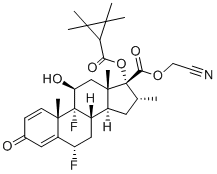
| DC33133 | GW-870086 Featured |
GW-870086 is a glucocorticoid receptor agonist potentially for the treatment of asthma and atopic dermatitis.
More description
|
|
| DC8198 | RTA-408(Omaveloxolone) Featured |
RTA-408 is a synthetic triterpenoid that potently activates the antioxidative transcription factor Nrf2 and inhibits the proinflammatory transcription factor NF-κB.
More description
|

|
| DC11410 | CP-671305 Featured |
CP-671305 is a potent and selective inhibitor of phosphodiesterase 4.
More description
|

|
| DC21956 | T16Ainh-A01 Featured |
T16Ainh-A01 is an inhibitor of the calcium-activated chloride channel TMEM16A, inhibits Ca2+-activated Cl− channel (CACC) activity in TMEM16A-transfected FRT cells with IC50 of 1 uM; T16Ainh-A01 (1-30 uM) inhibited single calcium (Ca2+)-activated chloride (Cl−) channels and whole cell currents activated by 500 nM free Ca2+; T16Ainh-A01 relaxed mouse thoracic aorta pre-contracted with methoxamine with an IC50 of 1.6 uM and suppressed the methoxamine concentration-effect curve; blocks calcium-activated chloride channels in vascular smooth muscle cells and relaxes murine and human blood vessels.
More description
|

|
| DC11145 | WAY213613 Featured |
WAY-213613 (WAY213613) is a potent, non-substrate inhibitor of EAAT2 (GLT-1) with IC50 of 85 nM, displays > 44-fold selectivity over EAAT1 and EAAT3; also exhibits no activity towards ionotropic and metabotropic glutamate receptors.
More description
|

|
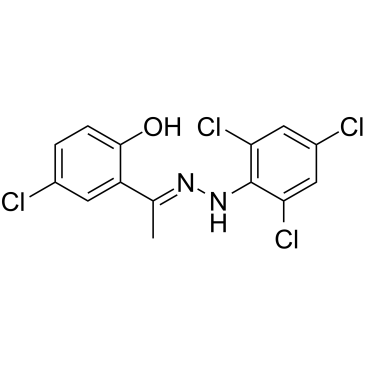
| DC40140 | Mitochondrial fusion promoter M1 Featured |
Mitochondrial fusion promoter M1 is a mitochondrial dynamic modulator. Mitochondrial fusion promoter M1 preserves the mitochondrial function and promotes cellular respiration. Mitochondrial fusion promoter M1 alleviates cardiac and brain damage in rats with cardiac ischemia/reperfusion injury.
More description
|
|
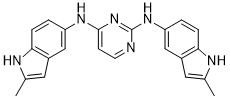
| DC40915 | AZA1 Featured |
AZA1 is a potent dual inhibitor of Rac1 and Cdc42. AZA1 induces prostate cancer cells apoptosis and inhibits prostate cancer cells proliferation, migration and invasion.
More description
|
|
| DC32723 | FGTI-2734 Featured |
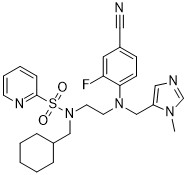
FGTI-2734 is a RAS C-terminal mimetic dual farnesyl transferase (FT) and geranylgeranyl transferase-1 (GGT-1) inhibitor. It can prevent membrane localization of KRAS, hence solving KRAS resistance problem and thwarting mutant KRAS patient-derived pancreatic tumors.
More description
|
|
| DC40217 | Metronidazole acetic acid Featured |
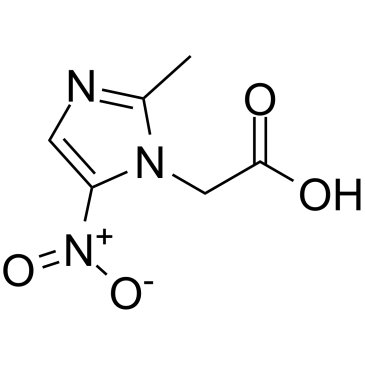
Metronidazole acetic acid is a metabolite of Metronidazole with mutagenic activity in bacteria. Metronidazole is a nitroimidazole antibiotic, amebicide, and antiprotozoal agent used particularly for anaerobic bacteria and protozoa.
More description
|
|
| DC40344 | 3-Phenyltoxoflavin Featured |
3-Phenyltoxoflavin, a derivative of Toxoflavin, is an Hsp90 inhibitor, with a Kd of 585 nM for the interaction of Hsp90-TPR2A. 3-Phenyltoxoflavin has anti-cancer activity.
More description
|

|
| DC41142 | Nor-benzetimide Featured |
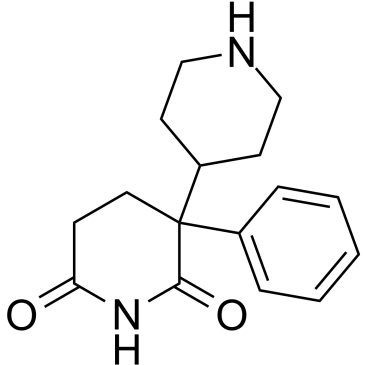
Nor-benzetimide is a major metabolite of Benzetimide. Benzetimide is a mAChR antagonist with anticholinergic activity.
More description
|
|
| DC9594 | Poloxin Featured |
Poloxin is a non-ATP competitive Polo-like Kinase 1 (PLK1) inhibitor that targets the polo-box domain.
More description
|

|
| DC31376 | LBQ-657(Sacubitrilat) Featured |
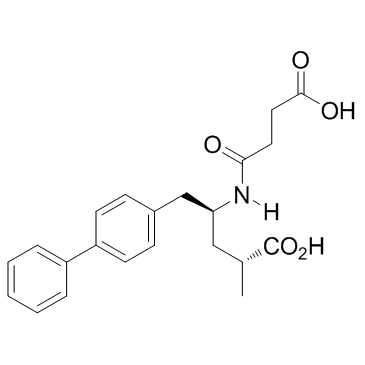
Sacubitrilat, also known as LBQ-657, is endopeptidase inhibitor. Sacubitril is a prodrug that is activated to LBQ657 by de-ethylation via esterases. LBQ657 inhibits the enzyme neprilysin, which is responsible for the degradation of atrial and brain natriuretic peptide, two blood pressure lowering peptides that work mainly by reducing blood volume.
More description
|
|
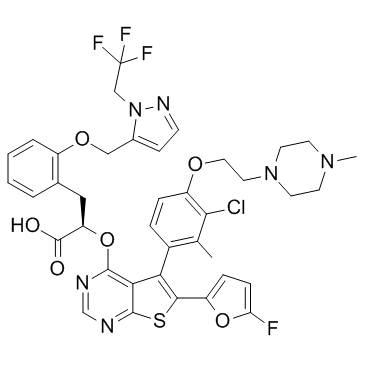
| DC10137 | S63845 Featured |
S63845 is a potent and selective myeloid cell leukemia 1 (MCL1) inhibitor; binds human MCL1 with a Kd of 0.19 nM.
More description
|
|
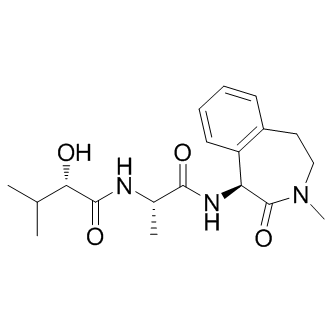
| DC7496 | Semagacestat Featured |
Semagacestat (LY450139) is a γ-secretase blocker for Aβ42, Aβ40 and Aβ38 with IC50 of 10.9 nM, 12.1 nM and 12.0 nM, also inhibits Notch signaling with IC50 of 14.1 nM.
More description
|
|
