 To enhance service speed and avoid tariff delays, we've opened a US warehouse. All US orders ship directly from our US facility.
| Cat. No. | Product Name | Field of Application | Chemical Structure |
|---|---|---|---|
| DC9648 | Dodecanoic acid ingenol ester Featured |
Dodecanoic acid ingenol ester is a natural compound.
More description
|

|
| DC7273 | Dolutegravir Featured |
Dolutegravir (DTG, GSK1349572) is an integrase inhibitor(IC50= 2.7 nM), modest activity against raltegravir-resistant signature mutants Y143R, Q148K, N155H, and G140S/Q148H.
More description
|

|
| DC10250 | Dolutegravir Sodium Featured |
Dolutegravir is a HIV integrase inhibitor with IC50 of 2.7 nM.
More description
|

|
| DC3142 | Dovitinib Dilacticacid Featured |
Dovitinib (TKI258, CHIR-258) is a multitargeted tyrosine kinase inhibitor of FLT3 and c-KIT with IC50 of 1 nM and 2 nM, respectively.
More description
|

|
| DC3141 | Dovitinib (TKI258) Lactate Featured |
Dovitinib (TKI258, CHIR258) is a novel multi-target inhibitor for Flt3, c-Kit, FGFR1/3, VEGFR1/2/3, PDGFRα/β with IC50 of 1 nM, 2 nM, 8 nM/9 nM and 10 nM/13 nM/8 nM, 210 nM/27 nM respectively.
More description
|

|
| DC9664 | Doxapram Featured |
Doxapram inhibits TASK-1, TASK-3, TASK-1/TASK-3 heterodimeric channel function with EC50 of 410 nM, 37 μM, 9 μM, respectively.
More description
|

|
| DC9949 | DprE1-IN-2 Featured |
DprE1-IN-2 is a potent DprE1 inhibitor.
More description
|

|
| DC10039 | DREADD Agonist 21 Featured |
DREADD agonist 21 is a potent muscarinic hM3Dq DREADD agonist (EC50 = 1.7 nM). Highly selective for hM3Dq DREADDs over endogenous hM3 receptors.
More description
|

|
| DCAPI1562 | Drospirenone Featured |
Drospirenone is a synthetic progestogen exhibiting antiandrogenic and antimineralocorticoid activity.
More description
|

|
| DC8825 | Dutasteride Featured |
Dutasteride is a 5-α-reductase inhibitor that inhibits the conversion of testosterone into dihydrotestosterone (DHT).
More description
|

|
| DC10805 | DWK-1339 Featured |
DWK-1339|DWK1339|cas 1018946-38-7
More description
|

|
| DC12674 | E3 ligase Ligand-Linker Conjugates 16 Featured |
E3 ligase Ligand-Linker Conjugates 16 is a synthesized compound that incorporates an E3 ligase ligand and a linker used in PROTAC technology.
More description
|

|
| DC10520 | E6446 dihydrochloride Featured |
E6446 dihydrochloride is a novel synthetic antagonist for nucleic acid-sensing TLRs; potently suppressed DNA stimulation of HEK:TLR9 cells with IC50 of 10 nM.
More description
|

|
| DC9534 | EBE-A22 Featured |
EBE-A22 is a derivative of PD 153035 which can inhibit ErbB-1-phosphorylation, whereas EBE-A22 is inactive.
More description
|

|
| DC26057 | Ecabet (sodium salt) Featured |
Ecabet is an antiulcerative and gastroprotective agent.
More description
|

|
| DC9912 | Echinocystic acid Featured |
Echinocystic acid a pentacyclic triterpene isolated from the fruits of Gleditsia sinensis Lam, has potent antioxidant, anti-inflammatory and anti-tumor properties.
More description
|

|
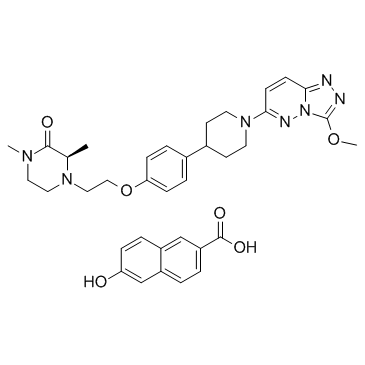
| DC10288 | AZD5153 6-Hydroxy-2-naphthoic acid Featured |
AZD5153 6-Hydroxy-2-naphthoic acid is the 6-Hydroxy-2-naphthoic acid of AZD5153. AZD5153 is a potent, selective, and orally available BET/BRD4 bromodomain inhibitor; disrupts BRD4 with an IC50 of 1.7 nM.
More description
|
|
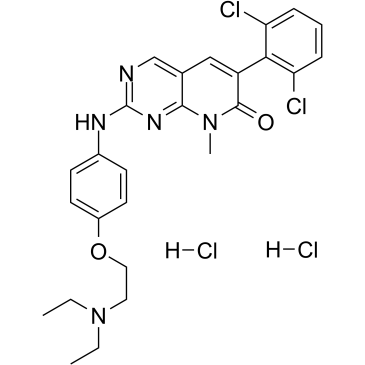
| DC21466 | PD166285 Featured |
PD166285 (PD 0166285) is a broad-spectrum receptor tyrosine kinase (RTK) inhibitor that inhibits PDGFR-β, EGFR, and FGFR1 and c-Src with IC50 of 7-85 nM.
More description
|
|
| DC44222 | DS-1205b free base Featured |
DS-1205b free base is a potent and selective inhibitor of AXL kinase, with an IC50 of 1.3 nM. DS-1205b free base also inhibits MER, MET, and TRKA, with IC50s of 63, 104, and 407 nM, respectively. DS-1205b free base can inhibit cell migration in vitro and tumor growth in vivo.
More description
|

|
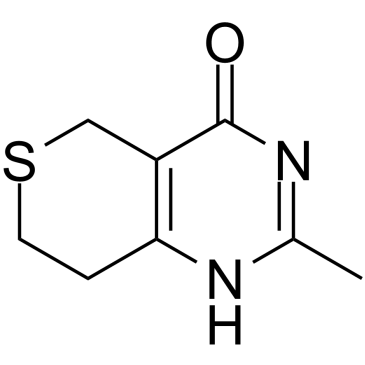
| DC45193 | DR2313 Featured |
DR2313 is a potent, selective, competitive and brain-penetrant inhibitor of poly(ADP-ribose) polymerase (PARP), with IC50s of 0.20 μM and 0.24 μM for PARP-1 and PARP-2, respectively. DR2313 exhibits neuroprotective effects on ischemic injuries in vitro and in vivo.
More description
|
|
| DC9160 | Cilnidipine Featured |
Cilnidipine(FRC8653) is a dual L- and N-type calcium channel blocker and displays antihypertensive, sympatholytic and neuroprotective activity.
More description
|

|
| DC5901 | Tadalafil Featured |
Tadalafil is a potent and selective inhibitor of Phosphodiesterase-5 (PDE5) This compound prevents the breakdown of phosphodiesterases, many of which are used as secondary messengers. By preventing the breakdown of these messenger molecules, tadalafil can
More description
|

|
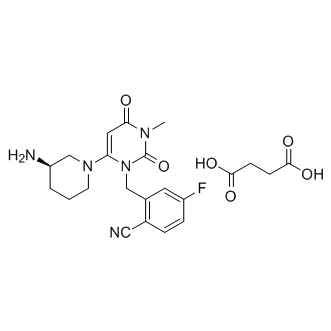
| DC6914 | Trelagliptin succinate Featured |
Trelagliptin(SYR-472) is a long acting dipeptidyl peptidase-4 (DPP-4) inhibitor that is being developed for the treatment of type 2 diabetes (T2D).
More description
|
|
| DC8962 | Tegafur Featured |
Tegafur (also known as Ftorafur) is a chemotherapeutic 5-FU prodrug used in the treatment of cancers; is a component of tegafur-uracil.
More description
|

|
| DC8421 | FTI 277 HCl Featured |
FTI 277 HCl is the methyl ester of FTI 277, which is a potent and selective farnesyltransferase (FTase) inhibitor with IC50 of 500 pM, about 100-fold selectivity over the closely related GGTase I.
More description
|

|
| DC9107 | Racecadotril Featured |
Racecadotril (acetorphan), a potent enkephalinase inhibitor (IC50= 4.5 uM), protects endogenous enkephalins from degradation.
More description
|

|
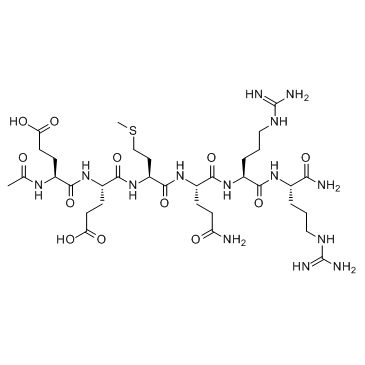
| DC32379 | Acetyl Hexapeptide-3(Argireline) Featured |
Argireline, also known as Acetyl Hexapeptide-3, is a newer ingredient in skincare, ideal for maturing skin and diminishing the appearance of wrinkles. Argireline is the brand name of Acetyl Hexapeptide-8, a molecule formed principally of 6 amino acids (which in a row are called a peptide). It is synthetically produced in a lab, but there are no indications of any degree of toxicity and it is one of our favorite compounds for maturing skin.
More description
|
|
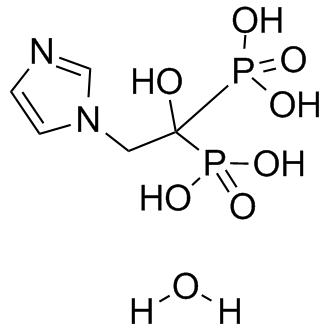
| DC9033 | Zoledronic acid hydrate Featured |
Zoledronic acid monohydrate(CGP 42446; ZOL 446) is an activator of protein kinase C with apoptotic effects on multiple myeloma cell lines. It inhibited proliferation of human foetal osteoblastic cell line (hFOB) with an IC50 of 40 uM.
More description
|
|
| DC10408 | BAY1125976 Featured |
BAY1125976 is a selective allosteric Akt1/2 inhibitor; inhibits Akt1 and Akt2 activity with IC50 values of 5.2 nM and 18 nM at 10 μM ATP, respectively.
More description
|
|
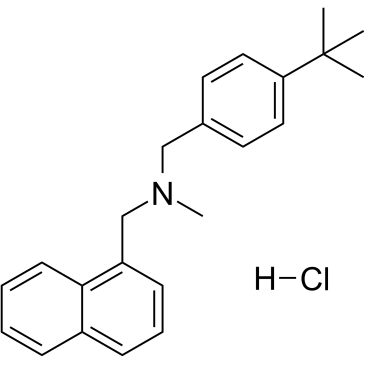
| DC23906 | Butenafine hydrochloride Featured |
A synthetic benzylamine antifungal that inhibits the synthesis of ergosterol by inhibiting squalene epoxidase.
More description
|
|
