 To enhance service speed and avoid tariff delays, we've opened a US warehouse. All US orders ship directly from our US facility.
| Cat. No. | Product Name | Field of Application | Chemical Structure |
|---|---|---|---|
| DC45561 | NiCur |
NiCur is a potent and selective CBP HAT inhibitor with an IC50 value of 0.35 μΜ. NiCur can be used for performing mechanistic studies without affecting the expression of target proteins.
More description
|

|
| DC45560 | DCH36_06 |
DCH36_06 is a potent and selective p300/CBP inhibitor with IC50s of 0.6 μM and 3.2 μM for p300 and CBP, respectively. DCH36_06 mediated p300/CBP inhibition leading to hypoacetylation on H3K18 in leukemic cells. Anti-tumor activity.
More description
|
|
| DC45559 | 5-Aza-4'-thio-2'-deoxycytidine |
5-Aza-4'-thio-2'-deoxycytidine (5-Aza-T-dCyd) is an orally active DNA methyltransferase I (DNMT1) inhibitor. 5-Aza-4'-thio-2'-deoxycytidine, a sulfur-containing deoxy-cytidine analog, has the potential for DNA hypomethylating and has antitumor effects.
More description
|
|
| DC45558 | 20-O-Demethyl-AP3 |
20-O-Demethyl-AP3 is a minor metabolite of Ansamitocin P-3. Ansamitocin P-3, a microtubule inhibitor, is a macrocyclic antitumor antibiotic.
More description
|
|
| DC45556 | (±)-Evodiamine |
(±)-Evodiamine, a quinazolinocarboline alkaloid, is a Top1 inhibitor. Evodiamine exhibits anti-inflammatory, antiobesity, and antitumor effects. (±)-Evodiamine inhibits the proliferation of a wide variety of tumor cells by inducing their apoptosis.
More description
|
|
| DC45553 | PR-104 sodium |
PR-104 (sodium) is a selective hypoxia-activated DNA cross-linking agent can be used for the research of multiple tumor xenograft models. PR-104 (sodium) as a nitrogen mustard pre-prodrug is converted efficiently to the more lipophilic dinitrobenzamide mustards alcohol PR-104A.
More description
|
|
| DC45552 | PR-104 |
PR-104 is a selective hypoxia-activated DNA cross-linking agent can be used for the research of multiple tumor xenograft models. PR-104 as a nitrogen mustard pre-prodrug is converted efficiently to the more lipophilic dinitrobenzamide mustards alcohol PR-104A.
More description
|
|
| DC45550 | L-Buthionine-(S,R)-sulfoximine hydrochloride |
L-Buthionine-(S,R)-sulfoximine hydrochloride is a cell-permeable, potent, fast acting, orally active and irreversible inhibitor of g-glutamylcysteine synthetase and depletes cellular glutathione levels. The IC50 value of L-Buthionine-(S,R)-sulfoximine on melanoma, breast and ovarian tumor specimens are 1.9 μM, 8.6 μM, and 29 μM, respectively.
More description
|
|
| DC45549 | TC11 |
TC11 is a MCL1 degradator and Caspase-9 and CDK1 activator. TC11 is structurally related to immunomodulatory drugs as phenylphthalimide derivative. TC11 induces apoptotic death caused by degradation of MCL1 during prolonged mitotic arrest.
More description
|
|
| DC45547 | MSN-50 |
MSN-50 is a Bax and Bak oligomerization inhibitor, efficiently inhibiting liposome permeabilization, preventing genotoxic cell death and promoting neuroprotection.
More description
|
|
| DC45546 | HXR9 |
HXR9 is a cell-permeable peptide and a competitive antagonist of HOX/PBX interaction. HXR9 antagonizes the interaction between HOX and a second transcrip-tion factor (PBX), which binds to HOX proteins in paralogue groups1 to 8. HXR9 selectively decreases cell proliferation and promotes apoptosis in cells with a high level of expression of the HOXA/PBX3 genes, such as MLL-rearranged leukemic cells.
More description
|
|
| DC45545 | 7,3′,5′-Trihydroxyflavanone |
7,3′,5′-Trihydroxyflavanone, a flavanoid derivative, induces the apoptotic cell death of MCF-7 cells by increasing Bax expression level. 7,3′,5′-Trihydroxyflavanone also exhibits antioxidant activity.
More description
|
|
| DC45544 | AT-9010 tetrasodium |
AT-9010 tetrasodium, a triphosphate active metabolite of AT-527, is a potent inhibitor of NiRAN (a function essential for viral replication). AT-9010 tetrasodium can inhibit SARS-CoV-2 replication.
More description
|
|
| DC45543 | AT-9010 |
AT-9010, a triphosphate active metabolite of AT-527, is a potent inhibitor of NiRAN (a function essential for viral replication). AT-9010 can inhibit SARS-CoV-2 replication.
More description
|
|
| DC45541 | GRL-0496 |
GRL-0496 is a potent chloropyridyl ester-derived SARS-CoV 3CLpro inhibitor, with an IC50 of 30 nM in both enzyme inhibitory and antiviral assays. GRL-0496 shows SARS-CoV antiviral activity, with an EC50 of 6.9 μM.
More description
|
|
| DC45540 | Cinchonine monohydrochloride hydrate |
Cinchonine ((8R,9S)-Cinchonine) monohydrochloride hydrate is a natural compound which has been effectively used as antimalarial agent. Cinchonine monohydrochloride hydrate activates endoplasmic reticulum stress-induced apoptosis in human liver cancer cells. Cinchonine monohydrochloride hydrate is also an inhibitor of human platelet aggregation. Cinchonine monohydrochloride hydrate possesses a suppressive effect on adipogenesis.
More description
|
|
| DC45539 | Clazuril |
Clazuril (R62690) has a coccidiocidal effect on the asexual and sexual developmental stages of both Eimeria species, resulting in a complete interruption of the life cycle.
More description
|
|
| DC45538 | Betulin diacetate |
Betulin diacetate, a natural diterpene, is an anti-AID agent and also possesses anti-cancer activity.
More description
|
|
| DC45536 | Fumitremorgin B |
Fumitremorgin B is a tremorgenic mycotoxin. Fumitremorgin B exhibits significant antifungal activities, with MICs of 6.25-50 μg/mL.
More description
|
|
| DC45535 | Ascr#18 |
Ascr#18, an ascaroside, is a hormone of nematodes. Ascr#18 is expressed during nematode development. Ascr#18 increases resistance in Arabidopsis, tomato, potato and barley to viral, bacterial, oomycete, fungal and nematode infections.
More description
|
|
| DC45534 | (R)-Eucomol |
(R)-Eucomol, a flavonoid derivative, displays marginal antibacterial activity. (R)-Eucomol shows cytotoxic activity against KB and P-388 cells.
More description
|
|
| DC45533 | Prodigiosin hydrochloride |
Prodigiosin (Prodigiosine) hydrochloride is a red pigment produced by bacteria as a bioactive secondary metabolite. Prodigiosin hydrochloride is a potent proapoptotic agent, and inhibits Wnt/β-catenin pathway. Prodigiosin hydrochloride has antibacterial, antifungal, antiprotozoal, antimalarial, immunosuppressive, and anticancer properties.
More description
|
|
| DC45532 | L748337 |
L748337 is a potent β3-adrenergic receptor antagonist and displays selectivity over β1 and β2 receptors. The Ki values of L748337 for β3-, β2- and β1-adrenoceptors are 4.0 nM, 204 nM and 390 nM, respectively. L748337 couples predominantly to Gi to activate MAPK signaling and increases phosphorylation of Erk1/2 with pEC50 value of 11.6. L748337 can be used for the research of cancer, nonalcoholic fatty liver disease (NAFLD), and cardiovascular related diseases.
More description
|
|
| DC42549 | Parsaclisib hydrochloride Featured |
Parsaclisib hydrochloride (INCB050465 hydrochloride) is a potent, selective and orally active inhibitor of PI3Kδ, with an IC50 of 1 nM at 1 mM ATP. Parsaclisib hydrochloride shows approximately 20000-fold selectivity over other PI3K class I isoforms. Parsaclisib hydrochloride can be used for the research of relapsed or refractory B-cell malignancies.
More description
|

|
| DC11645 | Pitstop 2 Featured |
A small molecule inhibitor of clathrin terminal domain and inhibits clathrin-mediated endocytosis.
More description
|

|
| DC10394 | Org-26576 |
Org 26576 is a AMPA receptor positive allosteric modulator.
More description
|

|
| DC44101 | Seralutinib Featured |
Seralutinib (GB002) is an inhaled Pdgfr kinase inhibitor. Seralutinib (GB002) is used in the study for pulmonary arterial hypertension.
More description
|

|
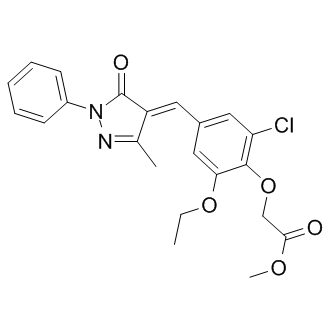
| DC9506 | SJ-172550 Featured |
SJ-172550 is the first MDMX inhibitor with EC50 of 0.84 uM; binds reversibly to MDMX and effectively kills retinoblastoma cells in which the expression of MDMX is amplified.
More description
|
|
| DC34594 | QLT-0267 Featured |
QLT0267 is an ATP-competitive selective inhibitor of integrin-linked kinase (ILK).
More description
|

|
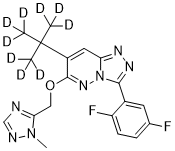
| DC32794 | CTP354 Featured |
CTP354, also known as C-21191, a novel deuterated subtype-selective GABA(A) modulator. CTP may be potentially useful for treatment of neuropathic pain, spasticity and anxiety disorders. GABAA receptors are found in the nervous system and, when activated, reduce the transmission of certain nerve signals. Several classes of widely used drugs target GABAA receptors, including benzodiazepines, but do not have the receptor subtype selectivity of CTP-354.
More description
|
|
