 To enhance service speed and avoid tariff delays, we've opened a US warehouse. All US orders ship directly from our US facility.
| Cat. No. | Product Name | Field of Application | Chemical Structure |
|---|---|---|---|
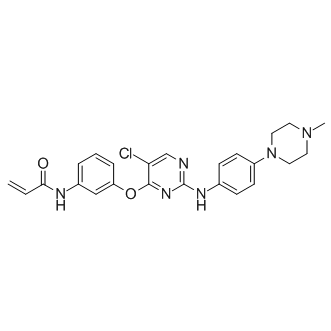
| DC9775 | WZ3146 Featured |
WZ3146 is a mutant-selective irreversible inhibitor of EGFR(L858R) and EGFR(E746_A750) with IC50 of 2 nM and 2 nM; does not inhibit ERBB2 phosphorylation (T798I).
More description
|
|
| DC1034 | WY14643 (Pirinixic Acid) Featured |
WY 14643 (Pirinixic Acid) is a potent peroxisome proliferator and activator of PPARα with ED50 of 1.5 μM.
More description
|

|
| DC7760 | WS3 Featured |
WS3 is a novel small molecule that promotes β cell proliferation with EC50 of 28 nM(induced R7T1 proliferation).
More description
|

|
| DC7558 | WP1130(Degrasyn) Featured |
WP1130(Degrasyn) is a novel selective small molecular deubiquitinase (USP5, UCH-L1, USP9x, USP14, and UCH37) inhibitor and a Bcr/Abl destruction pathway activator with an IC50 of 1.8 μM for K562 cells.
More description
|

|
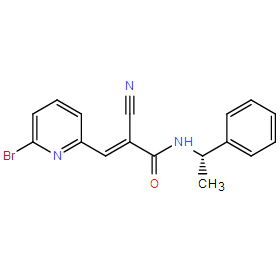
| DC8244 | wp1066(STAT Inhibitor III) Featured |
WP1066 is a cell-permeable inhibitor of STAT3 that directs dephosphorylation and nuclear export of constitutively phosphorylated STAT.
More description
|
|
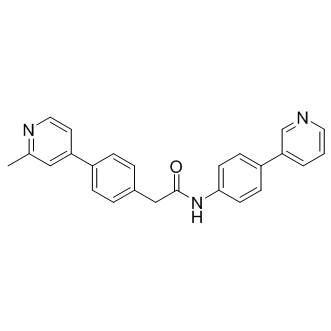
| DC7340 | Wnt-C59 Featured |
Wnt-C59(C59) is a very potent and highly selective Wnt signaling antagonist with an IC50 ~ 74 pM in the Wnt signaling reporter assay.
More description
|
|
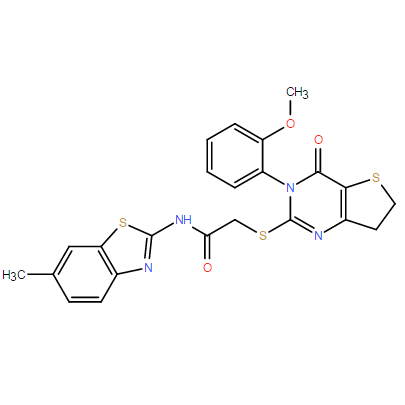
| DC9812 | IWP-4 Featured |
Wnt Inhibitor IWP-4 is a potent inhibitor of Wnt/β-catenin signaling (IC50 = 25 nM).
More description
|
|
| DC9883 | WNK463 Featured |
WNK463 is a pan-WNK-kinase inhibitor. It potently inhibits the in vitro kinase activity of all four WNK family members (WNK1, WNK2, WNK3, and WNK4).
More description
|

|
| DC10880 | WM-8014 Featured |
WM-8014(WM8014) is a highly potent, selective inhibitors of KAT6A and KAT6B.
More description
|

|
| DC2050 | WIN-55212-2 mesylate Featured |
WIN 55212-2 (mesylate) is a potent aminoalkylindole cannabinoid (CB) receptor agonist with a Ki of 62.3 and 3.3 nM for human recombinant CB1 and CB2 receptors, respectively.
More description
|

|
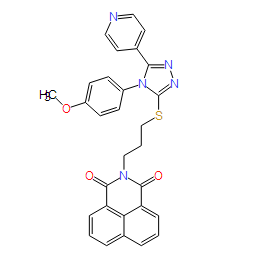
| DC7533 | wiki4 Featured |
WIKI4 is a novel Tankyrase inhibitor with IC50 of 15 nM for TNKS2, and leads to inhibition of Wnt/beta-catenin signaling.
More description
|
|
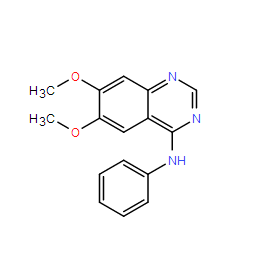
| DC8080 | WHI-P258 Featured |
WHI-P258 is a negative control for JAK3 inhibitors.
More description
|
|
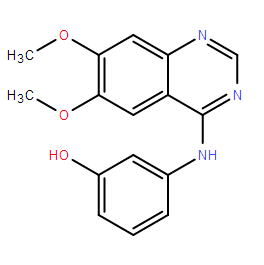
| DC8068 | WHI-P180(Janex 3) Featured |
WHI-P180(Janex 3) is a potent inhibitor of IgE-mediated mast cell responses to allergens in vitro and in vivo. Also inhibits cyclin-dependent kinase 2 (CDK2; IC50 = 1µM) by blocking the ATP site
More description
|
|
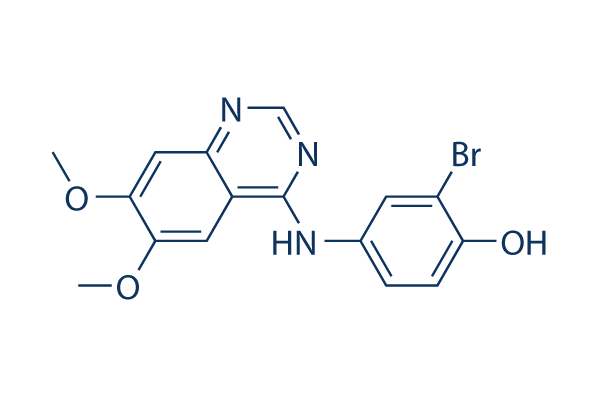
| DC7581 | WHI-P154 Featured |
WHI-P154 is a potent JAK3 inhibitor with IC50 of 1.8 μM, no activity against JAK1 or JAK2, also inhibits EGFR, Src, Abl, VEGFR and MAPK, prevents Stat3, but not Stat5 phosphorylation.
More description
|
|
| DC7657 | WH-4-023 Featured |
WH-4-023 is a potent and selective dual Lck/Src inhibitor with IC50 of 2 nM/6 nM for Lck and Src kinase respectively; little inhibition on p38α and KDR.
More description
|

|
| DC10373 | WEHI-345 Featured |
WEHI-345 is a potent and selective inhibitor of RIPK2, with IC50 of 0.13 μM.
More description
|

|
| DC7744 | WAY-262611 Featured |
WAY-262611 is a wingless β-Catenin agonist that increases bone formation rate; with EC50 of 0.63 uM in TCF-Luciferase assay.
More description
|

|
| DC10077 | WAY-200070 Featured |
WAY-200070 is a potent, selective estrogen receptor-beta (ER-β) agonist (IC50 2.3 nM vs 155 nM for ER-α) with anxiolytic-like and antidepressant-like effects.
More description
|

|
| DC24128 | WAY 100635 maleate salt Featured |
WAY-100635 is a potent, silent antagonist of 5-HT1A receptors (IC50 = 2.2 nM; Ki = 0.84 nM for rat 5-HT1A receptors). Displays 100-fold selectivity for 5-HT1A over other 5-HT subtypes. Also exhibits agonist activity at dopamine D4 receptors.
More description
|

|
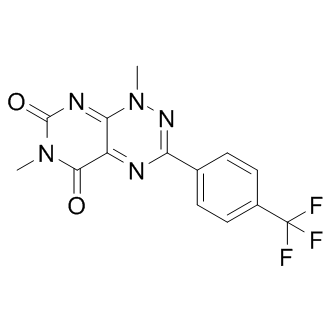
| DC7532 | Walrycin-B Featured |
Walrycin B is a novel antibacterial compound specifically targeting the essential WalR response regulator.
More description
|
|
| DC4173 | VX-745 Featured |
VX-745 is a potent and selective inhibitor of p38α MAPK and p38β MAPK with IC50 of 10 nM and 220 nM, respectively.
More description
|

|
| DC1016 | VU-0357121(VU0357121) Featured |
VU0357121 is a novel allosteric modulator of mGlu5 with EC50 of 33 nM.
More description
|

|
| DC9255 | VU0357017 Featured |
VU0357017 hydrochloride is a highly selective M1 agonists that appear to act at an allosteric site to activate the receptor (EC50 = 477 ± 172 nM; pEC50 = 6.37 ± 0.15).
More description
|

|
| DC9497 | VU0152100 Featured |
VU0152100 is a potent and selective allosteric potentiator of M4 mAChR with an EC50 of 380 ± 93 nM.
More description
|

|
| DC9928 | VU 0364770 Featured |
VU 0364770 is a positive allosteric modulator(PAM) of mGlu4 with EC50 of 1.1 μM, exhibits insignificant activity at 68 other receptors, including other mGlu subtypes.
More description
|

|
| DCAPI1480 | rosiglitazone maleate Featured |
Rosiglitazone maleate is a potent and selective activator of PPARγ, with EC50s of 30 nM, 100 nM and 60 nM for PPARγ1, PPARγ2, and PPARγ, respectively, and a Kd of appr 40 nM for PPARγ; Rosiglitazone maleate is also an modulator of TRP channels, inhibits T
More description
|

|
| DC9193 | Carbamazepine Featured |
Carbamazepine, a sodium channel blocker, is an anticonvulsant drug.
More description
|

|
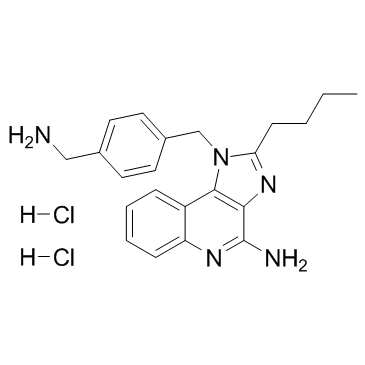
| DC50012 | TLR7/8 agonist 1 dihydrochloride Featured |
TLR7/8 agonist 1 dihydrochloride is a toll-like receptor TLR7/TLR8 dual-agonistic imidazoquinoline.
More description
|
|
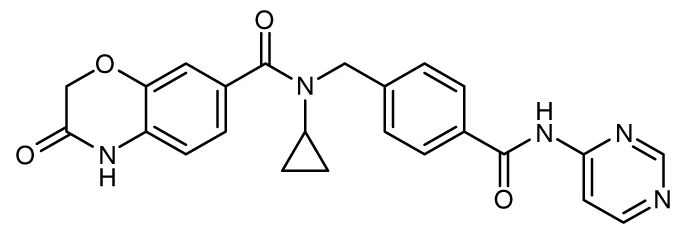
| DC57111 | UNC6934 Featured |
UNC6934 is a potent and selective drug-like chemical probe to interrogate the function of NSD2-PWWP1 with Kd of 91 nM.UNC6934 disrupts the NSD2-PWWP1 interaction with H3K36me2 nucleosomes in U2OS cells as measured by a NanoBret assay with an IC50 of 1.09
More description
|
|
| DC45792 | TPX-0131 Featured |
TPX-0131 is a potent, selective, CNS-penetrant and orally active inhibitor of wild-type ALK (IC50 of 1.4 nM) and ALK-resistant mutation, e.g. G1202R (IC50 of 0.3 nM), L1196M (IC50 of 0.3 nM). TPX-0131 has strong antitumor activities.
More description
|

|
