 To enhance service speed and avoid tariff delays, we've opened a US warehouse. All US orders ship directly from our US facility.
| Cat. No. | Product Name | Field of Application | Chemical Structure |
|---|---|---|---|
| DC7780 | ZM241385 Featured |
ZM 241385 is a Potent A2 adenosine receptor antagonist, with approx 50-fold selectivity for A2A receptors.
More description
|

|
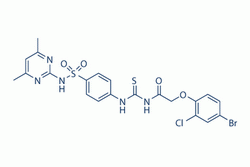
| DC7344 | ZCL 278 Featured |
ZCL278 is a Cdc42 small molecule modulator that directly binds to Cdc42 (Kd=11.4 uM) and inhibits Cdc42-intersectin interaction.
More description
|
|
| DC11471 | BGB-3111(Zanubrutinib) Featured |
Zanubrutinib is a selective Bruton tyrosine kinase (BTK) inhibitor.
More description
|

|
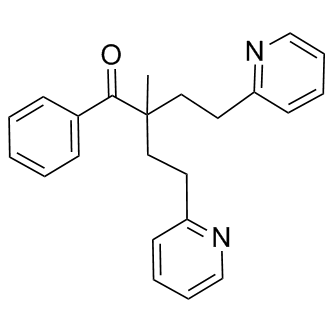
| DC7436 | JAK2 Inhibitor V,Z3 Featured |
Z3(NSC 42834), a novel specific inhibitor of Jak2, inhibits Jak2-V617F and Jak2-WT autophosphorylation in a dose-dependent manner but was not cytotoxic to cells at concentrations that inhibited kinase activity.
More description
|
|
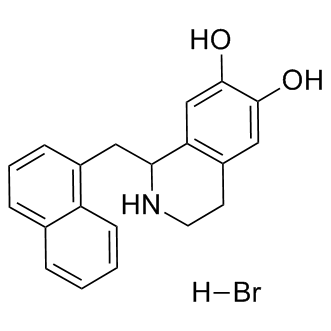
| DC8094 | Ys-49 Featured |
YS 49 inhibits Ang II-stimulated proliferation of VSMCs via induction of HO-1.
More description
|
|
| DC7343 | YM201636 Featured |
YM201636 is a selective PIKfyve inhibitor with IC50 of 33 nM, less potent to p110α.
More description
|

|
| DC4119 | YM155 Featured |
YM155 is a potent IAP (inhibitor of apoptosis proteins) inhibitor for survivin with IC50 of 0.54 nM.
More description
|

|
| DC9274 | YM 90709 Featured |
YM 90709 has been reported to be a selective inhibitor of interleukin-5 (IL-5).
More description
|

|
| DC10778 | YKL-06-061 Featured |
YKL-06-061 is a potent and selective SIK (salt-inducible kinase) inhibitor.
More description
|

|
| DC9504 | YH239-EE Featured |
YH239-EE, ethyl ester of the free carboxylic acid compound YH239, is a potent p53-MDM2 antagonizing and apoptosis-inducing agent
More description
|

|
| DC12370 | YF2 Featured |
YF2 is a First-in-Class Histone Acetyltransferase (HAT) Activators for Precision Targeting of Epigenetic Derangements in Lymphoma.
More description
|

|
| DC7720 | YC-1(Lificiguat) Featured |
YC-1(Lificiguat) is a soluble guanylyl cyclase(sGC) activator; binds to the heme-containing domain of the β subunit with Kd value of 0.6-1.1 μM in the presence of CO.
More description
|

|
| DC1028 | Y-27632 2HCL Featured |
Y-27632 2HCl is a selective ROCK1 (p160ROCK) inhibitor with Ki of 140 nM.
More description
|

|
| DC9446 | Y15 Featured |
Y15 is a novel small molecule FAK phosphorylation inhibitor; specifically block phosphorylation of Y397-FAK and total phosphorylation of FAK.
More description
|

|
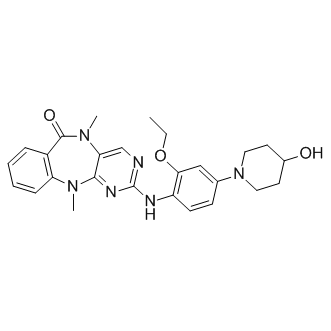
| DC7534 | XMD8-92 Featured |
XMD8-92 is highly selective ERK5/BMK1 inhibitor with Kd values of 80, 190, 600 and 890 nM for BMK1, DCAMKL2, PLK4 and TNK1 respectively ; displays selectivity over 402 diverse kinases.
More description
|
|
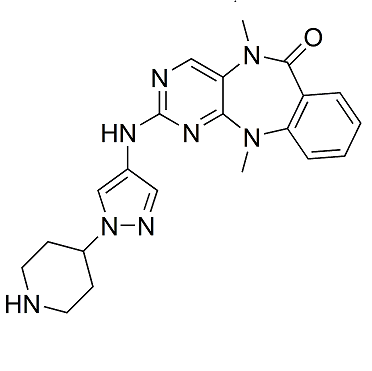
| DC7688 | XMD-17-51 Featured |
XMD-17-51 is a potent NUAK1-specific NUAK1 inhibitor
More description
|
|
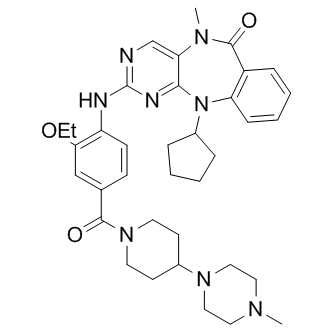
| DC7624 | XMD17-109 Featured |
XMD17-109 is a novel, specific ERK-5 inhibitor with an EC50 4.2 uM in HEK293 cells.
More description
|
|
| DC6307 | XL888 Featured |
XL888 is an orally bioavailable, ATP-competitive, small-molecule inhibitor of heat shock protein 90 (Hsp90) with potential antineoplastic activity.
More description
|

|
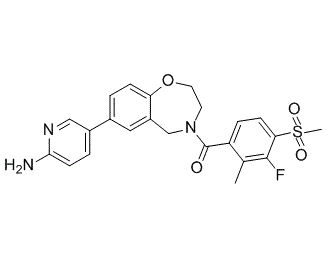
| DC3123 | XL388 Featured |
XL388 is a Novel Class of Highly Potent, Selective, ATP-Competitive, and Orally Bioavailable Inhibitors of the Mammalian Target of Rapamycin (mTOR).
More description
|
|
| DC1097 | XL-184 (Cabozantinib,BMS907351) Featured |
XL184 (Cabozantinib) is a potent VEGFR2 inhibitor with IC50 of 0.035 nM and also inhibits c-Met, Ret, Kit, Flt-1/3/4, Tie2, and AXL with IC50 of 1.3 nM, 4 nM, 4.6 nM, 12 nM/11.3 nM/6 nM, 14.3 nM and 7 nM, respectively.
More description
|

|
| DC1068 | XL147 analogue(PI3K inhibitor X) Featured |
XL147 analogue (SAR245408) is a selective and reversible class I PI3K inhibitor for wild type and mutant p110α with IC50 of 40 nM and 40 nM, respectively.
More description
|

|
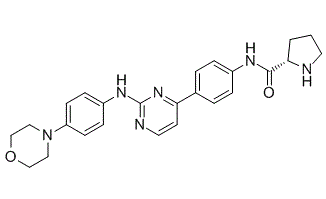
| DC5022 | XL019 Featured |
XL019 is an orally bioavailable inhibitor of Janus-associated kinase 2 (JAK2) with potential antineoplastic activity.
More description
|
|
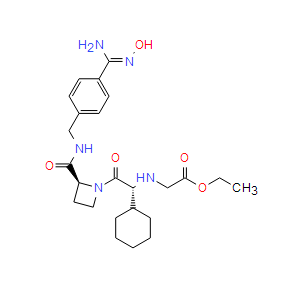
| DC7647 | Ximelagatran Featured |
Ximelagatran is an orally active direct thrombin inhibitor.
More description
|
|
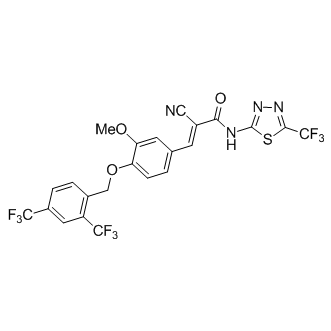
| DC7735 | XCT790 Featured |
XCT-790 is a potent, selective and inverse agonist of estrogen-related receptor alpha(ERRα); induces cell death in chemotherapeutic resistant cancer cells.
More description
|
|
| DC5006 | XAV-939 Featured |
XAV-939 selectively inhibits Wnt/β-catenin-mediated transcription through tankyrase1/2 inhibition with IC50 of 11 nM/4 nM, regulates axin levels and does not affect CRE, NF-κB or TGF-β.
More description
|

|
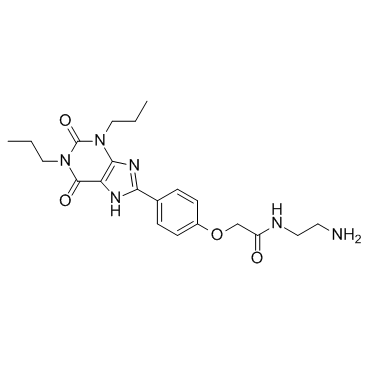
| DC11312 | Xanthine amine congener Featured |
Xanthine amine congener (XAC) is a non-selective adenosine receptor antagonist with Kb values of 83, 25, and 15 nM for rat PC12 cells, human platelets that endogenously express adenosine A2A receptors, and rat fat cells that endogenously express A1 recept
More description
|
|
| DC10493 | WZB117 Featured |
WZB117 is an irreversible inhibitor of glucose transporter 1 (Glut1) that blocks glucose transport in diverse cancer cells (IC50 = ~0.6 µM), reducing extracellular lactate and intracellular ATP levels.
More description
|

|
| DC7341 | WZ 811 Featured |
WZ811 is a novel small molecular and potency CXCR4 antagonist with EC50 of 0.3 nM.
More description
|

|
| DC23204 | WZ8040 Featured |
WZ8040 is a potent, mutant-selective, irreversible EGFRT790M inhibitor, does not inhibit ERBB2 phosphorylation (T798I) and is 100-fold less potent against wild-type EGFR.
More description
|

|
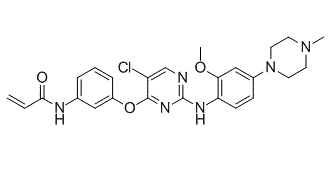
| DC5090 | WZ4002 Featured |
WZ4002 is a novel, mutant-selective EGFR inhibitor for EGFR(L858R)/(T790M) with IC50 of 2 nM/8 nM; does not inhibit ERBB2 phosphorylation (T798I).
More description
|
|
