
 To enhance service speed and avoid tariff delays, we've opened a US warehouse. All US orders ship directly from our US facility.
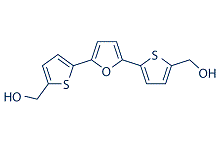




| Cas No.: | 213261-59-7 |
| Chemical Name: | 2-Thiophenemethanol, 5,5'-(2,5-furandiyl)bis- |
| Synonyms: | NSC-652287, NSC 652287 |
| SMILES: | C1=C(SC(=C1)C2=CC=C(O2)C3=CC=C(S3)CO)CO |
| Formula: | C14H12O3S2 |
| M.Wt: | 292.37 |
| Purity: | >98% |
| Sotrage: | 2 years -20°C Powder, 2 weeks 4°C in DMSO, 6 months -80°C in DMSO |
| Description: | RITA is an inhibitor of p53-HDM-2 interaction, binds to p53dN, with a Kd of 1.5 nM, and also induces DNA-DNA cross-links. |
| Target: | Kd: 1.5 nM (p53dN)[1] DNA Crosslinker[2] |
| In Vivo: | RITA (0.1, 1 or 10 mg/kg, i.p.) shows potent antitumor activity in SCID mice bearing HCT116 and HCT116 TP53−/− xenografts[1]. RITA (10 mg/kg, i.p.) also suppresses the growth of HeLa cells in SCID mice[3]. |
| In Vitro: | RITA inhibits p53-HDM-2 interaction, binding to p53dN, with a Kd of 1.5 nM. RITA (10 μM) blocks complex formation between p53 and HDM-2 in HCT116 cells and HDFs and in NHF-ERMyc cells irrespective of c-Myc expression. RITA (0.5 μM) reduces the viability of tumor cells in a wild-type p53-dependent manner. Moreover, RITA (0.1 μM) induces p53-dependent apoptosis. RITA induces p53 but does not via DNA damage-signaling pathway[1]. RITA (NSC 652287) induces DNA-DNA cross-links. RITA induces G2-M cell cycle arrest at 10 nM and causes apoptosis at 100 nM. RITA (100 nM) also elevates p53 and causes dose-dependent effects on p21WAF1 protein levels[2]. RITA inhibits the growth of HeLa and CaSki cells, with IC50s of 1 and 10 μM. In addition, RITA (1 μM) stabilizes p53 by inhibiting p53/E6AP interaction[3]. |
| Cell Assay: | For the cell viability assay, 3,000 cells per well are plated in a 96-well plate and treated with RITA for 48 h, after which cell viability is assessed with the proliferation reagent WST-1. For colony formation assay, cells are seeded in 12-well plates and treated with RITA for 24 h, after which the medium is replaced and the cells are allowed to grow for 10-14 d. The colonies are stained with crystal violet. For growth curves, 3000 cells/mL are plated in 12-well plates, treated with RITA, and counted over 5 d[3]. |
| Animal Administration: | Mice[1] Female SCID mice, 4-6 weeks old, are implanted with subcutaneous xenografts using 1 × 10⁶ cells in 90% Matrigel. Palpable tumors are established 3-6 d after the cells are injected, at which point RITA treatment is initiated. RITA is administered either 0.1, 1 or 10 mg/kg every day by intravenous or intraperitoneal injection in a total volume of 100 μL phosphate buffered saline. Xenografts are measured every 2 d. Tumor volumes are plotted for control and treated groups by dividing the average tumor volume for each data point by average starting tumor volume[1]. |
| References: | [1]. Issaeva N, et al. Small molecule RITA binds to p53, blocks p53-HDM-2 interaction and activates p53 function in tumors. Nat Med. 2004 Dec;10(12):1321-8. Epub 2004 Nov 21. [2]. Nieves-Neira W, et al. DNA protein cross-links produced by NSC 652287, a novel thiophene derivative active against human renal cancer cells. Mol Pharmacol. 1999 Sep;56(3):478-84. [3]. Zhao CY, et al. Rescue of p53 function by small-molecule RITA in cervical carcinoma by blocking E6-mediated degradation. Cancer Res. 2010 Apr 15;70(8):3372-81. |