 To enhance service speed and avoid tariff delays, we've opened a US warehouse. All US orders ship directly from our US facility.
| Cat. No. | Product Name | Field of Application | Chemical Structure |
|---|---|---|---|
| DC52025 | SM-102 Featured |
SM-102 is an ionizable amino lipid that has been used in combination with other lipids in the formation of lipid nanoparticles.Administration of luciferase mRNA in SM-102-containing lipid nanoparticles induces hepatic luciferase expression in mice. Formulations containing SM-102 have been used in the development of lipid nanoparticles for delivery of mRNA-based vaccines.
More description
|

|
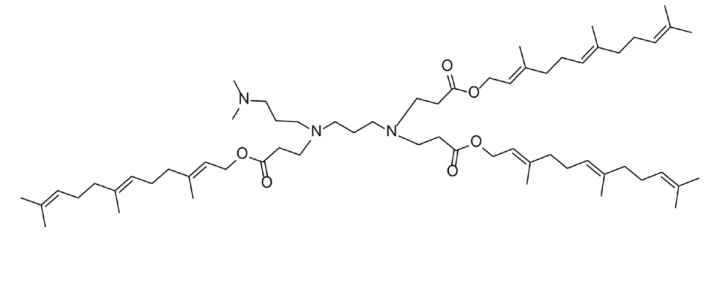
| DC60925 | Lipid H5T5 Featured |
H5T5 is a leading ionizable lipid nanoparticle (LNP) formulation optimized for in vivomRNA delivery, featuring a pKa of 6.51, a size of ~154 nm, and a narrow polydispersity index (PDI) of 0.05. It demonstrated superior in vitromRNA transfection efficiency in primary immune cells, such as bone marrow-derived macrophages. Following intravenous administration, H5T5 exhibits precise organotropism, predominantly targeting the spleen and bone marrow, where it effectively delivers mRNA to a broad spectrum of immune cells, including macrophages, dendritic cells, T cells, B cells, and NK cells. This capability enables its core application: the in vivogeneration of "pan-CAR" immune cells. When loaded with anti-HER2 CAR mRNA, the H5T5-based therapy achieved potent tumor regression and prolonged survival in multiple solid tumor models. Preliminary safety assessments indicated a manageable cytokine profile and no significant organ toxicity, positioning it as a promising platform for in vivocell engineering.
More description
|
|
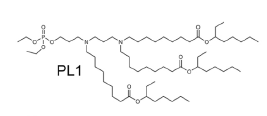
| DC80068 | LIPID PL1 |
PL1 is a novel biomimetic phospholipid.
More description
|
|
| DC67458 | DMT7 Featured |
DMT7 (pKa 6.5) is an ionizable cationic lipid engineered for co-delivery of mRNA and immunomodulators via LNPs. In 4T1 breast cancer metastasis models, DMT7 LNPs carrying IL-12 mRNA and STING agonist MSA-2 significantly reduce tumor burden and pulmonary metastases while modulating T cell populations. The formulation demonstrates broad immunotherapeutic effects in melanoma models, shifting tumor macrophages toward the M1 phenotype, reducing Tregs, and elevating pro-inflammatory cytokines (IL-12, IL-2, TNF-α, IFN-γ).
More description
|

|
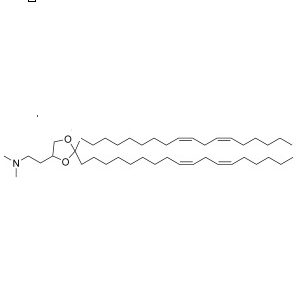
| DC12381 | DLin-KC2-DMA Featured |
DLin-KC2-DMA is a highly potent ionizable lipid used in the formulation of lipid nanoparticles (LNPs) for the delivery of siRNA. It represents a significant advancement over earlier generations of lipids, such as DLin-DMA, due to its dramatically improved gene silencing efficiency.
More description
|
|
| DC71417 | YSK 05 Featured |
YSK 05 is a pH-sensitive cationic lipid. YSK 05 improves the intracellular trafficking of non-viral vectors. YSK 05-MEND shows significantly good gene silencing activity and hemolytic activity. YSK 05 overcomes the suppression of endosomal escape by PEGylation. YSK 05 effectively enhances siRNA delivery both in vitro and in vivo.
More description
|

|
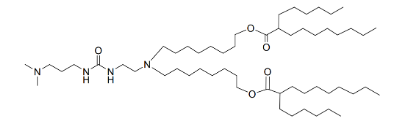
| DC67280 | Lipid 35 |
Lipid 35 is an novel ionizable lipid designed to enhance the delivery of mRNA to specific tissues, particularly the lungs.Lipid 35 demonstrates superior chemical stability, especially in storage conditions. This stability ensures that the lipid maintains its integrity over extended periods, making it ideal for long-term storage and large-scale production.Lipid 35 exhibits high transfection efficiency in various cell types, including nonimmune cells, endothelial cells, and epithelial cells. Lipid 35 has demonstrated excellent biocompatibility and safety in preclinical studies. It does not cause significant liver damage or adverse immune responses, making it a safer alternative for therapeutic applications.
More description
|
|
| DC33580 | DODMA Featured |
DODMA, also known as MBN 305A is a a cationic lipid containing the unsaturated long-chain (18:1) oleic acid inserted at both the sn-1 and sn-2 positions. It has been used in the composition of lipospomes formulated as stable nucleic acid lipid particles that can encapsulate siRNA or other small molecules to be used for drug delivery
More description
|

|
| DC10800 | DLin-MC3-DMA Featured |
D-Lin-MC3-DMA(MC3) is the most potent cationic lipid that has been synthesized for Lipid nanoparticles (LNPs) to deliver the siRNA.
More description
|

|
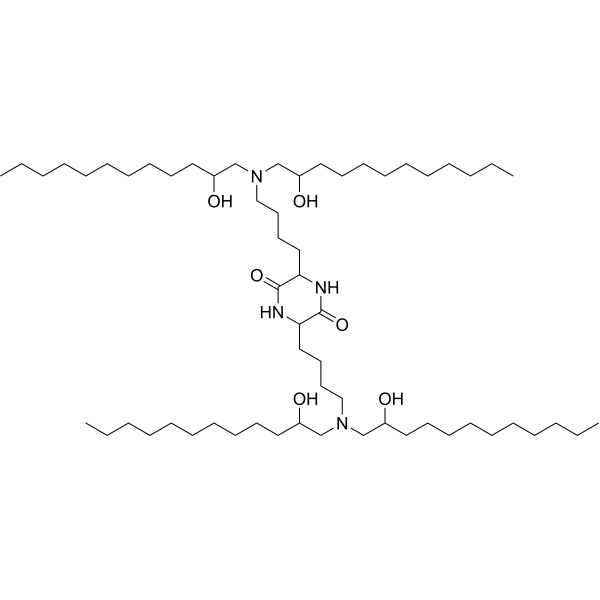
| DC49882 | CKK-E12 Featured |
CKK-E12 is a ionizable lipid in combination with other lipids make up the lipid nanoparticles which are used to deliver RNA-based therapeutics. cKK-E12 was highly selective toward liver parenchymal cell in vivo.Multitail lipids usually have three or more tails and tend to form
more cone-shaped structures due to the increase of tail crosssection,
which enhances the endosome escape and mRNA
delivery efficiency.CKK-E12 is an ionizable lipid with four
lipid tails and diketopiperazine core-based head. It has shown
excellent efficiency in delivering CRISPR-Cas9 mRNA and
sgRNA.cKK-E12 iLNPs encapsulated mRNA was used to
investigate the effect of Toll-like receptor 4 (TLR4) on iLNPsmediated
mRNA delivery, and it has been demonstrated that
the targeting, safety and efficacy of iLNPs are closely related
to disease state. In other words, even though iLNP delivers
therapeutic mRNA to a given cell type in one disease state, it
is not guaranteed to deliver mRNA to the same cell type in
another disease. As same as MC3 and C12-200, CKK-E12 is also
used to be a positive control ionizable lipid when exploiting new
ionizable lipids.
More description
|
|
| DC86120 | EA-PIP(LIPID 10) Featured |
Lipid 10 is a novel ionizable cationic lipid be used for delivery of therapeutic RNA to the Bone Marrow in Multiple Myeloma Using CD38-Targeted with Lipid 10-LNP.
More description
|

|
| DC67984 | L31(Lipid 31) Featured |
L31 is identified as a novel, proprietary ionizable cationic lipid that serves as the critical functional component within lipid nanoparticles (LNPs) engineered for CRISPR/Cas9 genome editing in head and neck squamous cell carcinoma (HNSCC). It was selected from a screened library of lipids for its superior performance. LNPs formulated with L31 exhibited excellent physicochemical properties, including a uniform size of 80-100 nm, low polydispersity, and high encapsulation efficiency (>85%) for both Cas9 mRNA and sgRNA. In vitro, L31-based LNPs demonstrated outstanding therapeutic efficacy, achieving approximately 68% gene editing of the oncogene SOX2 and an 88% reduction in cancer cell viability.For in vivo applications, L31-LNPs were further functionalized with anti-EGFR antibodies using the ASSET linker strategy to create targeted nanoparticles (tLNPs). This modification enhanced specific uptake by tumor cells. In a xenograft mouse model, intratumoral injection of these targeted L31-cLNPs co-encapsulating Cas9 mRNA and sgSOX2 led to potent tumor growth inhibition (90%) and a significant increase in survival, with tumor disappearance observed in half of the treated mice. In conclusion, L31 is a highly efficient ionizable lipid that forms the foundation of a potent targeted LNP platform for precise CRISPR-based cancer therapy against solid tumors.
More description
|
.png)
|
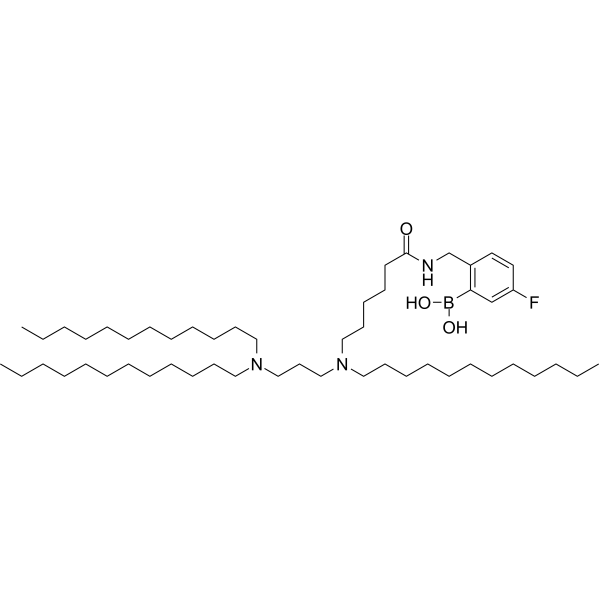
| DC67981 | Diamino lipid DAL4 Featured |
Diamino lipid DAL4 is diamino lipid for the preparation of lipid nanoparticles (LNPs) encapsulated with mRNAs encoding cytokines including IL-12, IL-27 and GM-CSF. Diamino lipid DAL4 delivers mRNA to tumor cells to exert anti-tumor activity.
More description
|
|
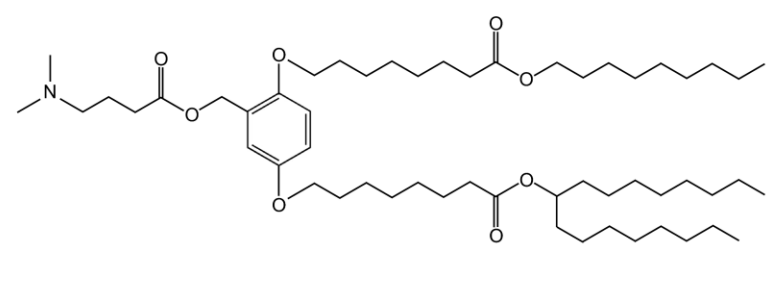
| DC67983 | XH-07 Featured |
XH-07 is an innovative ionizable cationic lipid that forms the backbone of the JCXH-211 lipid nanoparticle (LNP) delivery system. This complex is engineered to encapsulate and deliver self-replicating RNA (srRNA) encoding interleukin-12 (IL-12), a potent immunostimulatory cytokine. The LNP formulation featuring XH-07 exhibits optimal physicochemical properties, such as a mean particle size of approximately 82.12 nm with low polydispersity, and a near-neutral zeta potential around -3.181 mV, which facilitates stable circulation and efficient cellular uptake upon intravenous administration. Upon delivery, the srRNA leverages the host cell's machinery to produce sustained levels of IL-12p70, as demonstrated in B16F10 tumor-bearing mice, where a single dose led to peak cytokine production in sera and tumors. This induced IL-12 expression activates T cells and NK cells, generating a robust antitumor response. In murine models of melanoma and breast cancer, JCXH-211 monotherapy resulted in significant tumor regression and complete responses in some subjects, and it synergized with anti-PD-1 therapy to enhance efficacy. Importantly, the safety profile was acceptable, with transient liver enzyme elevations in mice that normalized quickly, and no significant adverse events in cynomolgus monkeys after repeated dosing, as evidenced by stable clinical observations and pathology tests. Thus, XH-07 is pivotal for enabling the safe and effective delivery of IL-12 encoding RNA, positioning JCXH-211 as a promising cancer immunotherapy.
More description
|
|
