 To enhance service speed and avoid tariff delays, we've opened a US warehouse. All US orders ship directly from our US facility.
| Cat. No. | Product Name | Field of Application | Chemical Structure |
|---|---|---|---|
| DC72213 | TP-050 |
TP-050 is a potent, orally active and selective NMDAR agonist with an EC50 value of 0.51 µM and 9.6 µM for GluN2A and GluN2D, respecticely. TP-050 enhances long-term potentiation in the rat hippocampus.
More description
|

|
| DC72212 | CFTR corrector 8 |
CFTR corrector 8 is a potent CFTR modulator. CFTR can be used in the research of cystic fibrosis.
More description
|
|
| DC40101 | Phenamil methanesulfonate |
Phenamil methanesulfonate, an analog of Amiloride, is a more potent and less reversible epithelial sodium channel (ENaC) blocker with an IC50 of 400 nM. Phenamil methanesulfonate is also a competive inhibitor of TRPP3 and inhibits TRPP3-mediated Ca2+ transport with an IC50 of 140 nM in a Ca2+ uptake assay. Phenamil methanesulfonate is an intriguing small molecule to promote bone repair by strongly activating BMP signaling pathway. Phenamil methanesulfonate is used for the research of cystic fibrosis lung disease.
More description
|

|
| DC41416 | 13-Hydroxyisobakuchiol |
Hydroxyisobakuchiol (Delta3,2-Hydroxylbakuchiol), an analog of Bakuchiol isolated from Psoralea corylifolia (L.), is a potent monoamine transporter inhibitor. 13-Hydroxyisobakuchiol is more selective for the dopamine transporter (DAT) (IC50=0.58 μM) and norepinephrine transporter (NET) (IC50=0.69 μM) than for the serotonin transporter (SERT) (IC50=312.02 μM). 13-Hydroxyisobakuchiol has the potential for the research of disorders such as Parkinson's disease, depression, and cocaine addiction.
More description
|

|
| DC41901 | Tat-NR2Baa TFA |
Tat-NR2BAA TFA is the control peptide of Tat-NR2B9c, inactive. The sequence of Tat-NR2BAA TFA is similar to Tat-NR2B9c, but it has a double-point mutation in the COOH terminal tSXV motif, making it incapable of binding PSD-95. Tat-NR2B9c is a membrane-permeant peptide and disrupts PSD-95/NMDAR binding, correlate with uncoupling NR2B- and/or NR2A-type NMDARs from PSD-95.
More description
|
|
| DC41900 | Tat-NR2Baa |
Tat-NR2BAA is the control peptide of Tat-NR2B9c, inactive. The sequence of Tat-NR2BAA is similar to Tat-NR2B9c, but it has a double-point mutation in the COOH terminal tSXV motif, making it incapable of binding PSD-95. Tat-NR2B9c is a membrane-permeant peptide and disrupts PSD-95/NMDAR binding, correlate with uncoupling NR2B- and/or NR2A-type NMDARs from PSD-95.
More description
|
|
| DC40985 | Verapamil EP Impurity C hydrochloride |
NSC-609249 hydrochloride is an impurity of Verapamil. Verapamil is a calcium channel blocker and a potent and orally active first-generation P-glycoprotein (P-gp) inhibitor.
More description
|

|
| DC48204 | QX-222 chloride |
QX-222 chloride, a trimethyl analogue of Lignocaine, is a potent Na+ channel blocker.
More description
|

|
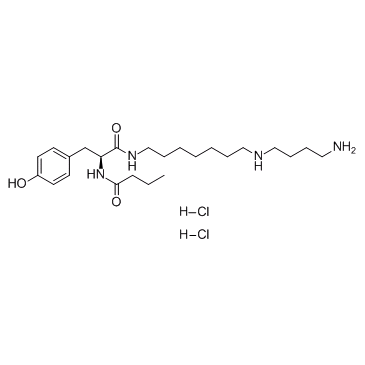
| DC10763 | Philanthotoxin 74 (hydrochloride) Featured |
Philanthotoxin 74 dihydrochloride (PhTx 74) is an AMPAR antagonist; inhibits GluR3 and GluR1 with IC50s of 263 and 296 nM, respectively.
More description
|
|
| DC46864 | Sivopixant Featured |
Sivopixant (S-600918) is a potent and selective P2X3 receptor antagonist (P2X3 IC50=4.2 nM; P2X2/3 IC50=1100 nM). Sivopixant shows strong analgesic effect.
More description
|

|
| DC72122 | SSR504734 |
SSR504734 is an orally active, selective and reversible inhibitor of human, rat, and mouse GlyT1 (IC50=18, 15, and 38 nM, respectively). SSR504734 shows anti-schizophrenia, anti-anxiety and anti-depression activities.
More description
|
|
| DC72050 | NS-8 |
NS-8, a pyrrole derivative, activates the Ca2+-sensitive k+-channel. NS-8 can suppress the micturition reflex by decreasing afferent pelvic nerve activity. NS-8 can be used in the research of urinary frequency and incontinence.
More description
|
|
| DC72049 | Neboglamine hydrochloride |
Neboglamine (CR-2249, XY-2401) hydrochloride is an orally active NMDA receptor glycine site positive modulator that can be used in schizophrenia research.
More description
|
|
| DC72048 | SRI-37240 |
SRI-37240 is a potent premature termination codons (PTCs) inhibitor. SRI-37240 suppresses CFTR nonsense mutations. SRI-37240 alters cellular translation termination at PTCs in HEK293T cells. SRI-37240 can also restore CFTR function in primary bronchial epithelial cells when combination with G418.
More description
|
|
| DC72047 | Fasudil dihydrochloride |
Fasudil (HA-1077; AT877) dihydrochloride is a nonspecific RhoA/ROCK inhibitor and also has inhibitory effect on protein kinases, with an Ki of 0.33 μM for ROCK1, IC50s of 0.158 μM and 4.58 μM, 12.30 μM, 1.650 μM for ROCK2 and PKA, PKC, PKG, respectively. Fasudil dihydrochloride is also a potent Ca2+ channel antagonist and vasodilator.
More description
|
|
| DC71805 | Puliginurad |
Puliginurad (YL-90148) is a potent urate transporter (URAT) inhibitor. Puliginurad can be used for hyperuricemia and gout research.
More description
|
|
| DC71804 | Zolunicant |
Zolunicant (MM-110) is a potent inhibitor against nicotinic α3β4 receptors with an IC50 of 0.90 μM to combat addiction. Zolunicant can decrease the self-administration of several addictive agents including morphine, cocaine, methamphetamine, nicotine, and ethanol in rat model. Zolunicant can be studied as a potential treatment for multiple forms of drug abuse. Zolunicant also reveals a potent leishmanicide effect against Leishmania amazonensis.
More description
|
|
| DC71802 | L-Homocysteic acid |
L-Homocysteic acid (L-HCA) is an endogenous excitatory amino acid that acts as a NMDA receptor agonist (EC50: 14 μM). L-Homocysteic acid is neurotoxic, and can be used in the research of neurological disorders.
More description
|
|
| DC71801 | L-Cysteine S-sulfate |
L-Cysteine S-sulfate is a potent N-methyl-d-aspartate (NMDA) glutamatergic receptors agonist. L-Cysteine S-sulfate is the substrate for cystine lyase.
More description
|
|
| DC71800 | Abecarnil |
Abecarnil (ZK 112119) is a ligand or a partial agonist for benzodiazepine (BZ) receptor. Abecarnil possesses anxiolytic and anticonvulsant properties. Abecarnil can act as a positive allosteric modulator of GABAA receptor. Abecarnil inhibits the binding of the BZ [3H]lormetazepam to rat cerebral cortex membranes, with an IC50 of 0.82 nM. Abecarnil can be used for epilepsy research.
More description
|
|
| DC71799 | IAB15 |
IAB15 is a potent T-type calcium channel inhibitor. IAB15 can be used for epilepsy research.
More description
|
|
| DC71798 | IAA65 |
IAA65 is a potent T-type calcium channel inhibitor with a IC50 value of 18.9 µM. IAA65 can be used for epilepsy research.
More description
|
|
| DC71797 | CXL-1020 |
CXL-1020 is a hydroxylamine-based nitroxyl (HNO) donor. CXL-1020 improves cardiac inotropy/lusitropy and Ca2+ cycling in rats with abnormal relaxation. CXL-1020 induces vasorelaxation and improves cardiac function in canine models. CXL-1020 has been used to research systolic heart failure and stable heart failure.
More description
|
|
| DC7287 | Ralfinamide Featured |
Sodium channel blocker. Suppresses tetrodotoxin (TTX)-resistant Na+ currents approximately twice as selectively as TTX-sensitive currents. Antinociceptive; displays analgesic effects in animal models of inflammatory and neuropathic pain.
More description
|

|
| DC71671 | WAY-303290 |
WAY-303290 (GluR6 antagonist-1) is a benzothiophene derivative acting as an ionotropic glutamate receptor 6 (GluR6) antagonist, which can be used for researching acute and chronic neurological disorders.
More description
|
|
| DC71539 | Pinokalant |
Pinokalant is a broad-spectrum and non-selectivecation channel inhibitor. Pinokalant significantly reduces cortical infarct volume. Pinokalant o improves the metabolic and electrophysiologic status of the ischemic penumbra. Pinokalant reduces lesion size on magnetic resonance images in the acute phase following middle cerebral artery occlusion in rats. Pinokalant has the potential for the research of stroke. Pinokalant also shows anti-SARS-CoV-2 activity.
More description
|
|
| DC71538 | Vonoprazan hydrochloride |
Vonoprazan hydrochloride, a proton pump inhibitor (PPI), is a potent and orally active potassium-competitive acid blocker (P-CAB), with antisecretory activity. Vonoprazan hydrochloride inhibits H+,K+-ATPase activity in porcine gastric microsomes with an IC50 of 19 nM at pH 6.5. Vonoprazan hydrochloride is developed for the research of acid-related diseases, such as gastroesophageal reflux disease and peptic ulcer disease. Vonoprazan hydrochloride can be used for eradication of Helicobacter pylori.
More description
|
|
| DC71537 | Omeprazole magnesium |
Omeprazole magnesium is an orally active proton pump inhibitor (PPI) and can suppress gastric acid. Omeprazole magnesium can be used for acid reflux-related symptoms and frequent heartburn research.
More description
|
|
| DC71535 | T16A(inh)-C01 |
T16A(inh)-C01 is an inhibitor of TMEM16A (ANO1). T16A(inh)-C01 blocks chloride channel mediated by ANO1 with an IC50 of 8.4 μM, without interfering with calcium signaling.
More description
|
|
| DC7834 | SKF 89976A HCl Featured |
SKF-89976A was used to study the role of adenosine receptors in uptake of GABA transport.
More description
|

|
