Alternate TextTo enhance service speed and avoid tariff delays, we've opened a US warehouse. All US orders ship directly from our US facility.
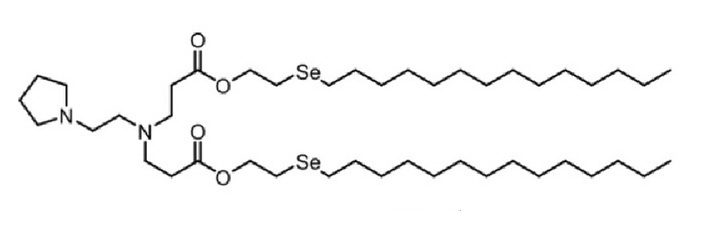
76-O17Se

  Cat. No.:  DC60494  
Chemical Structure
For research use only. We do not sell to patients.
We match the best price and quality on market.
Email:order@dcchemicals.com  sales@dcchemicals.com
Tel:+86 21 58447131
We are official vendor of:
  • 20
  • 19
  • 18
  • 17
  • 16
  • 15
  • 14
  • 12
  • 11
  • 10
  • 9
  • 8
  • 13
  • 6
  • 5
  • 4
  • 3
  • 2
  • 1
More than 5000 active chemicals with high quality for research!
Field of application
76-O17Se is a lipidoid for the efficient delivery of antiCD19 mRNA CAR to murine primary macrophages. 76-O17Se is more efficient than delivery with lipofectamine 2000 (LPF2K) or MC3
Cas No.:
Chemical Name: 76-O17Se
Synonyms: 76O17Se, 76 O17Se
SMILES: CCCCCCCCCCCCCC[Se]CCOC(=O)CCN(CCC(=O)OCC[Se]CCCCCCCCCCCCCC)CCN1CCCC1
Formula: C44H86O4N2Se2
M.Wt: 865.10
Purity: 98%
Sotrage: 2 years -20°C Powder, 2 weeks 4°C in DMSO, 6 months -80°C in DMSO
Cat. No. Product name Field of application
DC67557 Tidal Lipid 40 Tidal Lipid 40is an ionizable cationic lipid engineered to deliver RNA with high precision to immune cells like macrophages. Based on ​​Tidal Therapeutics' patent US 20250205169A1​​, ​​ Its pH-responsive design shifts from a ​​+8 mV charge at pH 5.5​​ (enabling endosomal escape) to ​​near-neutral at pH 7.4​​ (reducing off -target binding), ensuring efficient intracellular release while maintaining blood stability. In lipid nanoparticles, Lipid 40 achieves ​​65% transfection efficiency in human macrophages​​—surpassing benchmarks like ALC-0315—and protects >95% of RNA payloads from degradation. Critically, it maintains particle integrity after freeze-thaw cycles with minimal size drift (<5 nm) and excels in in vivo targeting, driving potent gene expression in tumor-associated macrophages while avoiding liver/spleen accumulation. This combination of ​​precision delivery, stability, and low toxicity​​ makes it ideal for immunotherapies, such as reprogramming M2 macrophages to anti-tumor M1 states.
DC67281 BNT-51 BNT-51 is an ionizable thiolipid developed by Biontech, characterized by its sulfur-containing moieties and a multiarm dendron-like architecture. Synthesized via reactions between amine-containing compounds and sulfur-based halides or sulfonates, it forms stable lipid nanoparticles (LNPs) optimized for mRNA delivery. The LNPs exhibit uniform particle size (80–100 nm, PDI <0.2), near-neutral zeta potential, and high mRNA encapsulation efficiency (>90%), while maintaining payload integrity through freeze-thaw cycles and extended storage. In vitro, BNT-51 demonstrates low cytotoxicity (>80% cell viability in C2C12, HepG2, and HEK293 cells) and superior transfection efficiency compared to conventional lipids, particularly in immune cells such as CD4+/CD8+ T cells within PBMCs. Its modular design allows integration of stealth lipids (e.g., PEG or vitamin E derivatives) to prolong circulation time and minimize immune activation, as evidenced by low hemolysis and complement activation risks. In vivo, BNT-51-based LNPs enable targeted mRNA delivery to splenic macrophages, achieving potent genome editing (e.g., Cre mRNA) and therapeutic protein expression (e.g., BACH1) in preclinical models. With its tunable structure, robust stability, and cell-specific tropism, BNT-51 holds promise for advancing mRNA therapeutics in gene editing, cancer immunotherapy, and regenerative medicine, offering a versatile platform for next-generation nanomedicine.
DC60578 TE-EP8-S TE-EP8-S is a single-component, ionizable cationic lipid designed specifically for the targeted delivery of mRNA to T cells within the spleen. This innovative lipid formulation enhances the efficiency and precision of mRNA-based therapies by ensuring optimal cellular uptake and expression in immune cells. Its unique structure and properties make it a promising tool for advancing immunotherapeutic applications.
DC60494 76-O17Se 76-O17Se is a lipidoid for the efficient delivery of antiCD19 mRNA CAR to murine primary macrophages. 76-O17Se is more efficient than delivery with lipofectamine 2000 (LPF2K) or MC3
X