| DC68228 |
Lipid SG5
|
SG5 is a dual-amine ionizable lipid developed for systemic, lung-selective mRNA delivery. Its two closely spaced tertiary amines and two C16 beta-hydroxy tails produce two apparent pKa transitions when formulated as fSG5 LNPs, enabling stepwise protonation during endosomal maturation. In mice, fSG5 generated substantially stronger pulmonary luciferase expression than a C12-200/DOTAP comparator and enabled functional Cre mRNA delivery. Delivery of Nrf2 mRNA reduced edema and inflammatory injury in an LPS-induced acute lung injury model. SG5 is a preclinical research lipid for pulmonary RNA delivery and gene-editing studies. |
| DC60964 |
TTP-3
|
TTP-3 is an asymmetric Ugi-derived ionizable lipid developed specifically for pulmonary delivery of structured suppressor tRNA cargo. Its architecture combines a dimethylaminopropyl ionizable headgroup, two amide-containing linkages, and chemically distinct hydrophobic tails. Selected from a 1,000-member lipid library, TTP-3 showed the strongest suppressor-tRNA delivery in a cystic-fibrosis-relevant air–liquid interface model containing artificial mucus. An optimized formulation containing TTP-3, DOPE, β-sitosterol, and C14-PEG2000 produced approximately 38-fold higher functional pulmonary reporter expression than MC3 following intratracheal administration in mice. TTP-3 LNPs preferentially delivered tRNA to airway epithelial cells, including ciliated, club, ionocyte, and basal progenitor populations. When combined with chemically modified suppressor tRNAs, the platform restored CFTR expression and function in cellular, mouse, and patient-derived organoid models. TTP-3 remains a preclinical research lipid, and further optimization is required for aerosol delivery, repeat dosing, and clinical translation. |
| DC68219 |
Lipid CY7
|
CY7 is an ionizable lipid engineered for localized pulmonary mRNA delivery. Its structure combines a cyclohexane-based core, a 4-dimethylaminopiperidine ionizable headgroup, two ester linkers, and four extended hydrophobic branches. In LNPs formulated with cholesterol, DSPC, and DMG-PEG, CY7 produced substantially higher local luciferase expression and lung-to-liver selectivity than SM-102 following intratracheal administration. CY7 LNPs also enhanced functional mRNA expression in pulmonary neutrophils, endothelial and epithelial cells, as well as dendritic and B cells in lung-draining lymph nodes. When used to deliver PcrV and OprF-I mRNAs, pulmonary CY7 LNP vaccination generated rapid antigen-independent innate protection followed by durable antigen-specific humoral, mucosal, and cellular immunity. In mouse models, it reduced bacterial burden and improved survival following challenge with laboratory and carbapenem-resistant Pseudomonas aeruginosa. CY7 remains a preclinical research lipid requiring further pharmacokinetic, repeat-dose, and translational safety evaluation. |
| DC68162 |
HGT5001
|
HGT5001, disclosed in patent US 2026/0125339 A1 by Translate Bio (now part of Sanofi), is a potent ionizable cationic lipid optimized for mRNA delivery, exhibiting versatile organ tropism governed by the route of administration. When delivered via intratracheal or pulmonary administration, it effectively crosses the mucosal barrier to achieve high transfection efficiency specifically within lung tissues. Conversely, intravenous injection redirects its tropism to the liver and spleen via endogenous ApoE mediation, facilitating systemic protein replacement therapies. Engineered with an optimized headgroup, HGT5001 ensures excellent encapsulation, rapid pH-responsive endosomal escape, and superior biocompatibility with minimal systemic toxicity, making it an exceptional candidate for cystic fibrosis therapies and hepatic treatments. |
| DC68144 |
Lipid G9-1
|
G9-1 is a nitric oxide (NO)-inhibitory ionizable lipid designed for anti-inflammatory mRNA delivery. Derived from the potent NO inhibitor G9, it retains the ability to suppress macrophage-driven inflammation while enabling efficient mRNA encapsulation and lung-targeted delivery. In a murine acute lung injury model, G9-1 lipid nanoparticles (LNPs) loaded with IL-10 mRNA demonstrated synergistic therapeutic effects by reducing inflammatory cell infiltration, suppressing pro-inflammatory cytokines, and improving systemic tissue injury markers. With its intrinsic immunomodulatory activity and preferential targeting of lung-resident cells, G9-1 represents a promising platform for safer and more effective mRNA therapeutics in inflammatory disorders. |
| DC68056 |
A1T2C3(CP-LC-1067)
|
A1T2C3 (CP-LC-1067) is a highly potent ionizable lipid designed for lung-targeted mRNA delivery. When formulated into lipid nanoparticles (LNPs), it produces particles approximately 80 nm in size with excellent uniformity and a high mRNA encapsulation efficiency (>94%). Its most distinguished feature is its exceptional organ selectivity. Following intravenous administration in mice, A1T2C3-based LNPs demonstrated a remarkable accumulation of over 94% of the signal in the lungs, with minimal distribution to other major organs. This makes it a leading candidate for developing therapeutics specifically targeted to pulmonary tissues. |
| DC68039 |
CHCha-10
|
CHCha-10 is an amino acid-derived ionizable lipid engineered for pulmonary gene therapy. Its optimal surface charge (-0.126 mV) enables efficient mucus penetration, while a pKa of ~7.0 facilitates endosomal escape. Its unique conical structure promotes membrane fusion and mRNA release. In animal models, CHCha-10-based LNPs achieved highly efficient and specific editing of lung epithelial cells, particularly stem-like basal cells (~44%), with effects persisting through tissue renewal. It also demonstrated excellent efficacy and safety in ferrets, a model closely mimicking human lung physiology. |
| DC68023 |
Lipid 1A7B13
|
1A7B13 is a top-performing "tripod-like" lung-targeting (LuT) lipid. It forms lipid nanoparticles (LNPs) that, after intravenous injection, deliver genetic medicines (like mRNA and CRISPR-Cas9) to the lungs with over 90% selectivity, particularly favoring epithelial cells. Compared to the benchmark DOTAP LNPs, 1A7B13 LNPs achieve a 25.5-fold increase in mRNA delivery and a 9.2-fold improvement in gene-editing efficiency within the lungs. Its therapeutic potential was demonstrated by successfully delivering IL-10 mRNA to treat acute lung injury in mice. |
| DC67721 |
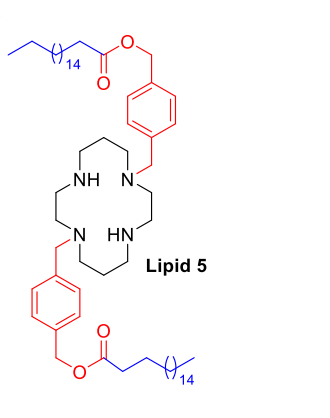
Macrocyclic Lipid 5
|
Lipid 5 is an ionizable lipid based on a macrocyclic cyclam headgroup. Its structure incorporates a benzylmethyl carbonate (BMC) linker, which contains an aromatic benzene ring, and a saturated C18 hydrophobic tail. Lipid 5 was mixed with helper lipids at a fixed molar ratio and formulated into mRNA-loaded lipid nanoparticles (LNPs) using microfluidic technology. Characterization data show that these LNPs have a hydrodynamic diameter of approximately 50-80 nanometers and a polydispersity index (PDI) below 0.2, indicating a small particle size with a uniform distribution. Their zeta potential at physiological pH is near neutral (ranging from -3 to +3 mV). The mRNA encapsulation efficiency, as determined by the Ribogreen assay, exceeds 95%. Cryo-transmission electron microscopy images reveal that the LNPs exhibit a typical spherical bilayer structure. In in vitro experiments, Lipid 5 LNPs mediated a higher level of luciferase protein expression in HEK293FT cells compared to the benchmark lipid DLin-MC3-DMA. In Balb/c mice, intravenous injection of LNPs encapsulating luciferase mRNA resulted in in vivo imaging signals predominantly concentrated in the lungs. Quantitative analysis indicated that the signal intensity in the lungs was over 100 times greater than that in the liver, with more than 95% of the total signal distributed in the lungs. In Ai9 reporter gene mice, two intravenous injections of Lipid 5 LNPs encapsulating Cre mRNA led to quantitative analysis of lung tissue sections showing that approximately 30% of lung cells were positive for tdTomato signal. |
| DC67657 |
Lipid TS41
|
TS41 is a trisulfide-derived ionizable lipid engineered for lipid nanoparticles (LNPs) to deliver mRNA therapeutics against multidrug-resistant bacterial pneumonia. Its optimized formulation, TS41S LNP, combines TS41 with helper lipids (e.g., DOPE, cholesterol) at a precise ratio, achieving a hydrodynamic diameter of ~105 nm, low polydispersity, and high mRNA encapsulation efficiency (~84%). This design enables efficient pulmonary delivery via intratracheal administration, with luminescence signals in lungs 4.8-fold higher than clinical benchmarks like SM-102 LNPs, ensuring targeted expression in epithelial cells, macrophages, and neutrophils. Crucially, TS41 LNPs exhibit potent anti-inflammatory properties by scavenging reactive oxygen species (ROS), reducing neutrophil infiltration and proinflammatory cytokines (e.g., IL-6, TNF-α) in infected lungs. In preclinical models, TS41S LNP encoding PB9 peptibody mRNA eradicated pathogens like Staphylococcus aureus and Pseudomonas aeruginosa, improved survival rates to 80%, and minimized tissue damage without systemic toxicity. Its ROS-scavenging capability synergizes with antibacterial effects, offering a promising, translatable platform for combating resistant infections while controlling inflammation. Future enhancements, such as codon optimization or inhalation delivery, could further broaden its therapeutic potential. |

 To enhance service speed and avoid tariff delays, we've opened a US warehouse. All US orders ship directly from our US facility.