 To enhance service speed and avoid tariff delays, we've opened a US warehouse. All US orders ship directly from our US facility.
| Cat. No. | Product Name | Field of Application | Chemical Structure |
|---|---|---|---|
| DC78011 | CH0076989 Featured |
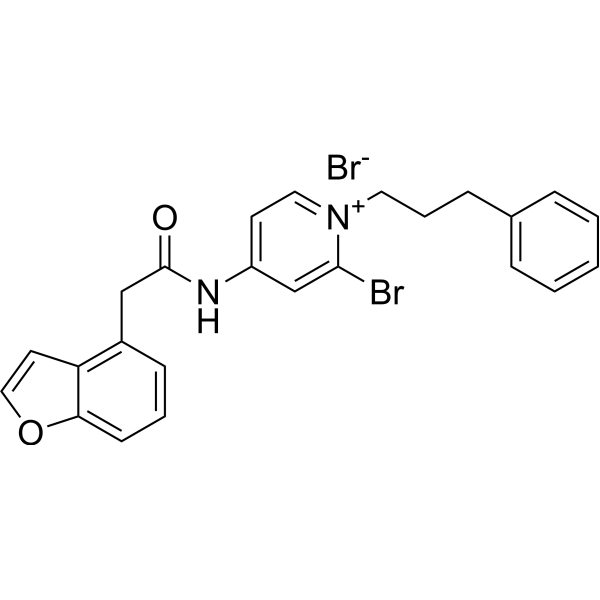
CH0076989 is a specific CCR3 agonist. CH0076989 activates eosinophils and transfectants expressing both wild-type CCR3 and a CCR1:CCR3 chimaeric receptor lacking the CCR3 amino-terminus. CH0076989 has a direct interaction with the transmembrane helices of CCR3, supported by the complete loss of its activity due to mutations of the residues Y41, Y113 and E287. CH0076989 can be used for the study of inflammation and allergic diseases (such as asthma).
More description
|
|
| DC68211 | lipid a12Dab4 Featured |
a12Dab4 is a novel, high-performance peptide-based ionizable lipid designed specifically as the core functional building block for lipid nanoparticles (LNPs) targeting challenging or quiescent cell types, such as human hematopoietic stem and progenitor cells (HSPCs). Chemically engineered to possess a unique peptide-mimetic backbone, it provides superior membrane fusion and exceptional endosomal escape capabilities compared to older-generation, industry-standard lipids like Dlin-MC3-DMA and ALC-0315. Functionally, its primary role within the LNP formulation is to complex and efficiently encapsulate sensitive nucleic acid payloads, such as mRNA or CRISPR/Cas9 editing machinery, at an optimal nitrogen-to-phosphate (N/P) ratio. When formulated, a12Dab4 enables maximum cellular transfection and robust genome editing while exhibiting minimal cytotoxicity and preserving the long-term proliferative, self-renewing functionality of primitive stem cell compartments. Although it delivers commendable baseline transfection independently, it functions as an exceptional molecular chassis that synergies seamlessly with surface antibody conjugation (such as anti-CD34) to unlock precise, therapeutic-grade in vivo gene engineering.
More description
|

|
| DC67295 | Lipid MK16 Featured |
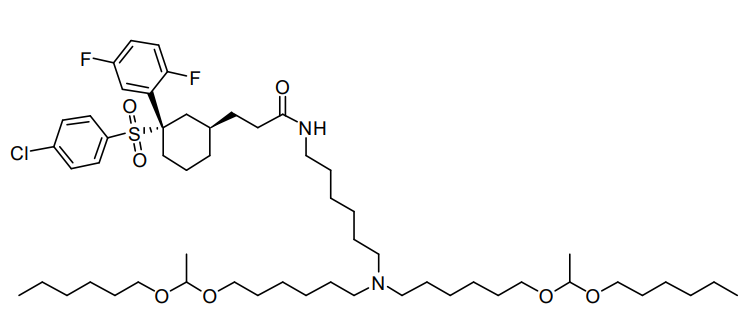
MK-16(pKa 6.86) is a specialized lipid designed to traverse the blood-brain barrier (BBB) for effective mRNA delivery. Its formulation, MK 16 BLNP, leverages dual mechanisms involving caveolae and γ-secretase to facilitate BBB penetration, ensuring the targeted and efficient transport of functional mRNA to diverse brain cell types. Demonstrating excellent tolerability across a range of dosing regimens, MK16 BLNP represents a promising platform for brain-targeted therapeutic applications.
More description
|
|
| DC65830 | 1-M-PES(1-Methoxy-5-methylphenazinium ethyl sulfate) Featured |
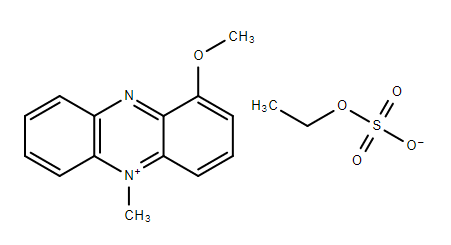
1-m-PES is an electron mediator which has higher stability of solutions than 1-Methoxy PMS. The stability in neutral to alkali conditions has been extremely improved with 1-Methoxy PES. 1-M-PES is a stable small-molecular compound and it has an equal or higher thermal stability than diaphorase. The 1-Methoxy PES solution can be stored long term. This product consists of approximately 90% 1-Methoxy-5-methylphenazinium ethyl sulfate, with the remaining 10% being its methyl sulfate analogue/derivative.
More description
|
|
| DC68207 | Q1-SM-102 iodide Featured |
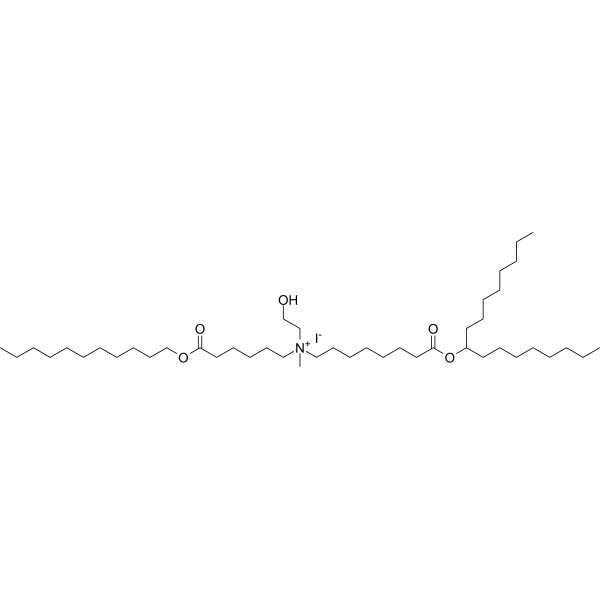
Q1-SM-102 iodide is a quaternary ammonium lipid derivative of SM-102. Q1-SM-102 iodide can be used to prepare lipid nanoparticles (LNPs) for the delivery of mRNA in vivo. Q1-SM-102 iodide is a carriers for targeting delivery of mRNA to immune organs.
More description
|
|
| DC68209 | SM6.1 tetrafluorophenyl ester Featured |
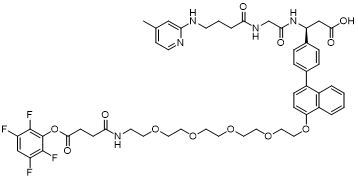
SM-6.1 is a small molecule delivery vehicle developed by Arrowhead, targeting αvβ6, which selectively delivers therapeutic siRNA to lung epithelial cells and mediates durable gene silencing post-inhalation.
More description
|
|
| DC80412 | Tri-SM6.1 Featured |
Tri-SM6.1 is a tridentate small-molecule ligand targeting integrin αvβ6. Tri-SM6.1 binds to integrin αvβ6 on epithelial cells to deliver conjugated α-ENaC RNAi agents。
More description
|

|
| DC65563 | GalNAc-L96-CPG Featured |

|
|
| DC71975 | TriGalNAc CBz Featured |
TriGalNAc CBz is a GalNAc derivative and tri-GalNAc is an asialoglycoprotein receptor (ASGPR) ligand. TriGalNAc CBz can be used for mRNA drug delivery as well as lysosomal targeted chimerism (LYTAC) studies.
More description
|

|
| DC66569 | GalNAc-L96-Amide Featured |

|
|
| DC66548 | GalNAc-Lipid GL3 Featured |

|
|
| DC65564 | GalNAc-L96-PS Featured |

|
|
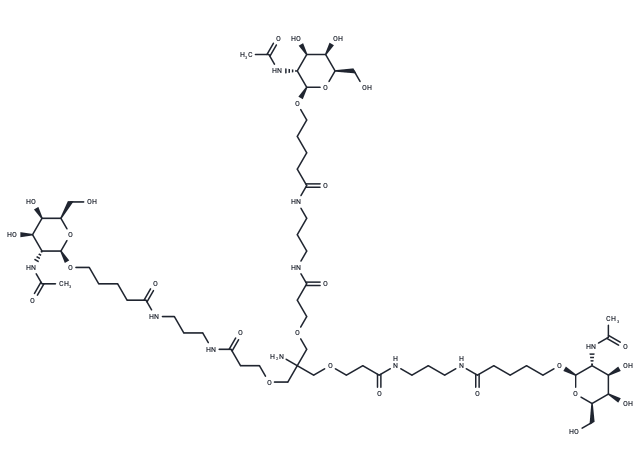
| DC65560 | GalNAc-L96 free base Featured |
GalNAc-L96 free base, the G-rich oligonucleotides carrying the longer GalNAc linker that can be used for delivery of nucleic acid drugs.
More description
|

|
| DC66565 | Peracetylated GalNAc-L96-Acid-1 Featured |

|
|
| DC65561 | GalNac-L96 analog Featured |
GalNAc-L96 analog is an intermediate in the synthesis of the asialoglycoprotein receptor (ASGPR) ligand GalNAc-L96.
More description
|

|
| DC67351 | Tri-GalNAc(OAc)3 Cbz Featured |
Tri-GalNAc(OAc)3 Cbz is a ligand for asialoglycoprotein receptor (ASGPR) where the sugars are protected by acetylation and the tris tertiary amine is protected by benzyloxycarbonyloxy (Cbz). This peracetylated tri-GalNAc(OAc)3 Cbz can be serve as a valuable building block for ASGPR-targeted therapies. Its three branches or arms, each ending in a GalNAc sugar, ensure strong binding to hepatocyte ASGPR. However, the key feature lies in its protective groups: acetylated sugars allow for controlled removal to expose reactive sites for conjugation, while the Cbz-protected amine provides stability and can be selectively cleaved to introduce a reactive amine group for further biomolecule attachment, ultimately enabling researchers to tailor tri-GalNAc(OAc)3 Cbz into customized conjugates for specific therapeutic applications.
More description
|

|
| DC72269 | Tri-GalNAc(OAc)3 TFA Featured |
Tri-GalNAc(OAc)3 TFA is a tri-GalNAc ligand that can be used for the synthesis of GalNAc-LYTAC. GalNAc-LYTAC engages the asialoglycoprotein receptor for targeted protein degradation. tri-GalNAc: triantenerrary N-acetylgalactosamine; LYTAC: lysosome-targeting chimera.
More description
|

|
| DC46965 | Tri-GalNAc-COOH Featured |
tri-GalNAc-COOH is an asialoglycoprotein receptor (ASGPR) ligand that can be used for LYsosome TArgeting Chimera (LYTAC) research.
More description
|

|
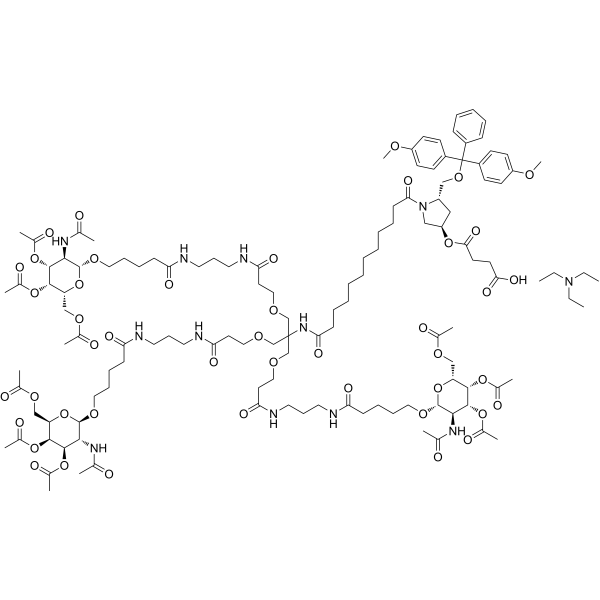
| DC67352 | C12-Diacid-Tri-GalNAc-COOH Featured |

|
|
| DC68011 | GalNAc-NAG25 Featured |

|
|
| DC65565 | GalNac-L96 Featured |
GalNac-L96, the G-rich oligonucleotides carrying the longer GalNAc linker that can be used for delivery of nucleic acid drugs[1].
More description
|
|
| DC47877 | tri-GalNAc-COOH (acetylation) Featured |
tri-GalNAc-COOH acetylation is the acetylated and modified form of tri-GalNAc-COOH. tri-GalNAc-COOH acetylation can be used for the synthesis of LYTAC.
More description
|

|
| DC68013 | GalNAc-THA-C6 Featured |

|
|
| DC68012 | GalNAc-NAG37 Featured |

|
|
| DC68016 | GalNAc-L-9 Featured |

|
|
| DC60911 | ASGPR ligand-1 Featured |
ASGPR ligand-1 is a compound that targets the asialoglycoprotein receptor (ASGPR) and is utilized in various disease research contexts .
More description
|
|
| DC68017 | THA8 acid Featured |

|
|
| DC68018 | GalNAc-L10 Featured |

|
|
| DC68014 | Tri-GalNAc Acid Featured |
Triantennary GalNAc Acid is an asialoglycoprotein receptor (ASGPR) ligand for lysosomal targeting chimera (LYTAC) research and development.
More description
|

|
| DC72546 | Tri-GalNAc-NHS ester Featured |
Tri-GalNAc-NHS ester is a LYsosome TArgeting Chimera (LYTAC) and a ligand of asialoglycoprotein receptor (ASGPR). ASGPR is a lysosomal targeting receptor specifically expressed on liver cells, for the degradation of extracellular proteins including membrane proteins. Tri-GalNAc-NHS ester can be used as a protein degrader and it can be used for the research of LYTAC.
More description
|

|
