
 To enhance service speed and avoid tariff delays, we've opened a US warehouse. All US orders ship directly from our US facility.
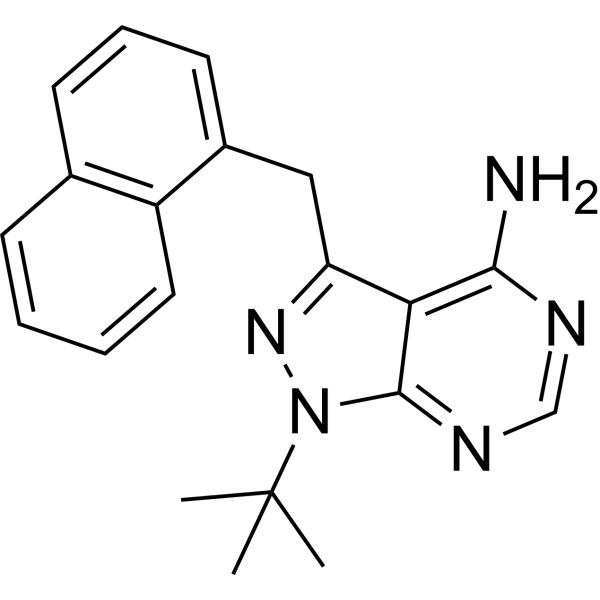




| Cas No.: | 221244-14-0 |
| Chemical Name: | 1-Tert-butyl-3-(naphthalen-1-ylmethyl)-1H-pyrazolo[3,4-d]pyrimidin-4-amine |
| Synonyms: | 1H-Pyrazolo[3,4-d]pyrimidin-4-amine,1-(1,1-dimethylethyl)-3-(1-naphthalenylmethyl)-;4-Amino-1-tert-butyl-3-(1’-naphthylmethyl)pyrazolo[3,4-d]pyrimidine;1NM-PP1(PP1 Analog II);1-(tert-butyl)-3-(naphthalen-1-ylmethyl)-1H-pyrazolo[3,4-d]pyrimidin-4-amine;1-NM-PP1;1NM-PP1;1-tert-Butyl-3-(naphthalen-1-ylmethyl)-1H-pyrazolo[3,4-D]pyrimidin-4-amine;1-tert-butyl-3-(naphthalen-1-ylmethyl)pyrazolo[3,4-d]pyrimidin-4-amine;4-AMino-1-tert-butyl-3-(1'-naphthylMethyl)pyrazolo[3,4-d]pyriMidine;PP1 Analog II, 1NM-PP1;1-(1,1-dimethylethyl)-3-(1-naphthalenylmethyl)-1H-pyrazolo[3,4-d]pyrimidin-4-amine;Mutant Kinases Inhibitor II;PP1 Analog II;1 NM-PP1;NM-PP1;MMV676599;C20H21N5;1-tert-but |
| SMILES: | N1(C2C(=C(N([H])[H])N=C([H])N=2)C(C([H])([H])C2=C([H])C([H])=C([H])C3=C([H])C([H])=C([H])C([H])=C23)=N1)C(C([H])([H])[H])(C([H])([H])[H])C([H])([H])[H] |
| Formula: | C20H21N5 |
| M.Wt: | 331.4142 |
| Purity: | >98% |
| Sotrage: | 2 years -20°C Powder, 2 weeks 4°C in DMSO, 6 months -80°C in DMSO |
| Description: | 1-NM-PP1 is a cell permeable protein kinase D (PKD) inhibitor with an IC50 of 0.398 μM. |
| In Vitro: | Cdk7 from Cdk7as/as or Cdk7+/+ cells is immunoprecipitated and tested its kinase activity towards both a Pol II CTD-containing fusion protein (GST-CTD) and human Cdk2. Cdk7 recovered from the mutant, but not the wild-type, cells is inhibited by 1-NM-PP1 (1-NMPP1), with an IC50 of ~50 nM with either substrate. Replacement of wild-type Cdk7 with Cdk7as/as also rendered growth of HCT116 cells sensitive to 1-NM-PP1. In the absence of 1-NM-PP1, the wild-type andCdk7as/as cells had population doubling times of ~17.9 and ~20.2 h, respectively, with similar cell-cycle distributions in asynchronous culture, indicating minimal impairment of Cdk7 function by the F91G mutation per se. The homozygous Cdk7as/as cells are sensitive to 1-NM-PP1, however, with an IC50 ~100 nM measured by cell viability (MTT) assays performed after 96 h of 1-NM-PP1 exposure. In contrast, wild-type HCT116 cells are resistant to 10 μM 1-NM-PP1. Addition of 10 μM 1-NM-PP1 retards G1/S progression by the mutant but not the wild-type cells. When added simultaneously with serum to the Cdk7as/as cells, 1-NM-PP1 prevents any progression into S phase in the next 15 h. After 24 h, there is evidence of progression into S-phase by a fraction of Cdk7as/as cells released from serum starvation directly into medium containing 1-NM-PP1, while a fraction remained in G1. The addition of 1-NM-PP1 3 h or 6 h after serum addition delays S-phase entry by ~7 h or by ~3 h, respectively[1]. |