
 To enhance service speed and avoid tariff delays, we've opened a US warehouse. All US orders ship directly from our US facility.
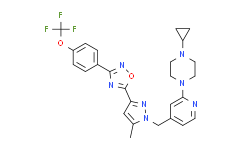




| Cas No.: | 1227158-85-1 |
| Chemical Name: | BAY87-2243 |
| Synonyms: | 1-cyclopropyl-4-{4-[(5-methyl-3-{3-[4-(trifluoromethoxy)phenyl]-1,2,4-oxadiazol-5-yl}-1H-pyrazol-1-yl)methyl]pyridin-2-yl}piperazine;1-Cyclopropyl-4-[4-[[5-methyl-3-[3-[4-(trifluoromethoxy)phenyl]-1,2,4-oxadiazol-5-yl]-1H-pyrazol-1-yl]methyl]-2-pyridinyl]piperazine;BAY 87-2243;1-cyclopropyl-4-[4-[[5-methyl-3-[3-[4-(trifluoromethoxy)phenyl]-1,2,4-oxadiazol-5-yl]-1H-pyrazol-1-yl]methyl]-2-pyridinyl]-piperazine;5-(1-((2-(4-Cyclopropylpiperazin-1-yl)pyridin-4-yl)methyl)-5-methyl-1H-pyrazol-3-yl)-3-(4-(trifluoromethoxy)phenyl)-1,2,4-oxadiazole;5-[1-[[2-(4-cyclopropylpiperazin-1-yl)pyridin-4-yl]methyl]-5-methylpyrazol-3-yl]-3-[4-(trifluoromethoxy)phenyl]-1,2,4-oxadiazole;5XQ7LE6DZG |
| SMILES: | FC(OC1C([H])=C([H])C(=C([H])C=1[H])C1=NOC(C2C([H])=C(C([H])([H])[H])N(C([H])([H])C3C([H])=C([H])N=C(C=3[H])N3C([H])([H])C([H])([H])N(C([H])([H])C3([H])[H])C3([H])C([H])([H])C3([H])[H])N=2)=N1)(F)F |
| Formula: | C26H26F3N7O2 |
| M.Wt: | 525.5256 |
| Sotrage: | 2 years -20°C Powder, 2 weeks 4°C in DMSO, 6 months -80°C in DMSO |
| Description: | BAY 87-2243 is a highly potent and selective hypoxia-inducible factor-1 (HIF-1) inhibitor. |
| In Vivo: | Nude mice are inoculated with H460 cells subcutaneously and after tumors have been established, animals are treated with BAY 87-2243 (0.5, 1, 2, and 4 mg/kg) for 3 weeks by daily oral gavage. BAY 87-2243 reduced tumor weight dose dependently in line with a dose-dependent reduction of the mRNA expression levels of the HIF-1 target genes CA9, ANGPTL4, and EGLN3, whereas the mRNA expression levels of hypoxia-insensitive EGLN2 gene and of HIF-1α itself are not affected by compound treatment in vivo[1]. |
| In Vitro: | BAY 87-2243 inhibits luciferase activity with a calculated IC50 value of ~0.7 nM. Hypoxic induction of the HIF target gene CA9 on protein level in HCT116luc cells is inhibited by BAY 87-2243 with an IC50 value of ~2 nM. BAY 87-2243 inhibits mitochondrial oxygen consumption measured by using the oxygen sensitive fluorescence dye LUX-MitoXpress with an IC50 value of ~10 nM[1]. BAY-87-2243 inhibits nuclear HIF-1α protein expression. Administration of BAY-87-2243 for about 18 days significantly reduces HIF-1α protein expression as well as pimonidazole hypoxic fraction (pHF) (mean 2.4% (BAY-87-2243) vs. 17.6% (carrier), p<0.0001), and necrotic fraction (NF) (mean 9% vs. 35.6%, p=0.0002), whereas relative vascular area (RVA) and perfused vessels (PF) remained unchanged[2]. |