
 To enhance service speed and avoid tariff delays, we've opened a US warehouse. All US orders ship directly from our US facility.
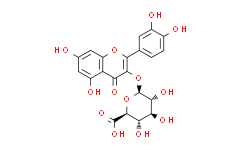




| Cas No.: | 22688-79-5 |
| Chemical Name: | Miquelianin |
| Synonyms: | b-D-Glucopyranosiduronic acid,2-(3,4-dihydroxyphenyl)-5,7-dihydroxy-4-oxo-4H-1-benzopyran-3-yl;Quercetin 3-glucuronide;Quercetin 3-O-β-D-Glucuronide;Quercetin 7-O-β-D-Gl;QUERCETIN-3-O-GLUCURONIDE;QUERCETIN-3-O-GLUCURONIDE(RG);Quercituron;Quercetin 3-O-glucuronide;3,3′,4′,5,7-Pentahydroxyflavone 3-glucuronide;Mikwelianin;Miquelianin;Querciturone;Quercetol 3-O-glucuronide;Quercetol glucuronide;quercetin 3-O-;A-D-glucuronopyranoside;MLS000563480;Quercetin 3-O-b-D-glucuronide;HMS2223E09;SMR000232284;Quercetin-3-glucuronideQUERCETIN GLUCURONIDE |
| SMILES: | O1C([H])(C(=O)O[H])C([H])(C([H])(C([H])(C1([H])OC1C(C2=C(C([H])=C(C([H])=C2OC=1C1C([H])=C([H])C(=C(C=1[H])O[H])O[H])O[H])O[H])=O)O[H])O[H])O[H] |
| Formula: | C21H18O13 |
| M.Wt: | 478.3598 |
| Sotrage: | 2 years -20°C Powder, 2 weeks 4°C in DMSO, 6 months -80°C in DMSO |
| Description: | Miquelianin (Quercetin 3-O-glucuronide) is a metabolite of quercetin and a type of natural flavonoid. |
| In Vivo: | Miquelianin treatment, compared to vehicle-control treatment, significantly improves AD-type deficits in hippocampal formation basal synaptic transmission and long-term potentiation[3]. A flavonoid fraction obtained from a crude extract of Hypericum perforatum (St. John's wort) is remarkably active in the forced swimming test. Miquelianin is one of the compound separated from the fraction[5]. |
| In Vitro: | Miquelianin shows an antioxidant effect in human plasma. At 50 μM, miquelianin suppresses the consumption of the three antioxidants lycopene, β-carotene and α-tocopherol significantly[1]. In vitro studies indicate that miquelianin is able to reach the central nervous system from the small intestine[2]. Miquelianin significantly reduces the generation of β-amyloid (Aβ) peptides by primary neuron cultures generated from the Tg2576 AD mouse model. It is also capable of interfering with the initial protein-protein interaction of Aβ1–40 and Aβ1–42 that is necessary for the formation of neurotoxic oligomeric Aβ species[3]. Treatment with 0.1 μM miquelianin suppresses ROS generation, cAMP and RAS activation, phosphorylation of ERK1/2 and the expression of HMOX1, MMP2, and MMP9 genes. Miquelianin suppresses invasion of MDA-MB-231 breast cancer cells and MMP-9 induction, and inhibits the binding of [3H]-NA to b2-AR. Miquelianin may function to suppress invasion of breast cancer cells by controlling b2-adrenergic signaling, and may be a dietary chemopreventive factor for stress-related breast cancer[4]. |