| Description: |
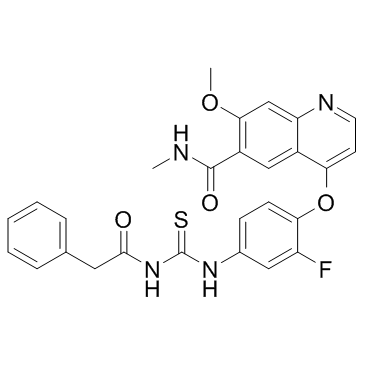
TAS-115 is a potent VEGFR and hepatocyte growth factor receptor (c-Met/HGFR)-targeted kinase inhibitor with IC50s of 30 and 32 nM for rVEGFR2 and rMET, respectively. |
| Target: |
VEGFR2:30 nM (IC50)
c-Met:32 nM (IC50) |
| In Vivo: |
TAS-115 (50 mg/kg/d) completely prevents tumor growth during the treatment period. TAS-115 (200 mg/kg/d) induces a 48% regression from the initial tumor volume in MET-amplified human cancer transplanted models. The estimated 50% effective dose (ED50) of TAS-115 in this model is 8 mg/kg/d. TAS-115 significantly prolongs survival of these mice when administered at doses of 50 or 200 mg/kg/d[1]. TAS-115 inhibits angiogenesis in PC-9/HGF tumors in vivo. Moreover, the doublet erlotinib and TAS-115 successfully inhibit PC-9/HGF tumor growth and delay tumor regrowth associated with sustained tumor vasculature inhibition even after cessation of the treatment[2]. |
| In Vitro: |
TAS-115 is ATP antagonism with inhibition constant (Ki) values against rVEGFR2 and rMET of 12 and 39 nM, respectively. AS-115 inhibits the kinase activity of both VEGFR2 and MET and their signal-dependent cell growth as strongly as other known VEGFR or MET inhibitors. TAS-115 induces less damage in various normal cells than do other VEGFR inhibitors[1]. TAS-115 does not affect the growth of PC-9 or HCC827 cells at concentrations less than 10 μM; however, the combined use of TAS-115 with erlotinib reverses HGF-induced resistance in the cell lines in a concentration-dependent manner. TAS-115 inhibits VEGF production by cancer cells and endothelial proliferation[2]. |
| Kinase Assay: |
Enzyme inhibition studies are performed using a mobility shift assay. Briefly, 0.3 μg/mL of recombinant MET (rMET, N-terminal glutathione S-transferase (GST) Tag) and 1.5 μM of FL-Peptide 2 or 2 μg/mL of recombinant VEGFR2 (rVEGFR2, amino acid 790-end, N-terminal 6His Tagged) and 1.5 μM of FL-Peptide 22 are added to a 25 μL mixture containing 1/2 the Michaelis constant (Km) level of ATP, 100 mM of HEPES (pH 7.2), 0.003% (w/v) Brij35, 0.04% (v/v) Tween 20, 10 mM of MgCl2, 1 mM of dithiothreitol, a Complete Mini EDTA-free Protease Inhibitor Cocktail Tablet, and a PhosSTOP Phosphatase Inhibitor Cocktail Tablet, with the addition of 0.05% (w/v) CHAPSO only in the case of rVEGFR2. The reaction mixture is incubated for 90 minutes at 28°C and is stopped by the addition of 15 mM of EDTA. Phosphorylated peptide is calculated using a LabChip EZ Reader, Version 2.1.82.0 (UCC Version: 1.96, CCD Version: 102). On the basis of the amount of phosphorylated peptide formed in the control well and the drug-treated well, the 50% inhibitory concentration (IC50) is calculated using a logistic regression analysis. A total of 192 kinase panel assays is performed using the ProfilerPro Kit 1-8 and is analyzed using a mobility shift assay. |
| Cell Assay: |
Cell growth is measured using the MTT dye reduction method. Tumor cells are plated into 96-well plates at a density of 2×10³ cells/100 mL RPMI-1640 medium with 10% FBS per well. After 24-hour incubation, various reagents are added to each well, and the cells incubated for a further 72 hours, followed by the addition of 50 μL of MTT solution (2 mg/mL) to each well and incubation for 2 hours. The media containing MTT solution is removed, and the dark blue crystals are dissolved by adding 100 mL of dimethyl sulfoxide. The absorbance of each well is measured with a microplate reader at test and reference wavelengths of 550 and 630 nm, respectively. The percentage of growth is shown relative to untreated controls. Each reagent concentration is tested at least in triplicate during each experiment, and each experiment is conducted at least three times. |
| Animal Administration: |
A SC-9 fragment is implanted subcutaneously into the right abdomen of each mouse via a trocar. Suspensions of MKN45 cells are prepared and are implanted subcutaneously into the right abdomen of each nude mouse. The tumor volume (TV, mm3) is calculated. The TAS-115 dose levels are set at 12.5, 50, and 200 mg/kg/d. The dose level for sunitinib is set at 40 mg/kg/d; this dose is equivalent to the maximum tolerated dose (MTD). Oral drug treatment is continued for 14 or 42 consecutive days for the chronic dosing in the SC-9 xenograft model. During the treatment period, TV and body weight are measured twice per week. |
| References: |
[1]. Fujita H, et al. The novel VEGF receptor/MET-targeted kinase inhibitor TAS-115 has marked in vivo antitumor properties and a favorable tolerability profile. Mol Cancer Ther. 2013 Dec;12(12):2685-96.
[2]. Nakade J, et al. Triple inhibition of EGFR, Met, and VEGF suppresses regrowth of HGF-triggered, erlotinib-resistant lung cancer harboring an EGFR mutation. J Thorac Oncol. 2014 Jun;9(6):775-83. |

 To enhance service speed and avoid tariff delays, we've opened a US warehouse. All US orders ship directly from our US facility.