
 To enhance service speed and avoid tariff delays, we've opened a US warehouse. All US orders ship directly from our US facility.
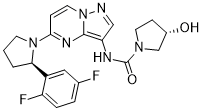




| Cas No.: | 1223403-58-4 |
| Chemical Name: | Larotrectinib free base |
| Synonyms: | LOXO-101;LOXO-101 ARRY-470;Larotrectinib;ARRY470;ARRY-470;LOXO 101;(3S)-N-[5-[(2R)-2-(2,5-Difluorophenyl)-1-pyrrolidinyl]pyrazolo[1,5-a]pyrimidin-3-yl]-3-hydroxy-1-pyrrolidinecarboxamide;PF9462I9HX;(S)-N-(5-((R)-2-(2,5-difluorophenyl)pyrrolidin-1-yl)pyrazolo[1,5-a]pyrimidin-3-yl)-3-hydroxypyrrolidine-1-carboxamide;Vitrakvi;ARRY 470;1-Pyrrolidinecarboxamide, N-[5-[(2R)-2-(2,5-difluorophenyl)-1-pyrrolidinyl]pyrazolo[1,5-a]pyrimidin-3-yl]-3-hydroxy-, (3S)-;1-Pyrrolidinecarboxamide, N-(5-((2R)-2-(2,5-difluorophenyl)-1-pyrrolidinyl)pyrazolo(1,5-a)pyrimidin-3-yl)-3-hydroxy-, (3S)-;Larotrectinib [USAN:IN;Larotrectin |
| SMILES: | FC1C([H])=C([H])C(=C([H])C=1[C@@]1([H])C([H])([H])C([H])([H])C([H])([H])N1C1C([H])=C([H])N2C(=C(C([H])=N2)N([H])C(N2C([H])([H])C([H])([H])[C@@]([H])(C2([H])[H])O[H])=O)N=1)F |
| Formula: | C21H22F2N6O2 |
| M.Wt: | 428.44 |
| Purity: | >98% |
| Sotrage: | 2 years -20°C Powder, 2 weeks 4°C in DMSO, 6 months -80°C in DMSO |
| Description: | Larotrectinib (LOXO-101) is an ATP-competitive oral, selective inhibitor of the tropomyosin-related kinase (TRK) family receptors, with low nanomolar 50% inhibitory concentrations against all three isoforms (TRKA, B, and C). |
| In Vivo: | In rat and monkey studies, Larotrectinib (LOXO-101) demonstrates 33-100% oral bioavailability and 60-65% plasma protein binding. It has low brain penetration, and is well tolerated in 28 day (d) GLP toxicology studies. A single dose (30 mg/kg) of Larotrectinib (LOXO-101) reduces tyrosine phosphorylation of TRKA and downstream signal transduction (pERK) in the tumor >80%[1]. Athymic nude mice injected with KM12 cells are treated with Larotrectinib (LOXO-101) orally daily for 2 weeks. Dose-dependent tumor inhibition is observed demonstrating the ability of this selective compound to inhibit tumor growth in vivo[4]. Larotrectinib (LOXO-101) (200mg/kg/day p.o for six weeks) reduces leukemic infiltration to undetectable levels in the bone marrow and spleen compared to vehicle-treated mice. Mice treated with Larotrectinib (LOXO-101) are still alive and leukemia-free four weeks after the cessation of treatment, as determined by Xenogen imaging[5]. |
| In Vitro: | Larotrectinib (LOXO-101) is an ATP-competitive oral inhibitor of the tropomyosin-related kinase (TRK) family of receptor kinases (TRKA, B, and C), with low nanomolar 50% inhibitory concentrations against all three isoforms, and 1,000-fold or greater selectivity relative to other kinases[1][2]. Measurement of proliferation following treatment with Larotrectinib (LOXO-101) demonstrates a dose-dependent inhibition of cell proliferation in all three cell lines. The IC50 is less than 100 nM for CUTO-3.29 and less than 10 nM for KM12 and MO-91 consistent with the known potency of this drug for the TRK kinase family[3]. |
| Animal Administration: | Mice[4] Athymic nude mice are used throughout the study. 5×10⁵ KM12 cells are injected subcutaneously into the dorsal flank area of the mice. Tumor volume is monitored by direct measurement with calipers and calculated by the formula: length × (width2)/2. Following the establishment of tumor and when the tumor size is between 150-200 mm2, mice are randomly selected to receive diluent, 60 mg/kg/dose or 200 mg/kg/dose of Larotrectinib (LOXO-101). Larotrectinib (LOXO-101) is administered by oral gavage once daily for 14 days. After the last dose, tissue and blood are collected at 3, 6 and 24 hours post-treatment[4]. |
| References: | [1]. Karyn Bouhana, et al. LOXO-101, a pan TRK inhibitor, For The Treatment Of TRK-driven Cancers. [2]. Nagasubramanian R, et al. Infantile Fibrosarcoma With NTRK3-ETV6 Fusion Successfully Treated With the Tropomyosin-Related Kinase Inhibitor LOXO-101. Pediatr Blood Cancer. 2016 Aug;63(8):1468-70. [3]. Doebele RC, et al. An Oncogenic NTRK Fusion in a Patient with Soft-Tissue Sarcoma with Response to the Tropomyosin-Related Kinase Inhibitor LOXO-101. Cancer Discov. 2015 Oct;5(10):1049-57. [4]. Doebele RC, et al. An Oncogenic NTRK Fusion in a Patient with Soft-Tissue Sarcoma with Response to the Tropomyosin-Related Kinase Inhibitor LOXO-101. Cancer Discov. 2015 Oct;5(10):1049-57. [5]. Kathryn G, et al. Genetic Modeling and Therapeutic Targeting of ETV6-NTRK3 with Loxo-101in Acute Lymphoblastic Leukemia. Blood 2016 128:278. |