Alternate TextTo enhance service speed and avoid tariff delays, we've opened a US warehouse. All US orders ship directly from our US facility.
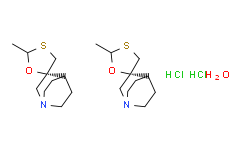
Cevimeline (hydrochloride hemihydrate)

  Cat. No.:  DC9500   Featured
Chemical Structure
153504-70-2
For research use only. We do not sell to patients.
We match the best price and quality on market.
Email:order@dcchemicals.com  sales@dcchemicals.com
Tel:+86 21 58447131
We are official vendor of:
  • 20
  • 19
  • 18
  • 17
  • 16
  • 15
  • 14
  • 12
  • 11
  • 10
  • 9
  • 8
  • 13
  • 6
  • 5
  • 4
  • 3
  • 2
  • 1
More than 5000 active chemicals with high quality for research!
Field of application
Cevimeline hydrochloride hemihydrate, a novel muscarinic receptor agonist, is a candidate therapeutic drug for xerostomia in Sjogren's syndrome.
Cas No.: 153504-70-2
Chemical Name: Cevimeline hydrochloride hemihydrate
Synonyms: Cevimeline hydrochloride hemihydrate;(+/-)-cis-2-Methylspiro[1,3-oxathiolane-5,3'-quinuclidine] hydrochloride hemihydrate;(2R,5R)-2-Methylspiro[1,3-oxathiolane-5,8'-1-azabicyclo[2.2.2]octane] hydrate dihydrochloride;Cevimeline (hydrochloride hemihydrate);Cevimeline hydrochloride;(+/-)-cis-2;(+/-)-cis-2-methylspiro[1,2-oxathiolane-5,3'-quinclidine] monohydrochloride;(+/-)-cis-2-methylspiro[1,3-oxathiolane-5,3'-quinuclidine]monohydrochloride hemihydrate;2H2o;Cevimeline HCl 1;CevimelineHCl;cis-2-Methylspiro(1,3-oxathiolane-5,3')quinuclidine hydrochloride hydrate (2:2:1);AF-102B;SNI-2011;C07772;Unii-p81Q6V85np;AF-102B,SNI-2011;Cevimeline HCl 1/2H2o;Cevimelinehydrochloride;Cevimeline HCl hemihydrate;CeviMeline hydrochloride heMihydrates
SMILES: CC1O[C@@]2(C3CCN(CC3)C2)CS1.CC1O[C@@]2(C3CCN(CC3)C2)CS1.Cl.Cl.O
Formula: C20H38Cl2N2O3S2
M.Wt: 489.563321590424
Purity: >98%
Sotrage: 2 years -20°C Powder, 2 weeks 4°C in DMSO, 6 months -80°C in DMSO
Description: Cevimeline hydrochloride hemihydrate, a novel muscarinic receptor agonist, is a candidate therapeutic drug for xerostomia in Sjogren's syndrome. The general pharmacol. properties of this drug on the gastrointestinal, urinary, and reproductive systems and other tissues were investigated in mice, rats, guinea pigs, rabbits, and dogs. The in vitro metab. of SNI-2011 was also evaluated with rat and dog liver microsomes. After oral administration, plasma concns. of SNI-2011 reached to Cmax within 1 h in both species, suggesting that SNI-2011 was quickly absorbed, and then decreased with a t1/2 of 0.4-1.1 h. The bioavailability was 50% and 30% in rats and dogs, resp. Major metabolites in plasma were both S- and N-oxidized metabolites in rats and only N-oxidized metabolite in dogs, indicating that a large species difference was obsd. in the metab. of SNI-2011. Sex difference was also obsd. in the pharmacokinetics of SNI-2011 in rats, but not in dogs. In the in vitro study, chem. inhibition and pH-dependent studies revealed that the sulfoxidn. and N-oxidn. of SNI-2011 were mediated by cytochrome P 450 (CYP) and flavin-contg. monooxygenase (FMO), resp., in both species. In addn., CYP2D and CYP3A were mainly responsible for the sulfoxidn. in rat liver microsomes.
Target: mAChR
References: [1]. Iga Y, Arisawa H, Ogane N, Saito Y, Tomizuka T, Nakagawa-Yagi Y, Masunaga H, Yasuda H, Miyata N. (+/-)-cis-2-methylspiro[1,3-oxathiolane-5,3'-quinuclidine] hydrochloride, hemihydrate (SNI-2011, cevimeline hydrochloride) induces saliva and tear secretions [2]. Omori Y, Asari T, Maruyama K, Kusama H, Kojima M, Shibata N. Effects of pilocarpine hydrochloride and cevimeline on submandibular/sublingual salivation in rat xerostomia model produced by X-ray irradiation. Arzneimittelforschung. 2003;53(5):342-50. [3]. Washio, Takuo; Kohsaka, Kazuhiro; Arisawa, Hirohiko; et al.Pharmacokinetics and metabolism of radiolabeled SNI-2011, a novel muscarinic receptor agonist, in healthy volunteers: Comprehensive understanding of absorption, metabolism and excretion using radi [4]. Washio, Takuo; Kohsaka, Kazuhiro; Arisawa, Hirohiko; et al.Pharmacokinetics and metabolism of the novel muscarinic receptor agonist SNI-2011 in rats and dogs.Arzneimittel-Forschung (2003), 53(1), 26-33. [5]. Arisawa, Hirohiko; Fukui, Kenji; Imai, Eiichi; et al.General pharmacological profile of the novel muscarinic receptor agonist SNI-2011, a drug for xerostomia in Sjogren's syndrome. Arzneimittel-Forschung (2002), 52(4), 225-232.
Cat. No. Product name Field of application
DC31079 Abarelix Abarelix is a synthetic decapeptide and antagonist of naturally occurring gonadotropin-releasing hormone (GnRH). Abarelix directly and competitively binds to and blocks the gonadotropin releasing hormone receptor in the anterior pituitary gland, thereby inhibiting the secretion and release of luteinizing hormone (LH) and follicle stimulating hormone (FSH). In males, the inhibition of LH secretion prevents the release of testosterone. As a result, this may relieve symptoms associated with prostate hypertrophy or prostate cancer, since testosterone is required to sustain prostate growth.
DC31074 Isopropyl myristate Isopropyl myristate is the ester of isopropyl alcohol and myristic acid.
DC79856 EVT0185 EVT0185 is an orally active ATP citrate lyase (ACLY) inhibitor. EVT0185 is converted to a CoA thioester in the liver by SLC27A2 and interacts with the CoA-binding site of ACLY. EVT0185-CoA inhibits ACLY activity with an IC50 of 2.5 μM. EVT0185 can phenocopy the immune and antitumour effects of genetic ACLY deletion. EVT0185 can increase tumour-infiltrating B cells and chemokine CXCL13 levels. EVT0185 can be used for the research of cancer, such as hepatocellular carcinoma (HCC).
DC79609 NCGC00685960 NCGC00685960 is a Nicotinamide N-methyltransferase (NNMT) inhibitor with an IC50 < 10  nM. NCGC00685960 has potent antitumor activity. NCGC00685960 increases H3K27 trimethylation levels in ovarian cancer cells and inhibits α-SMA expression in NNMT-expressing ovarian fibroblasts. NCGC00685960 reduces 1-MNA levels, reverses SAM and H3K27 hypomethylation and significantly impairs collagen contractility in cancer-associated fibroblasts (CAFs). NCGC00685960 can be used for cancers research.
DC79112 Simepdekinra Simepdekinra (Compound 221) is a IL-17A modulator with IC50s ≤10  nM and 10-100 nM for IL-17A/A HEK-Blue and IL-17A/F HEK-Blue cells. Simepdekinra can be used for inflammatory diseases such as psoriasis, ankylosing spondylitis and psoriatic arthritis research.
DC78751 RSL3-NH2 RSL3-NH2 is a GPX4 inhibitor and Ferroptosis inducer. RSL3-NH2 can be used as a cytotoxic payload for synthesis of antibody-drug conjugates (ADCs).
DC77831 Vicadrostat Vicadrostat (compound 29 A) is a potent and selective inhibitor of aldosterone synthase(CYP11B2) with an IC50 of 16 nM. It exhibits potential in renal disease, diabetic nephropathy, cardiovascular diseases and fibrotic disorder research.
DC77813 Zeltociclib Zeltociclib is a cyclin-dependent kinase inhibitor with antitumor effects.
DC77784 UNC10013 UNC10013 is a SETDB1 allosteric modulator that forms a covalent bond with Cys385 in the 3TD domain, exhibiting negative allosteric regulatory activity. It has a kinact/KI value of 1.0 × 10⁶ M-1*s-1. UNC10013 effectively disrupts SETDB1-mediated Akt methylation and holds potential value for research in cancer and neurodegenerative diseases.
DC77740 T0080 T0080 is a FPR-1 antagonist. T0080 reduces the cell apoptosis, inhibits ROS production and pro-inflammatory cytokines (TNF-α and IL-1β) from plaque macrophages, which attenuates atherosclerotic progression in ApoE−/− mice.
X