
 To enhance service speed and avoid tariff delays, we've opened a US warehouse. All US orders ship directly from our US facility.
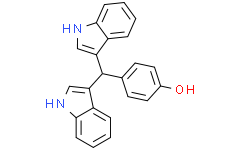




| Cas No.: | 151358-47-3 |
| Chemical Name: | 4-(Di(1H-indol-3-yl)methyl)phenol |
| Synonyms: | 4-(di-1H-indol-3-ylmethyl)-Phenol;4-(di(1H-indol-3-yl)Methyl)phenol;DIM-C-pPhOH;4-[bis(1H-indol-3-yl)methyl]phenol;CDIM8;C-DIM8;DIM-C-pPhOH(CDIM8);BCP28949;4-(di-1H-indol-3-ylmethyl)phenol;STK521918;4-[Bis(1H-indole-3-yl)methyl]phenol;Phenol, 4-(di-1H-indol-3-ylmethyl)-;AK431678 |
| SMILES: | O([H])C1C([H])=C([H])C(=C([H])C=1[H])C([H])(C1=C([H])N([H])C2=C([H])C([H])=C([H])C([H])=C12)C1=C([H])N([H])C2=C([H])C([H])=C([H])C([H])=C12 |
| Formula: | C23H18N2O |
| M.Wt: | 338.4018 |
| Sotrage: | 2 years -20°C Powder, 2 weeks 4°C in DMSO, 6 months -80°C in DMSO |
| Description: | DIM-C-pPhOH is a nuclear receptor 4A1 (NR4A1) antagonist. DIM-C-pPhOH inhibits cancer cell growth and mTOR signaling, induce apoptosis and cellular stress. DIM-C-pPhOH reduces cell proliferation with IC50 values of 13.6 μM and 13.0 μM for ACHN cells and 786-O cells, respectively[1]. |
| In Vivo: | DIM-C-pPhOH (30 mg/kg; oral gavage; daily; for 50 days; male athymic nude mice) treatment results in a significant inhibition of tumor growth[1]. Animal Model: Male athymic nude mice (aged 6-7 weeks) injected with ACHN cells[1] Dosage: 30 mg/kg/day Administration: Oral gavage; daily; for 50 days Result: Resulted in a significant inhibition of tumor growth. |
| In Vitro: | DIM-C-pPhOH (7.5-20 μM; 24 hours; ACHN and 786-O cells) treatment significantly decreases cell proliferation[1]. DIM-C-pPhOH (20 μM; 24 hours; ACHN and 786-O cells) treatment induces Annexin V staining in ACHN and 786-O cells, confirming that DIM-C-pPhOH induce apoptosis, and also induces cleavage of caspases 7 and 8[1]. DIM-C-pPhOH (15-20 μM; 24 hours; ACHN and 786-O cells) treatment inhibits NR4A1-regulated expression of survivin, bcl-2 and EGFR in ACHN and 786-O cells. And also induces sestrin 2, activates AMPKα and inhibits activation of mTOR and downstream kinases[1]. DIM-C-pPhOH decreases expression of β1-integrin protein and mRNA and β1-integrin-dependent responses in MCF7, MDA-MB-231, and SKBR3 cells and also inhibits migration of the latter two cell lines[2]. Cell Proliferation Assay[1] Cell Line: ACHN and 786-O cells Concentration: 7.5 μM, 15 μM, 20 μM Incubation Time: 24 hours Result: Significantly decreased cell proliferation. Apoptosis Analysis[1] Cell Line: ACHN and 786-O cells Concentration: 20 μM Incubation Time: 24 hours Result: Induced apoptosis in ACHN and 786-O cells. Western Blot Analysis[1] Cell Line: ACHN and 786-O cells Concentration: 15 μM, 20 μM Incubation Time: 24 hours Result: Inhibited NR4A1-regulated expression of survivin, bcl-2 and EGFR in ACHN and 786-O cells. And also induced sestrin 2, activated AMPKα and inhibited activation of mTOR and downstream kinases. |