
 To enhance service speed and avoid tariff delays, we've opened a US warehouse. All US orders ship directly from our US facility.
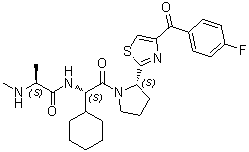




| Cas No.: | 1005342-46-0 |
| Chemical Name: | Lcl-161 |
| Synonyms: | LCL161;LCL-161;N-[(1S)-1-Cyclohexyl-2-{(2S)-2-[4-(4-fluorobenzoyl)-1,3-thiazol-2-yl]-1-pyrrolidinyl}-2-oxoethyl]-N2-methylalaninamide;(S)-N'-(1H-benzimidazol-2-ylmethyl)-N'-(5,6,7,8-tetrahydroquinolin-8-yl)butane-1,4-diamine;(S)-N'-(1H-benzimidazol-2-ylmethyl)-N'-(5,6,7,8-tetrahydro-quinolin-8-yl)-butane-1,4-diamine;(S)-N1-((1H-Benzo[d]imidazol-2-yl)methyl)-N1-(5,6,7,8-tetrahydroquinolin-8-yl)butane-1,4-diamine;AMD 070;AMD11070;N'-(1H-benzimidazol-2-ylmethyl)-N'-(S)-5,6,7,8-tetrahydro-quinolin-8-yl-butane-1,4-diamine;S14-0353;(2S)-N-[(1S)-1-Cyclohexyl-2-[(2S)-2-[4-(4-fluorobenzoyl)-2-thiazolyl]-1-pyrrolidinyl]-2-oxoethyl]-2-(methylamino)-propanamide;(S)-N-((S)-1-Cyclohexyl-2-((S)-2-(4-(4-fluorobenzoyl)thiazol-2-yl)pyrrolidin-1-yl)-2-oxoethyl);N-[(1S)-1-cyclohexyl-2-[(2S)-2-[4-(4-fluorobenzoyl)-2-thiazolyl]-1-pyrrolidinyl]-2-oxoethyl]-2-(methylamino)-(2S)-propanamide;(2S)-N-[(1S)-1-Cyclohexyl-2-[(2S)-2-[4-(4-fluorobenzoyl)-2-thiazolyl]-1-pyrrolidinyl]-2-oxoethyl]-2-(methylamino)-propanamide LCL 161;LCL 161;6TNS415Y3P;(s)-n-((s)-1-cyclohexyl-2-((s)-2-(4-(4-fluorobenzoyl)thiazol-2-yl)pyrrolidin-1-yl)-2-oxoethyl)-2-(methylamino)propanamide;(2S)-N-[(1S)-1-cyclohexyl-2-[(2S)-2-[4-(4-fluorobenzoyl)-1,3-thiazol-2-yl]pyrrolidin-1-yl]-2-oxoethyl]-2-(methylamino)propanamide;Propanamide, N-[(1S)-1-cyclohexyl-2-[(2S)-2-[4-(4-fluorobenzoyl)-2-thiazolyl]-1-pyrrolidinyl]-2-oxoethyl]-2-(methylamino)-, (2S)-;Propanamide, N-[(1S)-1-cyclohexyl-2-[(2S) |
| SMILES: | C[C@H](NC)C(N[C@@H](C1CCCCC1)C(N2[C@H](C3=NC(C(C4=CC=C(F)C=C4)=O)=CS3)CCC2)=O)=O |
| Formula: | C26H33FN4O3S |
| M.Wt: | 500.6286 |
| Sotrage: | 2 years -20°C Powder, 2 weeks 4°C in DMSO, 6 months -80°C in DMSO |
| Description: | LCL161 is a IAP inhibitor which inhibits XIAP in HEK293 cell and cIAP1 in MDA-MB-231 cell with IC50s of 35 and 0.4 nM, respectively. |
| In Vivo: | Tumor-bearing mice are treated with vehicle or LCL161 p.o. at a dose of 50 mg/kg/day, or SC-2001 p.o. at a dose of 10 mg/kg/day, 5 days a week, or in combination for the duration of the study. Tumor growth is significantly inhibited by co-treatment with SC2001 and LCL161 and tumor size in the co-treatment group is only one third of that of the control group at the end of the study[2]. LCL161 is a first-in-class oral Smac mimetic shown to induce degradation of cIAP1 and cleavage of caspase 3 in mouse xenograft models[4]. |
| In Vitro: | LCL161 shows anti-proliferative effects and reduces cell viability significantly in Hep3B (IC50=10.23 μM) and PLC5 (IC50=19.19 μM) cells in a dose-dependent manner. LCL161 induces apoptosis significantly in both the sensitive cell lines in a dose-dependent manner. LCL161 significantly down regulates the expression of cIAP1, starting at very low concentrations. LCL161 at low concentrations inhibits cIAP1 starting at the concentration of 0.5 nM[2]. LCL161 is a small molecule oral IAP antagonist in development for use in combination with cytotoxic agents. The effect of LCL161 on CYP3A4/5 (CYP3A) activity is investigated in vitro. Results in human liver microsomes indicated LCL161 inhibited CYP3A in a concentration- and time-dependent manner (KI of 0.797 µM and Kinact of 0.0803 min-1). LCL161 activates human PXR in a reporter gene assay and induced CYP3A4 mRNA up to ~5-fold in human hepatocytes[3]. |