
 To enhance service speed and avoid tariff delays, we've opened a US warehouse. All US orders ship directly from our US facility.
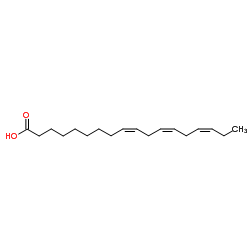




| Cas No.: | 463-40-1 |
| Chemical Name: | Linolenic acid |
| Synonyms: | (9Z,12Z,15Z)-Octadeca-9,12,15-trienoic acid;OCTADECA-9Z,12Z,15Z-TRIENOIC ACID;(Z,Z,Z)-9,12,15-Octadecatrienoic acid;9,12,15-OCTADECATRIENIC ACID;9,12,15-OCTADECATRIENOIC ACID;9Z,12Z,15Z-OCTADECATRIENOIC ACID;ALPHA-LINOLENIC ACID;ALPHA-LNN;ALL CIS-9,12,15-OCTADECATRIENOIC ACID;α-Linolenic acid;9-cis,12-cis,15-cis-Octadecatrienoic acid;Linolenic acid;LINOLENIC ACID(ALA)(AS) PrintBack;(9Z,12Z)-1,3-dihydroxypropan-2-yl octadeca-9,12-dienoate;(9Z,12Z,15Z)-linolenic acid;2-Linoleoylglycerol;2-linoleoyl-sn-glycerol;2-Monolinolein;8,11,14-Heptadecatriene-1-carboxylic acid;9,12-Octadecadienoic acid (Z,Z)-,2-hydroxy-1-(hydroxymethyl)ethyl ester;9Z,12Z,15Z-octadecatrienic acid;alpha;C18:3 (9,12,15-cis all);Glyceryl 2-linoleate;linoleic acid monoacylglycerol;octadecatrienoic acid;α-Lnn;9,12,15-all-cis-Octadecatrienoic acid;Perilla seed oil;linolenate;a-Linolenic acid;9,12,15-Octadecatrienoic acid, (Z,Z,Z)-;(9,12,15)-linolenic acid;Linolenic acid (8CI);Industrene 120;(9Z,12Z,15Z)-Octadecatrienoic acid;UNII |
| SMILES: | O([H])C(C([H])([H])C([H])([H])C([H])([H])C([H])([H])C([H])([H])C([H])([H])C([H])([H])/C(/[H])=C(/[H])\C([H])([H])/C(/[H])=C(/[H])\C([H])([H])/C(/[H])=C(/[H])\C([H])([H])C([H])([H])[H])=O |
| Formula: | C18H30O2 |
| M.Wt: | 278.4296 |
| Purity: | >98%, Standard References Grade |
| Sotrage: | 4°C for 1 year, -20°C for more than 2 years |
| Description: | α-Linolenic acid, isolated from seed oils, is an essential fatty acid that cannot be synthesized by humans. α-Linolenic acid can affect the process of thrombotic through the modulation of PI3K/Akt signaling. α-Linolenic acid possess the anti-arrhythmic properties and is related to cardiovascular disease and cancer[1]. |
| Target: | PI3K Akt |
| In Vivo: | α-Linolenic acid (50, 100, 250 mg/kg; for 10 days) can completely inhibit collagen- and adrenaline-induced thrombosis in mice at 250 mg/kg[1]. α-Linolenic acid (35, 70, 175 mg/kg) suppresses A-V thrombus formation in rats (weighing at 250 ~ 300 g)[1]. α-Linolenic acid (70 or 175 mg/kg) inhibits collagen stimulated platelet aggregation in rats[1]. Animal Model: Mice weighing at 18 ~ 22 g[1] Dosage: 50, 100, 250 mg/kg Administration: For 10 days Result: Completely inhibited collagen- and adrenaline-induced thrombosis at 250 mg/kg. |
| In Vitro: | α-Linolenic acid converses into the longer chain fatty acids eicosapentaenoic acid (EPA) and docosahexaenoic acid (DHA)[1]. |
| References: | [1]. Yang Q, et al. Anti-thrombotic effects of α-linolenic acid isolated from Zanthoxylum bungeanum Maxim seeds. BMC Complement Altern Med. 2014 Sep 23;14:348. |