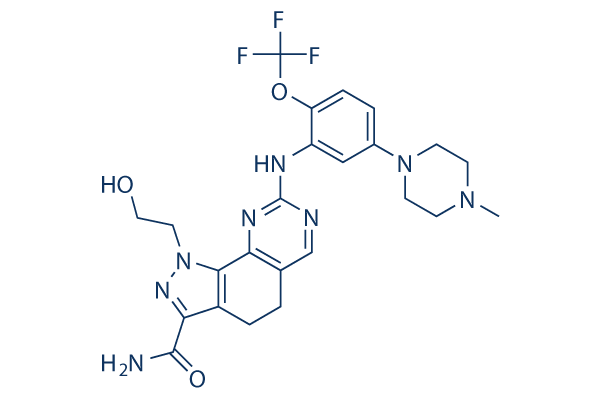
| Description: |
NMS-1286937 is a potent, selective and orally available PLK1 inhibitor, with an IC50 of 2 nM. |
| Target: |
PLK1:2 nM (IC50)
MELK:744 nM (IC50)
CK2:826 nM (IC50)
FLT3:510 nM (IC50) |
| In Vivo: |
NMS-1286937 (45 mg/kg, i.v.) shows a good tumor growth inhibition with acceptable and reversible body weight loss in CD1 nu/nu mice xenografted with human HCT116 colon adenocarcinoma cells. NMS-1286937 (60 mg/kg, p.o.) also inhibits the growth of tumor on HCT116 xenograft model[1]. NMS-P937 (45 mg/kg, i.v.or 60 mg/kg, p.o) inhibits tumor growth to a comparable degree (TGI, 83% and 79% intravenously and orally, respectively) in HCT116-bearing mice. The combination of NMS-P937 (120 mg/kg given for 4 cycles of 2 consecutive days with 10-day rest) and cytarabine (75 mg/kg for 4 cycles of 5 consecutive days with 7-day rest) in the disseminated leukemia model AmL-PS is well tolerated and clearly showed increased mice survival[2]. NMS-P937 (60 mg/kg bid os per day over 2 days with a 5 day rest) shows good efficacy compared to standard therapies, with a significant increase in median survival time (MST) in the established disease setting[3]. |
| In Vitro: |
NMS-1286937 is a potent, selective and orally available PLK1 inhibitor, with IC50 of 2 nM. NMS-1286937 also shows inhibitory activities against FLT3, MELK, and CK2, with IC50s of 510, 744, and 826 nM, respectively[1]. NMS-P937 possesses a pure ATP competitive mechanism with a reversible dissociation and no time dependency. NMS-P937 (10 μM) is selective with a marginal activity of 48% and 40% inhibition on PLK2 and PLK3, respectively. NMS-P937 shows antiproliferative activity against a panel of 137 cell lines, with IC50 values of below 100 nM for 60 of 137 cell lines and higher than 1 μM for only 9 of 137 cell lines[2]. NMS-P937 shows cytotoxic activity against AmL-NS8 cells with IC50 of 36 nM[3]. |
| Kinase Assay: |
The inhibitory activity of putative kinase inhibitors and the potency of selected compounds are determined using a trans-phosphorylation assay. Specific peptide or protein substrates are trans-phosphorylated by their specific serine-threonine or tyrosine kinase, in the presence of ATP traced with 33P-γ-ATP, at optimized buffer and cofactors conditions. At the end of the phosphorylation reaction, more than 98% unlabeled ATP and radioactive ATP is captured by adding an excess of the ion exchange dowex resin; the resin then settles down to the bottom of the reaction plate by gravity. Supernatant, containing the phosphorylated substrate, is subsequently withdrawn and transferred into a counting plate, followed by evaluation by b-counting. Inhibitory potency evaluation for all the tested kinases is performed at 25°C using a 60 min end-point assay where the concentrations of ATP and substrates are kept equal to 2 × αKm and saturated (>5 × αKm), respectively. |
| Cell Assay: |
Cells are seeded into 96- or 384-well plates at densities ranging from 10,000 to 30,000/cm2 for adherent and 100,000/mL for nonadherent cells in appropriate medium supplemented with 10% fetal calf serum. After 24 hours, cells are treated in duplicate with serial dilutions of NMS-P937, and 72 hours later, the viable cell number is assessed by the CellTiter-Glo Assay. IC50 values are calculated with a sigmoidal fitting algorithm. Experiments are carried out independently at least twice. |
| Animal Administration: |
For carcinoma xenograft studies, 5- to 6-week-old female Hsd, athymic nu/nu mice (average weight, 20-22 g), are used. HCT116, HT29, Colo205 colorectal, and A2780 ovarian human carcinoma cell lines are inoculated subcutaneously. Mice bearing a palpable tumor (100-200 mm3) are treated with vehicle or NMS-P937 following doses and schedules starting from the day after randomization. Tumor dimensions are measured regularly with Vernier calipers, and tumor growth inhibition (TGI) is calculated. Toxicity is evaluated on the basis of body weight reduction. For leukemia studies, 5- to 6-week-old female severe combined immunodeficient mice (SCID; average weight, 20-22 g) are used. The AmL cell line HL-60 (5×10⁶ cells) is injected subcutaneously and treatments initiated when tumor size reaches 200 to 250 mm3. Tumor dimensions and TGI are assessed. For disseminated models, 5×10⁶ AmL primary cells (AmL-PS) are injected intravenously and treatments start after 2 days. Mice are monitored daily for clinical signs of disease, and the median survival time is determined for each group. |
| References: |
[1]. Beria I, et al. NMS-P937, a 4,5-dihydro-1H-pyrazolo[4,3-h]quinazoline derivative as potent and selective Polo-like kinase 1 inhibitor. Bioorg Med Chem Lett. 2011 May 15;21(10):2969-74.
[2]. Valsasina B, et al. NMS-P937, an orally available, specific small-molecule polo-like kinase 1 inhibitor with antitumor activity in solid and hematologic malignancies. Mol Cancer Ther. 2012 Apr;11(4):1006-16.
[3]. Casolaro A, et al. The Polo-Like Kinase 1 (PLK1) inhibitor NMS-P937 is effective in a new model of disseminated primary CD56+ acute monoblastic leukaemia. PLoS One. 2013;8(3):e58424. |

 To enhance service speed and avoid tariff delays, we've opened a US warehouse. All US orders ship directly from our US facility.