
 To enhance service speed and avoid tariff delays, we've opened a US warehouse. All US orders ship directly from our US facility.
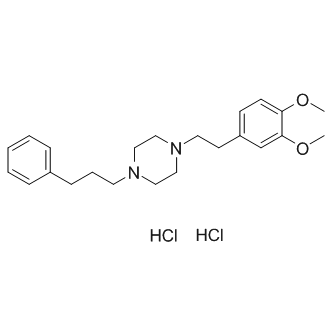




| Cas No.: | 165377-44-6 |
| Chemical Name: | Cutamesine HCl |
| Synonyms: | SA4503; SA 4503; SA-4503; AGY94806; AGY-94806; AGY 94806; Cutamesine HCl; Cutamesine hydrochloride |
| SMILES: | COC1=C(C=C(C=C1)CCN2CCN(CC2)CCCC3=CC=CC=C3)OC.Cl.Cl |
| Formula: | C23H34Cl2N2O2 |
| M.Wt: | 441.437 |
| Purity: | >98% |
| Sotrage: | 2 years -20°C Powder, 2 weeks 4°C in DMSO, 6 months -80°C in DMSO |
| Description: | Cutamesine dihydrochloride (SA4503 dihydrochloride) is a potent Sigma 1 receptor agonist with an IC50 of 17.4 nM in guinea pig brain membranes. |
| Target: | IC50: 17.4 nM (σ1receptor, guinea pig brain membranes)[1] |
| In Vivo: | Cutamesine extends the survival time in the SOD1G93A mice[2]. |
| In Vitro: | The sigma receptor might be involved in several diseases in the central nervous system. Cutamesine, a potent σ1receptor agonist, has 103-fold higher affinity for σ1 (IC50=17.4 nM) than σ2 (IC50=1,784 nM) sites in guinea pig brain membranes. Cutamesine is 14-fold selective for σ1 (Ki=4.6 nM) over σ2 (Ki=63.1 nM) sites in guinea pig brain homogenates[1]. Cutamesine protects motor neuron NSC34 cells against superoxide dismutase 1 and serum free neurotoxicity. It upregulates the phosphorylation levels of Akt and extracellular signal-regulated kinase (ERK) 1/2[2]. Cutamesine reduces the activation of the MAPK/ERK pathway and down-regulated the ionotropic glutamate receptor, GluR1[3]. |
| Cell Assay: | The NSC34 cells are seeded at a density of 7000 cells per well into 96-well plates with D-MEM and transfected using Lipofectamine 2000 mixed with 2 μg /mL of plasmid vector in D-MEM for 6 h. After 6 h, the cell-culture medium is replaced with fresh D-MEM and culture and allowed to proceed for a further 42 h. The cells are then transferred to serum-free D-MEM and immediately treated with Cutamesine at a final concentration of 1, 3, or 10 nM[2]. |
| Animal Administration: | Mice: Transgenic female mice overexpressing mutated human SOD1G93A are used in the study. Cutamesine is dissolved in saline and subcutaneously administered at a dose of 1 mg/kg once daily to 5-week-old SOD1G93A mice to the time of death. In a control group, vehicle (saline) is subcutaneously administered at 10 ml/kg[2]. |
| References: | [1]. Lever JR, et al. Sigma1 and sigma2 receptor binding affinity and selectivity of SA4503 and fluoroethyl SA4503. Synapse. 2006 May;59(6):350-8. [2]. Tuerxun T, et al. SA4503, a sigma-1 receptor agonist, prevents cultured cortical neurons from oxidative stress-induced cell death via suppression of MAPK pathway activation and glutamate receptor expression. Neurosci Lett. 2010 Jan 29;469(3):303-8. |