Alternate TextTo enhance service speed and avoid tariff delays, we've opened a US warehouse. All US orders ship directly from our US facility.
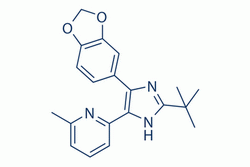
SB-505124

  Cat. No.:  DC7278   Featured
Chemical Structure
694433-59-5
For research use only. We do not sell to patients.
We match the best price and quality on market.
Email:order@dcchemicals.com  sales@dcchemicals.com
Tel:+86 21 58447131
We are official vendor of:
  • 20
  • 19
  • 18
  • 17
  • 16
  • 15
  • 14
  • 12
  • 11
  • 10
  • 9
  • 8
  • 13
  • 6
  • 5
  • 4
  • 3
  • 2
  • 1
More than 5000 active chemicals with high quality for research!
Field of application
SB505124 is a selective inhibitor of TGFβR for ALK4, ALK5 with IC50 of 129 nM and 47 nM, respectively, also inhibits ALK7, but does not inhibit ALK1, 2, 3, or 6.
Cas No.: 694433-59-5
Chemical Name: SB505124
Synonyms: SB 505124; SB505124
SMILES: C(C1NC(C(C)(C)C)=NC=1C1C=C2C(=CC=1)OCO2)1=NC(C)=CC=C1
Formula: C20H21N3O2
M.Wt: 335.4
Sotrage: 2 years -20°C Powder, 2 weeks 4°C in DMSO, 6 months -80°C in DMSO
Description: SB-505124 is a selective inhibitor of TGFβR with IC50 of 129 nM and 47 nM for ALK4, ALK5, respectively, and it does not inhibits ALK1, 2, 3, or 6 but ALK7.
In Vitro: SB-505124 demonstrates no toxicity to renal epithelial A498 cells at concentrations up to 100 μM for 48 h. 505124 inhibits the closely related ALK4 with an IC50 value of 129±11 nM (about 2.5-fold less sensitive than ALK5) but does not inhibit ALK2 at concentrations up to 10 μM. SB-505124 (1 μM) inhibits the TGF-β-induced phosphorylation of Smad2 in all three of these cell lines in a concentration-dependent fashion. SB-505124 (1 or 5 μM) potently inhibits TGF-β-induced activation of JNK/SAP, extracellular signal-regulated kinase 1/2, and p38 despite the different patterns of activation in these cells[1]. SB-505124 (10 µM) impairs Smad2 phosphorylation and CTGF and α-SMA expression in vitro[2]. SB-505124 susspresses CTGF and α-SMA observed by immunofluorescence. Cell outgrowth from explants dissected from eyes to which SB-505124 is applied during GFS is robust while outgrowth is poor from those treated with MMC[3].
Cat. No. Product name Field of application
DC82301 IC-8 IC8 is an ionizable cationic lipid. It has been used in combination with other lipids for the formation of lipid nanoparticles (LNPs). Immunization with severe acute respiratory coronavirus 2 (SARS-CoV-2) spike glycoprotein mRNA in IC8- and manganese-containing LNPs induces IgG responses to SARS-CoV-2 Delta and Omicron variants in mice.1 Administration of mRNA encoding B7-H3 X CD3 bispecific T cell engaging (BiTE) antibodies in IC8-containing LNPs reduces tumor growth in MV4-11 and A375 mouse xenograft models.
DC75721 CL2A-SN38 (Govitecan) CL2A-SN38 is a SN38 derivative with a peptide-linker which can easily react with antibody to form an antibody-drug conjugate (ADC). CL2A-SN-38 is composed of a potent a DNA Topoisomerase I inhibitor SN-38 and a linker CL2A to make antibody drug conjugate (ADC). CL2A-SN-38 provides significant and specific antitumor effects against a range of human solid tumor types. CL2A is a noncleavable complicated PEG8- and triazole-containing PABC-peptide-mc linker. CL2A is cleavable through pH sensitivity, giving rise to bystander effect, and binds the antibody at a cysteine residue via a disulfide bond. .
DC47877 tri-GalNAc-COOH (acetylation) tri-GalNAc-COOH acetylation is the acetylated and modified form of tri-GalNAc-COOH. tri-GalNAc-COOH acetylation can be used for the synthesis of LYTAC.
DC46965 Tri-GalNAc-COOH tri-GalNAc-COOH is an asialoglycoprotein receptor (ASGPR) ligand that can be used for LYsosome TArgeting Chimera (LYTAC) research.
DC46471 RP101988 RP101988, the major active metabolite of Ozanimod, is a selective, potent S1PR1 (sphingosine-1-phosphate receptor 1) agonist, with EC50s of 0.19 nM and 32.8 nM for S1PR1 and S1PR5, respectivlely.
DC37901 PD-173212 PD-173212 is a small molecule N-type calcium channel blocker.
DC37333 N,N-Diethyl-p-toluamide N,N-Diethyl-p-toluamide is a mosquito repellent.
DC37321 AI3-15902 AI3-15902 is a biochemical.
DC37283 Methyl phenylcarbamate Methyl phenylcarbamate is a biochemical.
DC37252 Ampyrone Ampyrone is a metabolite of AMINOPYRINE with analgesic and anti-inflammatory properties. It is used as a reagent for biochemical reactions producing peroxides or phenols. Ampyrone stimulates LIVER MICROSOMES and is also used to measure extracellular water.
X